I have eyes but I do not see

17 May, 2015                  I have eyes but I do not see

I was a few steps from the parking lot at Pony Pasture Tuesday morning (May 12) when I looked at the ground and it was covered with these: 
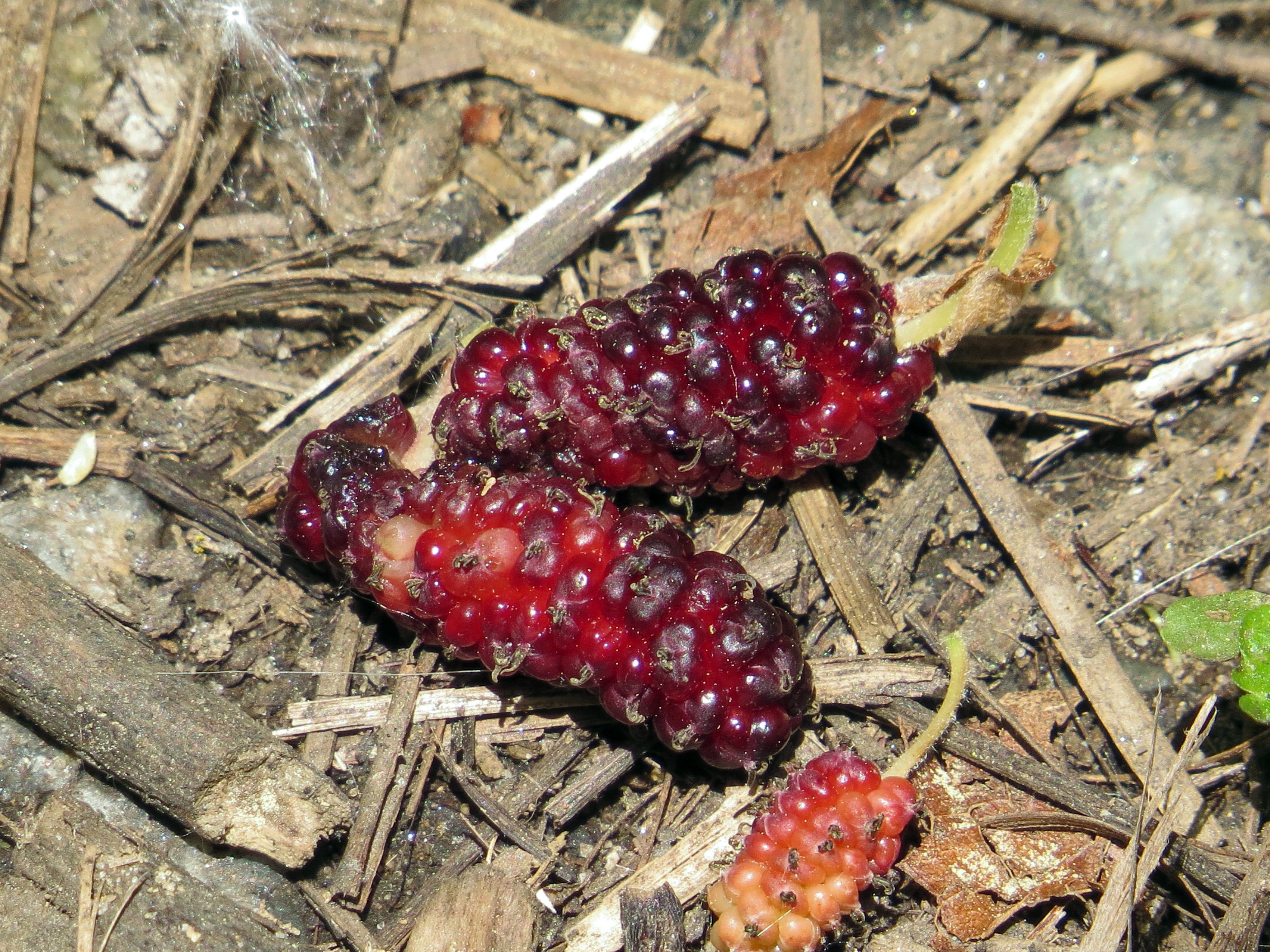
Almost (but not quite) ripe mulberries on the trail at Pony Pasture

Almost (but not quite) ripe mulberries on the trail at Pony Pasture

They’re mulberries. I’ve had six plus months of “keen observation” of “every living thing” at Pony Pasture. I’ve walked past that 4” thick tree a hundred times – minimum – and never knew it was there. And I’m looking for stuff! That’s pretty weak. How much other stuff is there? Stuff that’s right in front of me and I still don’t even know it’s there? Crazy. Tons, I’m sure. It’s a process.

Those little fruits come from a mulberry tree (Morus rubra). The ones in the picture  are not quite ripe – they’re more of a dark purple when they’re ripe. I found some ripe ones and brushed them off and ate them. They’re delicious. Like blackberries only sweeter. I cannot believe I didn’t know that tree was there. All this time.

I was fortunate later the same day to look across a wide field (at Pony Pasture, of course) and see what I thought was a hawk sitting on a branch. When I zoomed in with my camera I saw it was a deer’s head! Look how pretty:

Whitetail deer at Pony Pasture. The dogs were right beside me!

Whitetail deer at Pony Pasture. The dogs were right beside me!

I sent that picture to my sister Katie in Maryland. She spends a lot of time outdoors, and a lot of time with hoofed mammals. In her case, horses. She looked at the picture and replied, “I see your deer have their summer coats. Ours are holding onto the winter coat very late this year.”

I thought the deer’s face looked slender, but I didn’t think about coat length. But compare its coat to this deer I photographed in February:
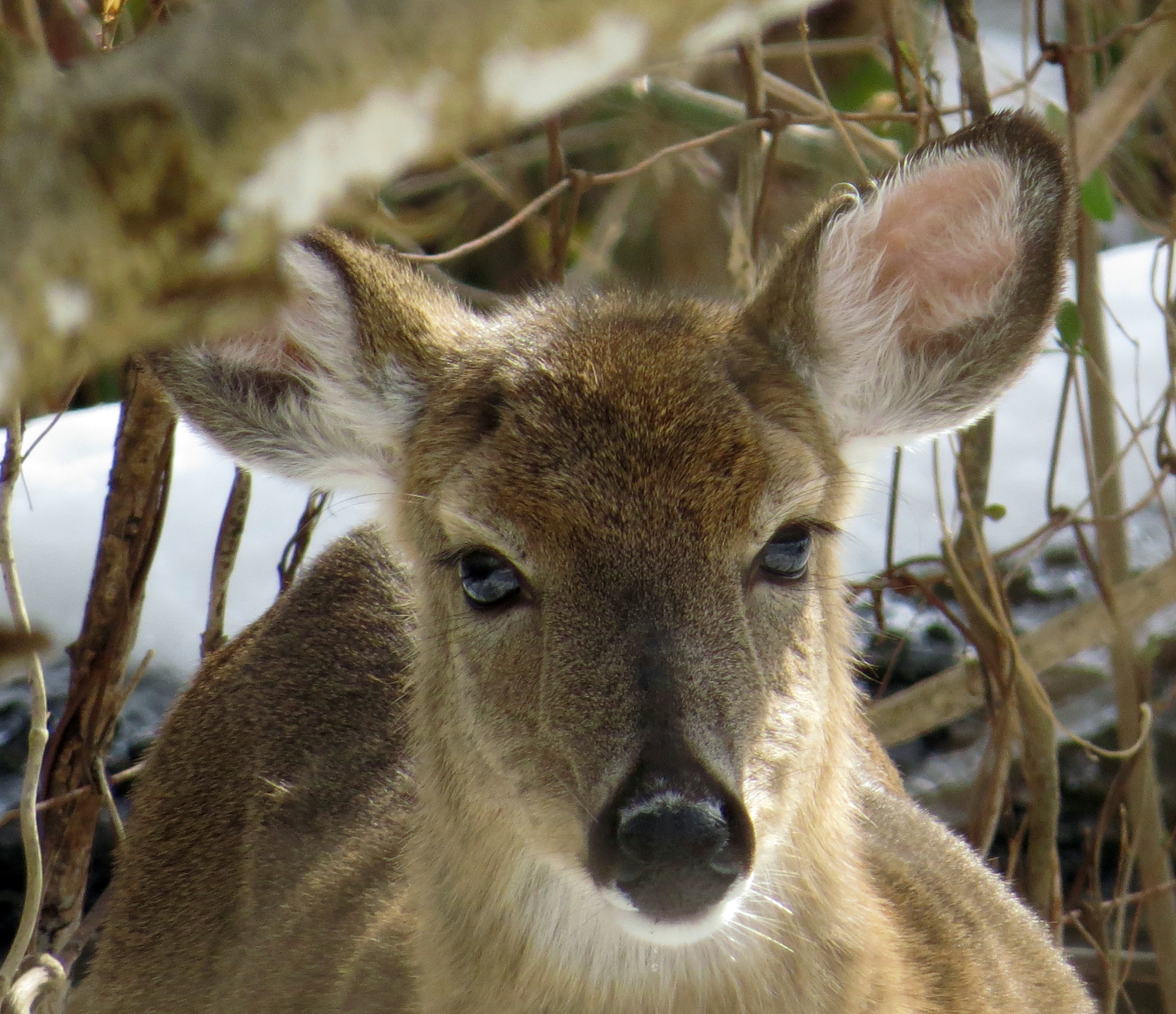
Much shaggier look with a winter coat. I took this picture at Pony Pasture in February.

Much shaggier look with a winter coat. I took this picture at Pony Pasture in February.

The difference is obvious.

Speaking of obvious differences. Toads have begun to appear at Pony Pasture. They’re not always noticeable, but after missing a tree for half a year I’m happy to see anything! I’ve gotten two; one is a decent shot and one is marginal.

I believe this is a Fowler’s Toad (Anaxyrus fowleri) but I wouldn’t bet on it:

Probably a Fowler's Toad.

Probably a Fowler’s Toad.

I don’t love this shot as much. I had a difficult time getting an angle that felt comfortable. It’s a weird fact for me – with birds or deer or snakes or toads or anything – if I get uncomfortable, whatever I’m photographing gets uncomfortable and I take poor photographs. 100% of the time. It’s a difficult variable to control. 

Anyway – I think this is an Eastern American Toad (Anaxyrus americanus):
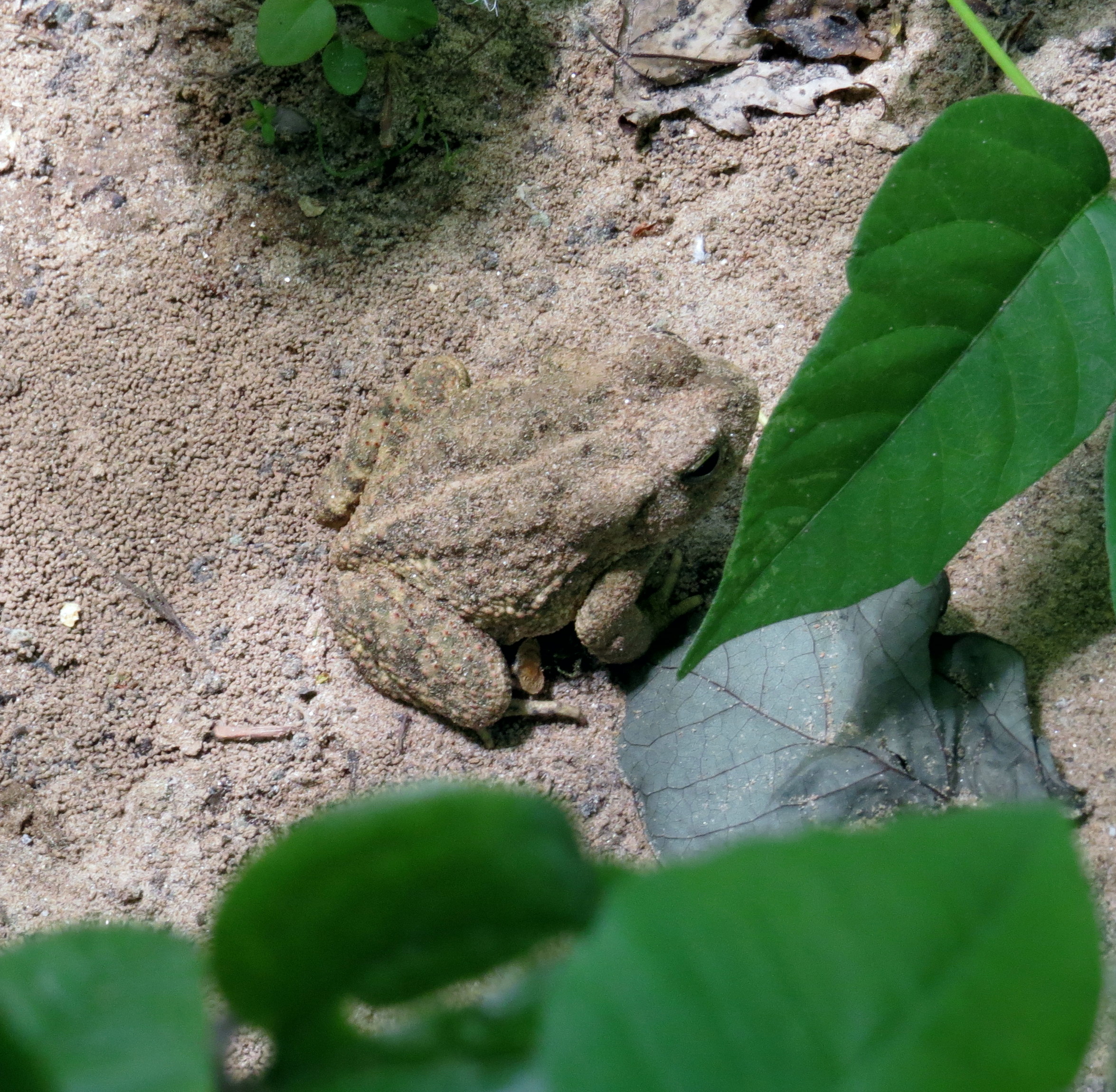
Perhaps an American Toad. See how well camouflaged they are?

Perhaps an American Toad. See how well camouflaged they are?

I may have mentioned in the past that I write these posts at my computer in my office and I have a window 6” to the right of this monitor. The window has a bird feeder on it. Chickadees, Tufted titmice, house finches, sparrows, cardinals, nuthatches, wrens, they go back and forth all day long. About 6:30 Wednesday morning, just as I was shutting off my computer to go to work I looked up and saw this – for the first time in my life:
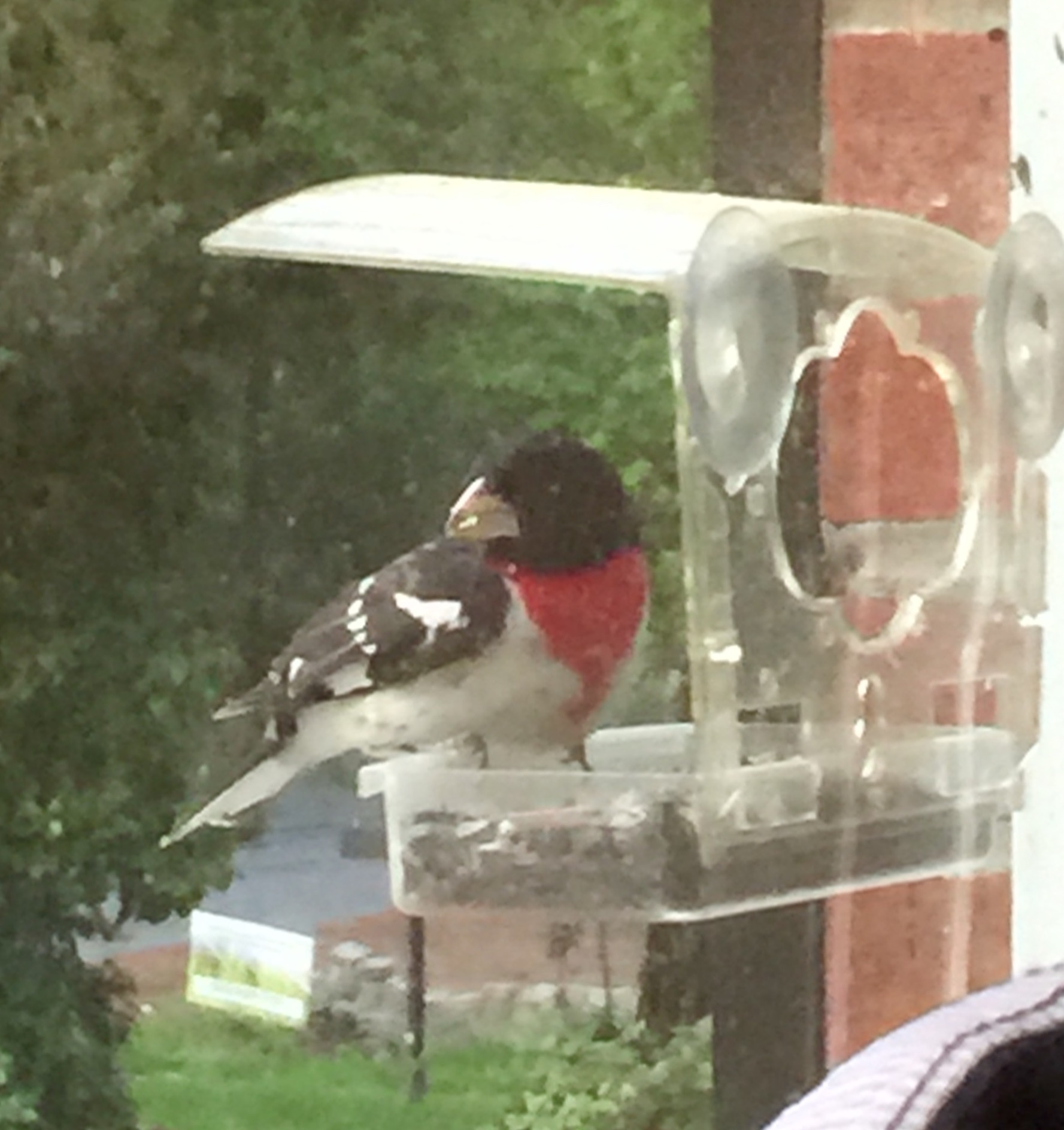
Rose-breasted grosbeak - what a stunning bird.

Rose-breasted grosbeak – what a stunning bird.

A Rose-breasted grosbeak (Pheucticus ludovicianus). Incredible. All I had was my phone so the picture quality is weak. But I was happy to “get” a new bird! And a Rose-breasted grosbeak is not a bird you’re likely to mistake for something else. Not subtle! 

Here’s a picture with better photo quality. It’s my favorite picture in some time, even though I cut off a couple of millimeters of the tail. This is great light. And a stunning subject, a Barn Swallow (Hirundo rustica), on a wire at Bryan Park Thursday afternoon:

Barn swallow. THAT is a sharp picture. Great subject, great light, it makes it easy.

Barn swallow. That is a sharp picture. Great subject, great light, it makes it easy.

On a website called “Birds of North America” they have profiles of certain birds – not all. I was particularly fond of the quote on the Barn Swallow page:

One hardly knows what quality to admire most in . . . the Barn Swallow. All the dear associations of life at the old farm come thronging up at sight of him. You think of him somehow as part of the sacred past; yet here he is today as young and as fresh as ever, bubbling over with springtime laughter.“ William L. Dawson, 1923, The Birds of California

When we’d ride the tractor in the summer at Camp in the evenings, Barn Swallows would swirl around us catching flying insects stirred up by the wheels in the grass. Another beautiful form of natural pest control.

Speaking of birds who live off of flying insects, I took a few more Purple Martin shots at Bryan Park this week. They’re always around their houses so it’s not hard to get a lens on them. But it’s hard to get what I think of as an attractive image. But here’s a male perched on the edge of the martin house. Males are darker, a deep gun metal blue:
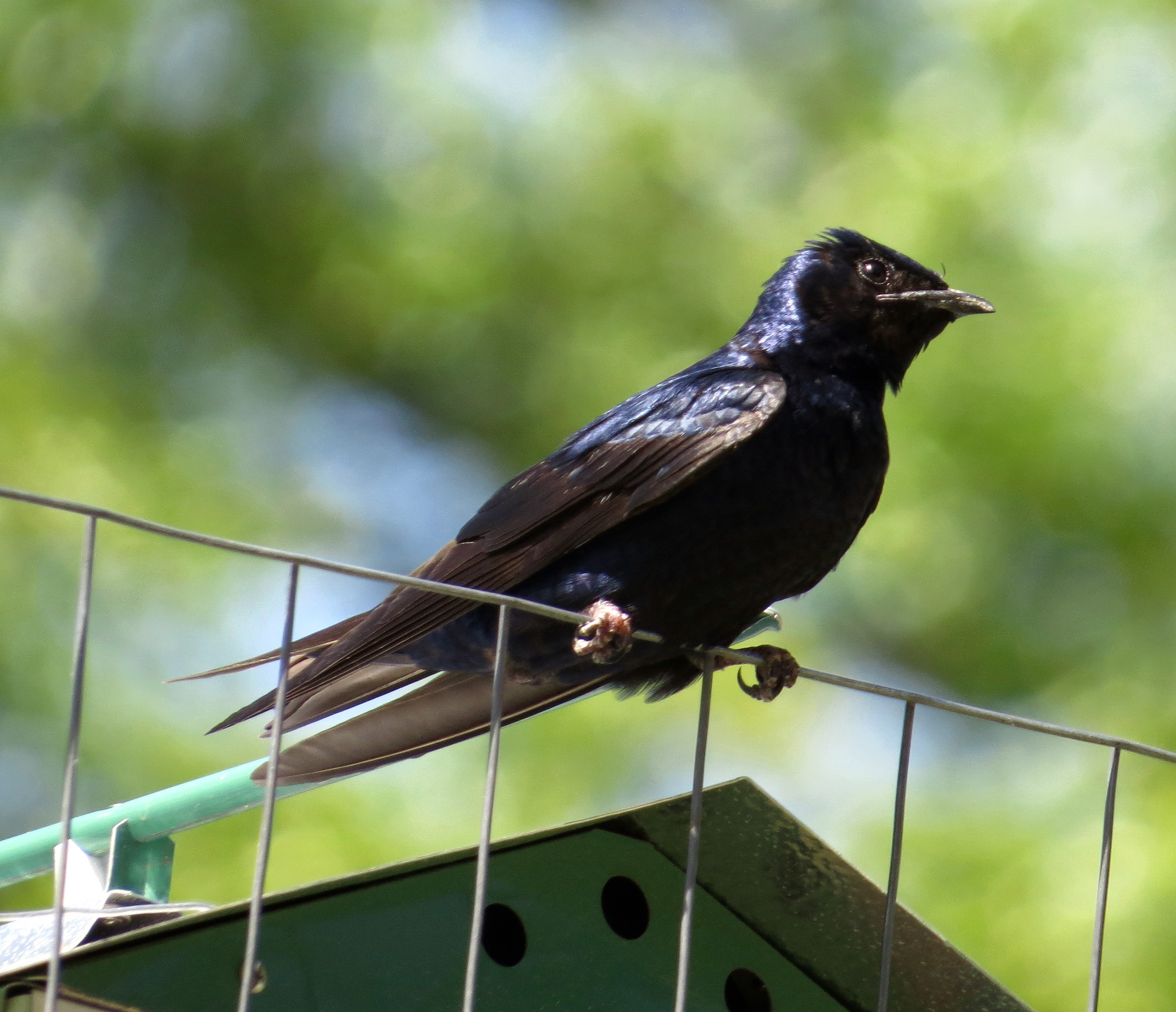
Male purple martin at Bryan Park

Male purple martin at Bryan Park

Females are lighter. This pretty gal is staring straight at me: 
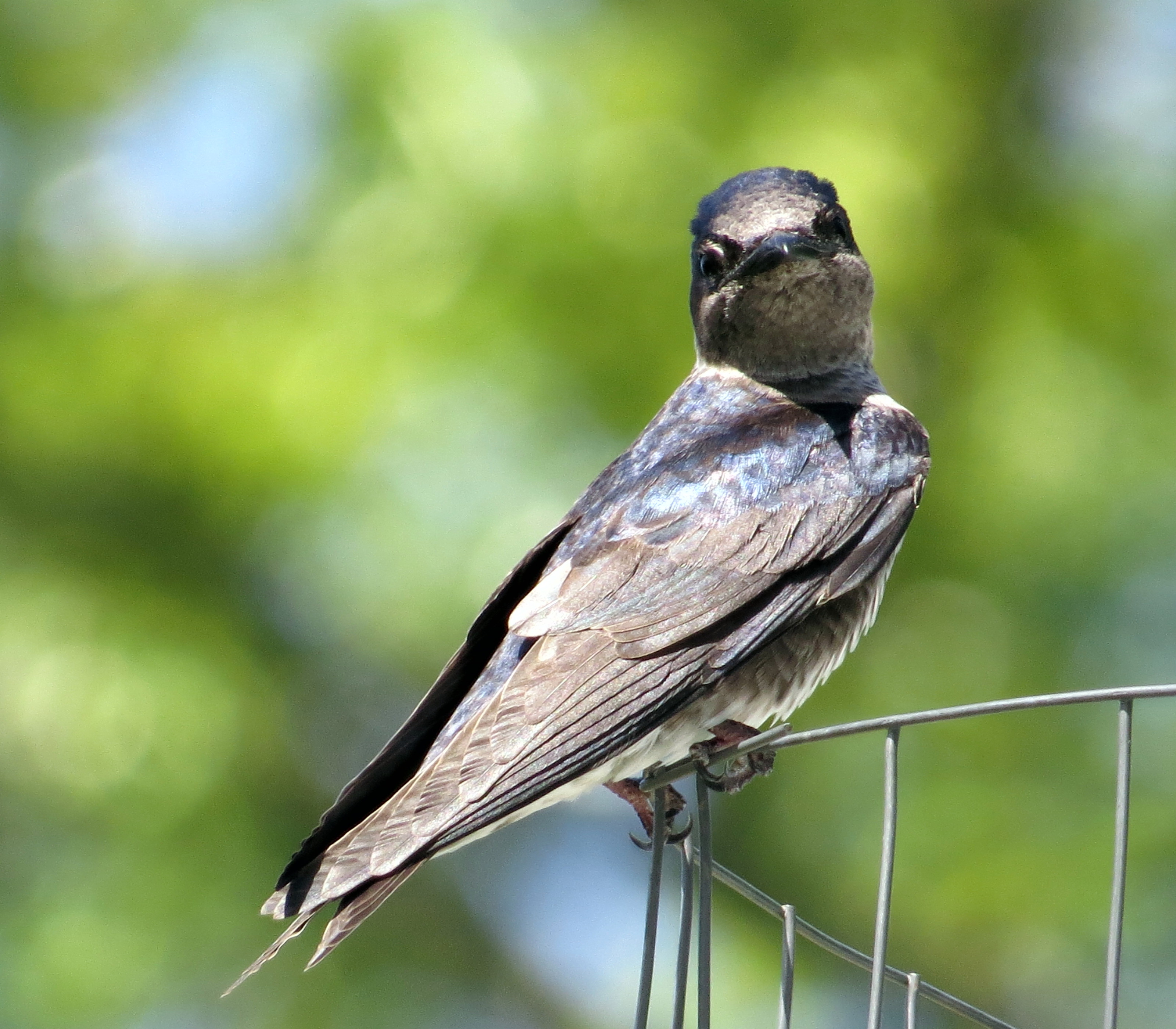
Beautiful female purple martin at Bryan Park.  Possibly that handsome guy's mate.

Beautiful female purple martin at Bryan Park. Possibly that handsome guy’s mate.

This just in! I watch the purple martins at Bryan Park with a friend of mine named Ethan. Ethan and I have had many conversations with a man  named Adolph White, who put up all the purple martin houses. He educates us about purple martins whenever we talk with him. Here is an article from the Richmond Times Dispatch about Mr. White and the purple martins of Bryan Park:

Flyways and Byways: Purple martins in good hands at Bryan Park          

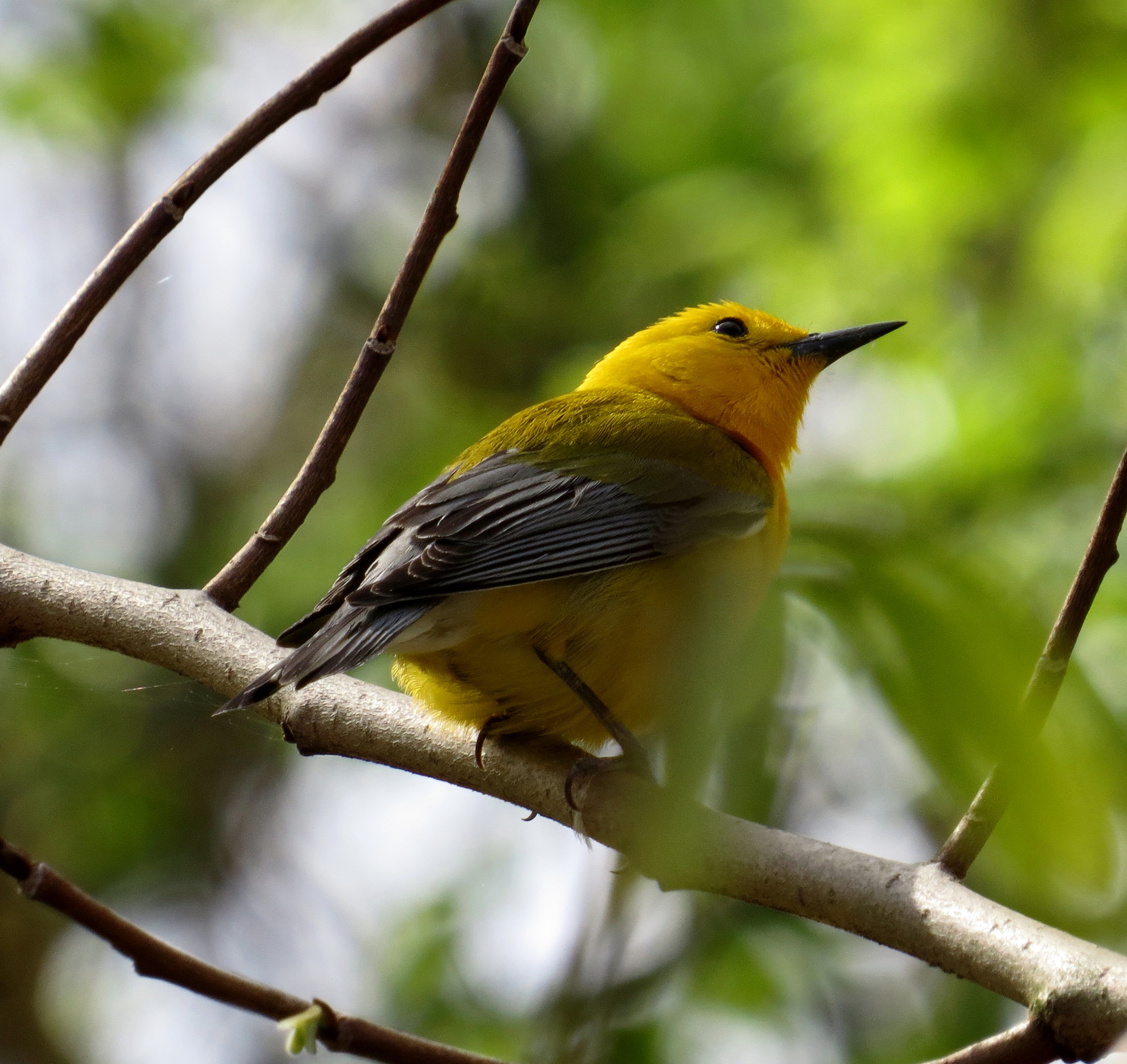
Ev and I hiked at the river yesterday and we could hear a prothonotary warbler warbling over our heads. The leaf cover is getting dense and it took us some time to locate him. Our efforts paid off; look at this handsome guy. The focus could be sharper (next time) but the color is lovely: 
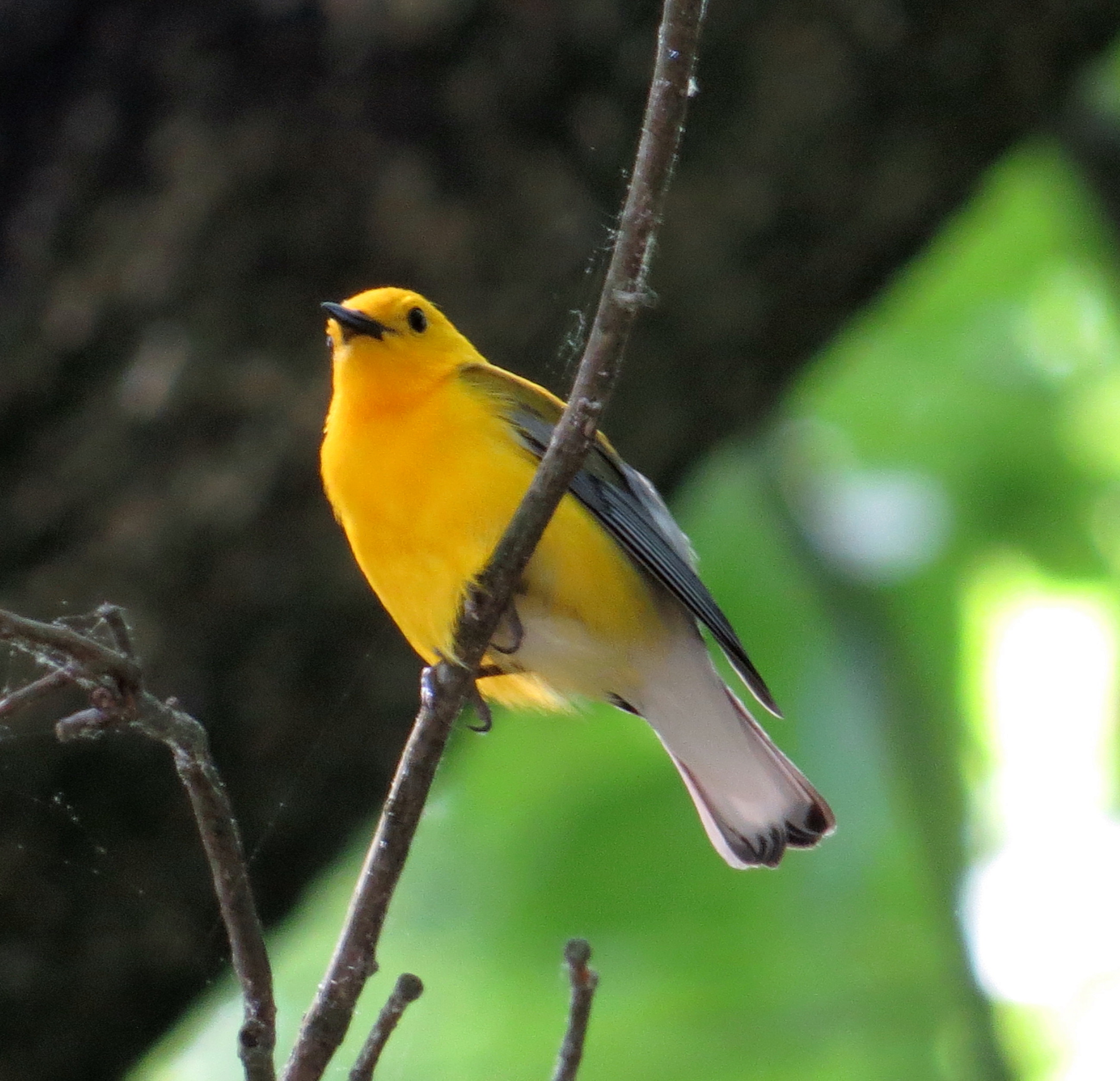
Prothonotary warbler. It's so bright it looks like it takes batteries.

Prothonotary warbler. It’s so bright it looks like it takes batteries.

We had Mackey and Turner with us on that hike plus we were walking our friend’s dog Yuki. We stopped by our friend’s house to drop Yuki off on the way home. They have a shelf on the side of the house with an empty flower-pot lying sideways in it and a pair of mourning doves built a nest inside! Yesterday there was one adult and two babies (they’re called “squabs”!) inside. All three gazed peacefully at me while I snapped away. It’s easy to see why doves are a symbol for peace:
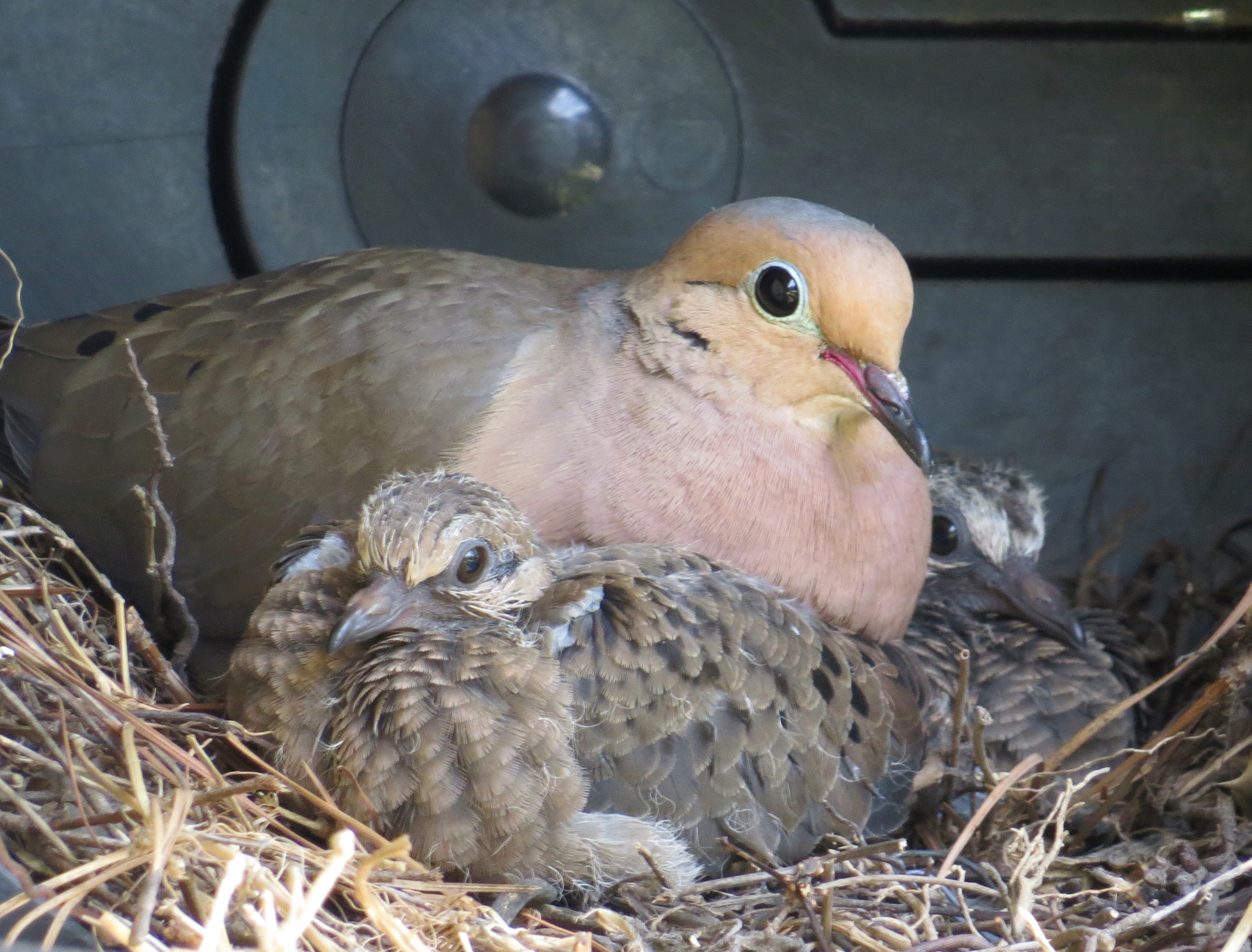
Boy that is a peaceful looking family.

Boy that is a peaceful looking family.

And finally, my first honeysuckle of 2015. Honeysuckle is invasive – it’s big time invasive – but I can’t help it. It’s my favorite photosynthetic plant. It’s exuberant. It’s graceful. It smells better than anything I know that is not a chocolate chip cookie. Anything that produces this much beauty and enjoyment with this little effort can only be a good thing: 
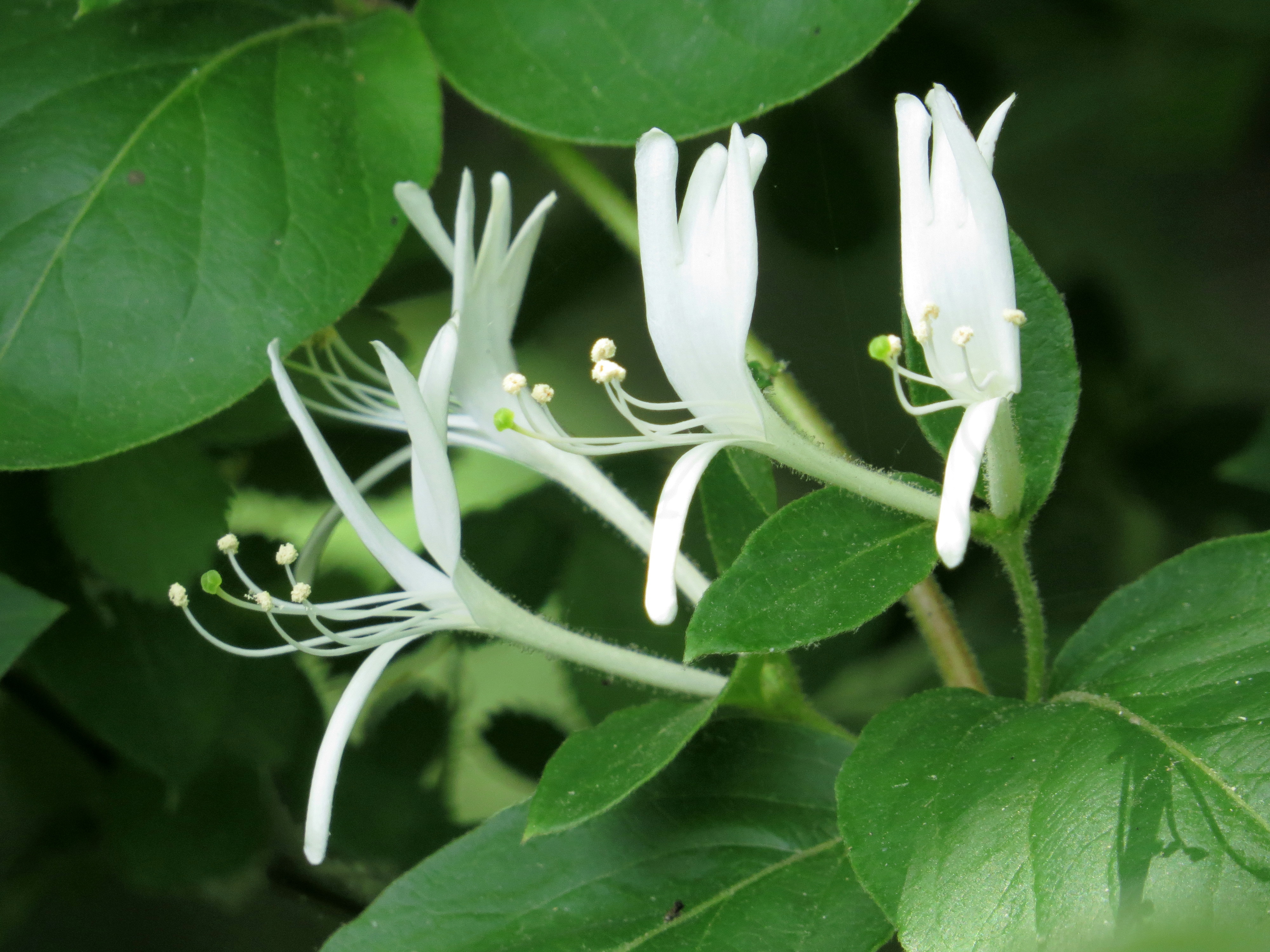
Fresh honeysuckle

Fresh honeysuckle

Have a great week,

Jay

Posted in Birds, Dogs, Flowers, Fun, James River, People, Pony Pasture, Rivers, Smiles (including "dog smiles"!) | Tagged , , , , , , , , , , , , , | 4 Comments

Winning combination

10 May, 2015                   Winning combination 

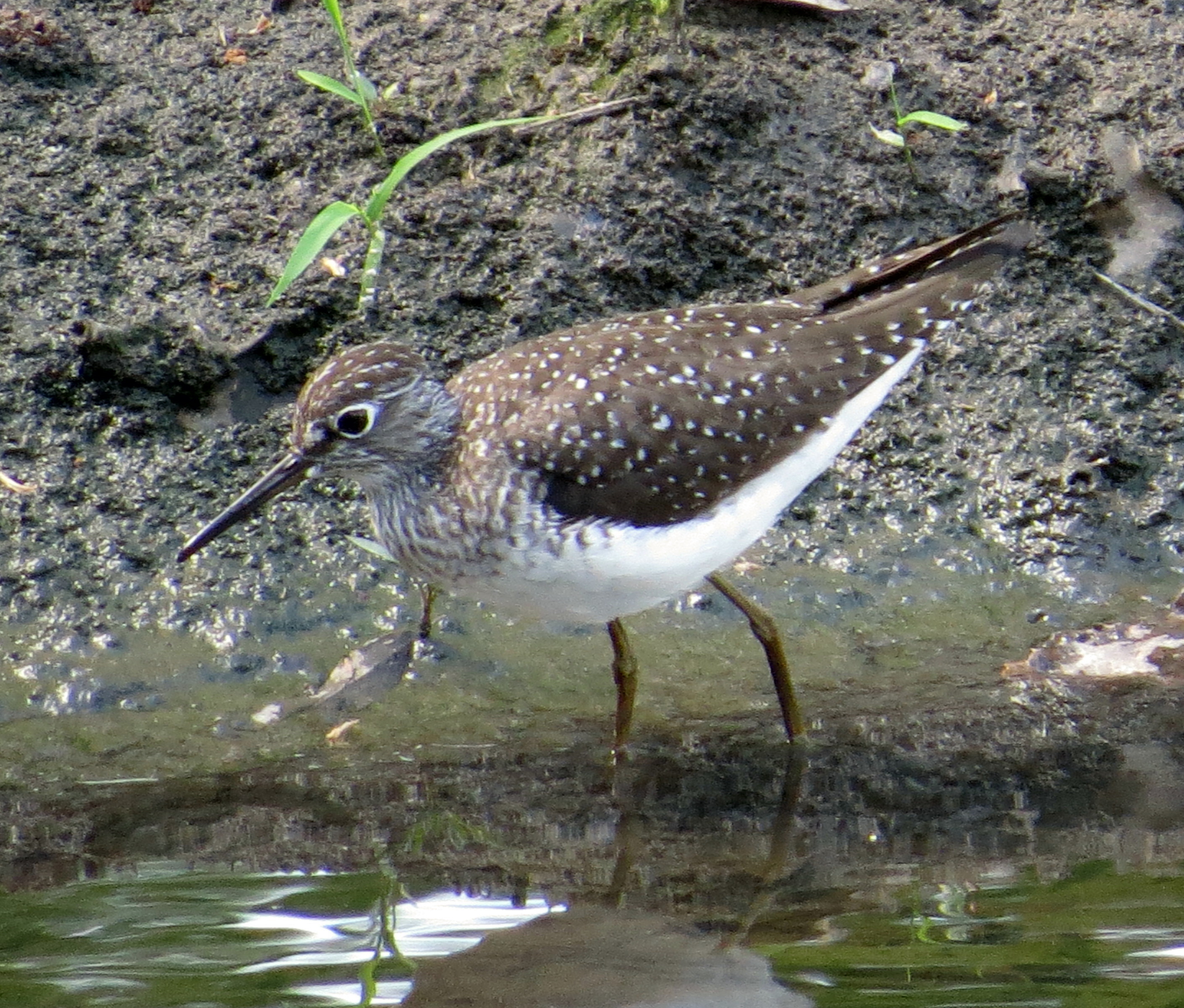
My first  ever Solitary sandpiper - Bryan Park

My first ever Solitary sandpiper – Bryan Park

That’s a Solitary sandpiper (Tringa solitaria) – the first I’ve ever seen. A friend complimented me on the picture and I said “right place, right time, lens cap off – a winning combination.” Because there’s more luck than skill involved. 

I took that picture at Bryan Park on Monday, May 4. Thursday I was at Pony Pasture – and I saw another! Since it’s my newest entry in “Every living thing / Pony Pasture Fauna” I’ll include it here:

My second Solitary sandpiper - this time at Pony Pasture

My second ever Solitary sandpiper – this time at Pony Pasture

There’s been a White-breasted Nuthatch (Sitta carolinensis ) visiting my feeder regularly. The feeder is attached to my office window about three feet from my right shoulder. I see that nuthatch a lot when I’m working on my blog. One day last week I came home from work and it was clinging to the vertical wall! I was a long way away and snapped a picture; I cropped a lot out so it’s a little blurry. But look at this little guy hanging here:

Technically a crummy picture. But the oddness makes up for the poor quality.

Technically a weak image. But the oddness makes up for the poor quality.

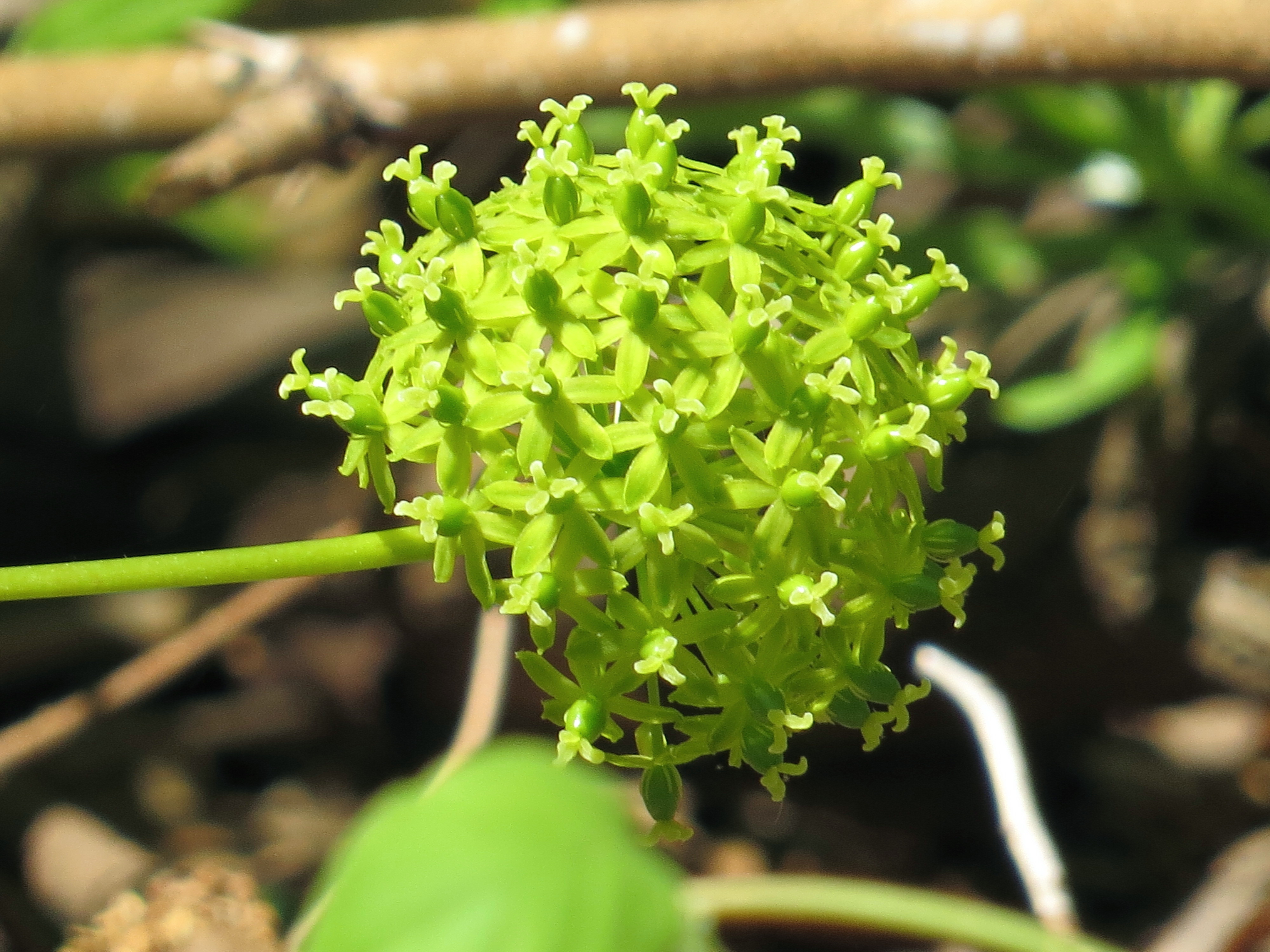
In addition to the new bird (Solitary sandpiper) I found a “new” (to me) plant at Pony Pasture this week. Still pinning down the identification; stay tuned. But look at this beauty. Speaking of oddness: 

Non-typical - at this point I have no idea. Perhaps next week. It almost looks fake.

Non-typical – at this point I have no idea. Perhaps next week. It almost looks fake.

I haven’t done any dog pictures in a while – try out this video. The actual video is seventeen seconds long. But this is in slow motion so it lasts two minutes. Turner starts in the upper right. You can fast forward to around 0:40 and his handsome friend Yuki enters the frame on the lower left. Thirty seconds later (around 1:10) Yuki decides Turner is having way too much fun on his own. (Turner often has way too much fun on his own). So Yuki jumps in to share the excitement. It’s not an award-winning video but they’re cute:

Turner & Yuki having fun, 5.2.2015

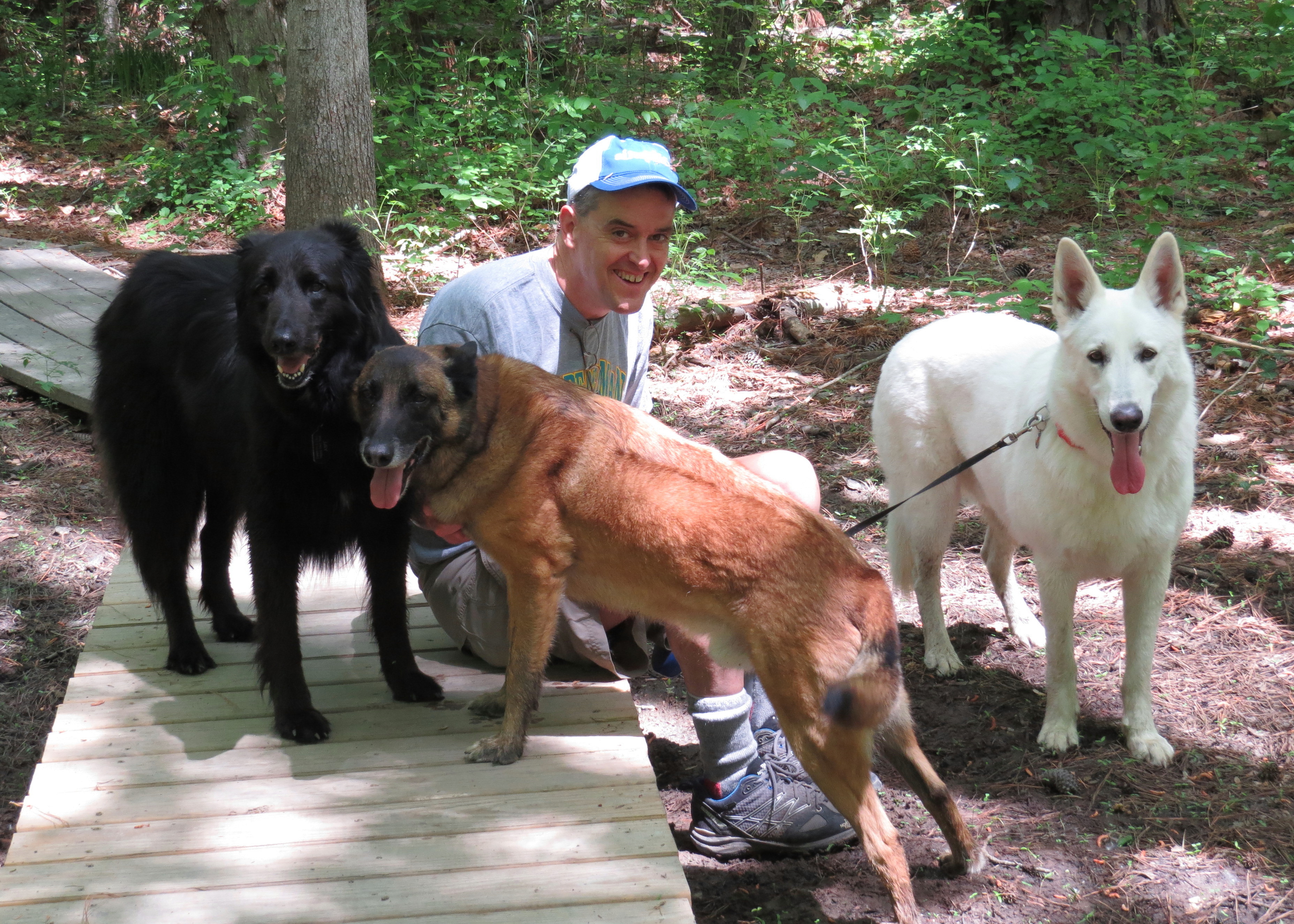
Saturday Yuki joined Evie and Mackey and Turner and me for a hike at Pony Pasture. Ev took this picture while the four of us took a break:

Hanging with my posse

Hanging with my posse

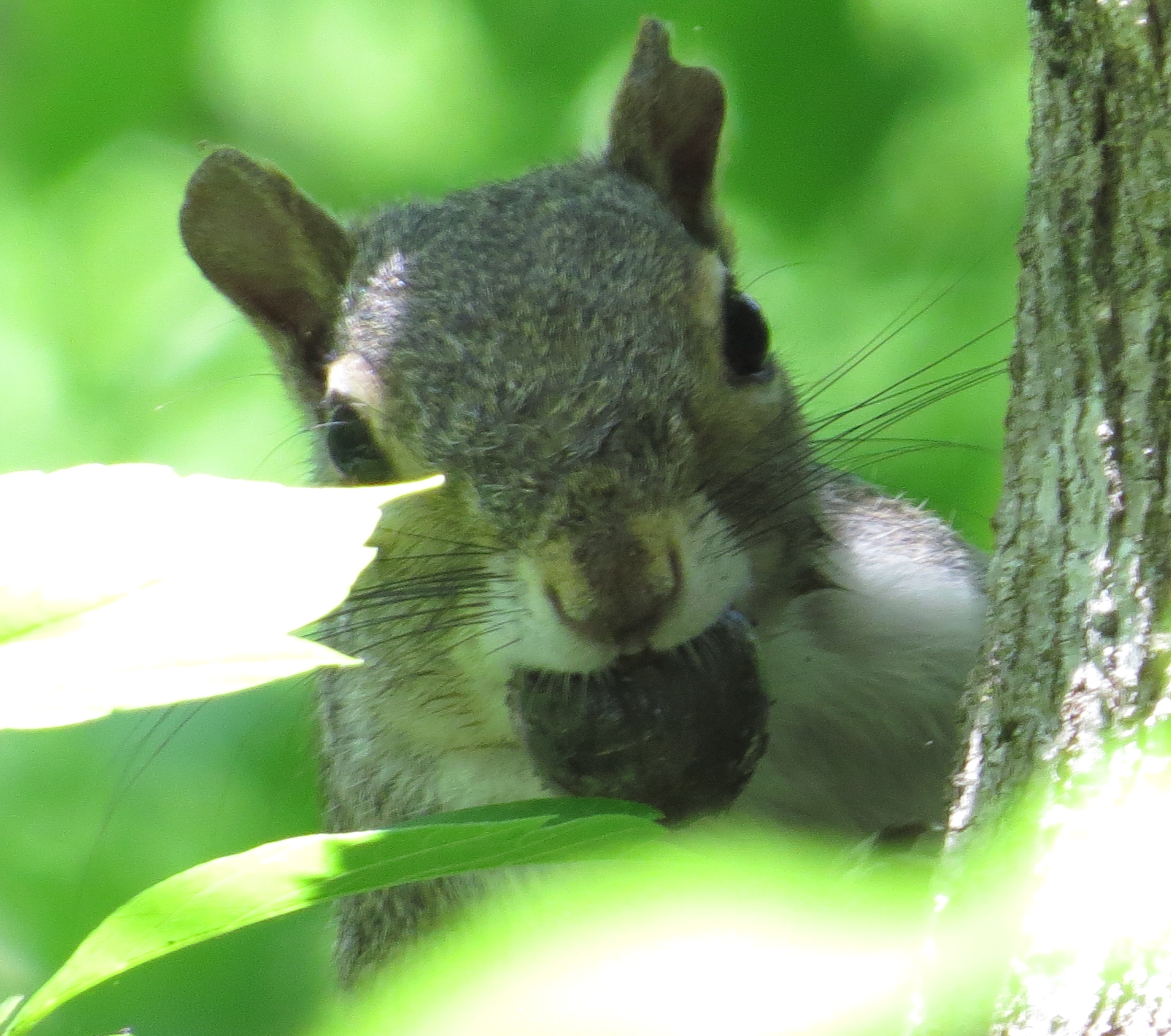
There is a baby of everything around right now – plants and animals. This squirrel is not a baby – it was missing more than half its tail plus has lost a chunk from its ear. It was climbing a tree with a nut in its mouth but it took a break to glare at Turner. Mackey they couldn’t care less – but they never take their eyes off Turner:

Checking out Turner for a while - the nut can wait.

Checking out Turner for a while – the nut can wait.

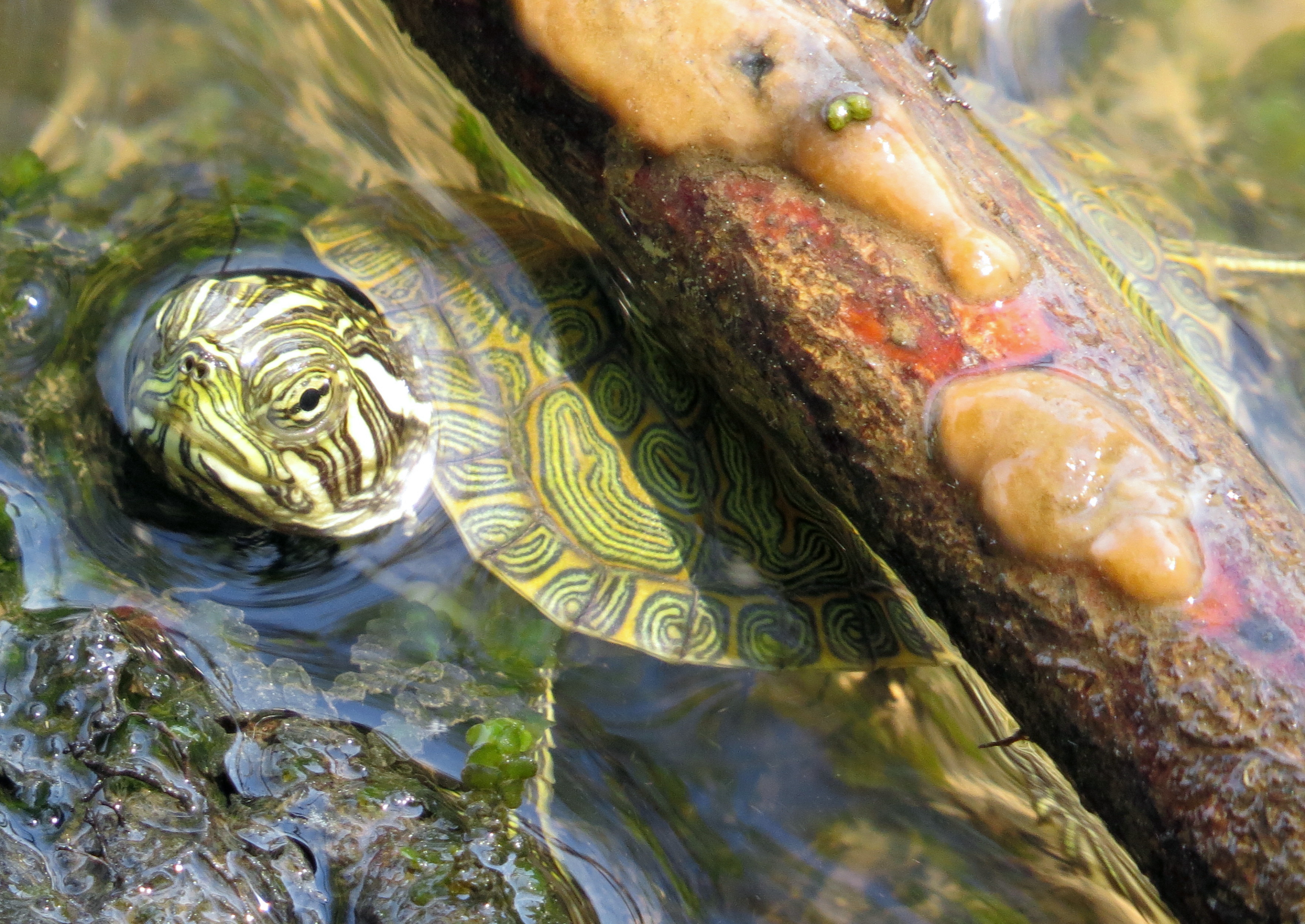
Saw a baby turtle the same day – this guy was swimming around and popped his head out for a look. He was bigger than a quarter, but just barely:

Baby turtle coming up for a breath of fresh air and a quick look around

Baby turtle coming up for a breath of fresh air and a quick look around

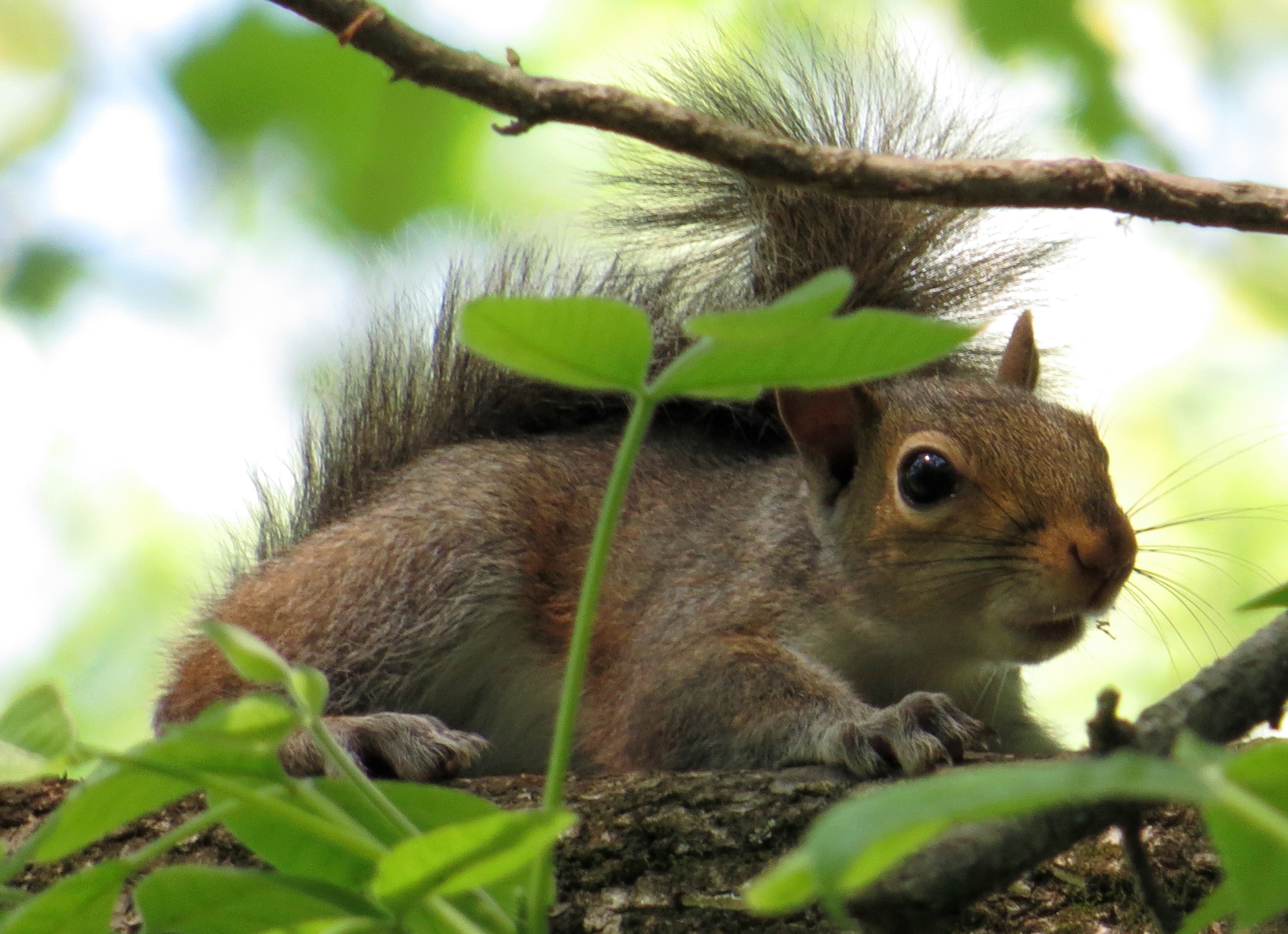
This (next picture) was a baby squirrel – and he was giving Turner a piece of his mind. If you watch Turner it’s easy to see two things happening simultaneously:

  1. It drives him crazy
  2. He can’t get enough of it

That’s  just the way he is. Check this little guy out:

Look at those wide eyes. The things this turtle was saying to Turner are entirely inappropriate  for a family-oriented blog.

Look at those wide eyes. The things this squirrel was saying to Turner are entirely inappropriate for a family oriented blog.

You may have read in previous blog posts of my continuing fascination with Black locust trees (Robinia pseudoacacia). They’re flowering now and they are as fragrant as they are beautiful and delicate: 

Isn't that stunning? If you've never smelled locust, look around for some this week. Or wait until 2016.

Isn’t that stunning? If you’ve never smelled locust, look around for some this week. Or wait until 2016. Great wood and great flowers – what a treasure. 

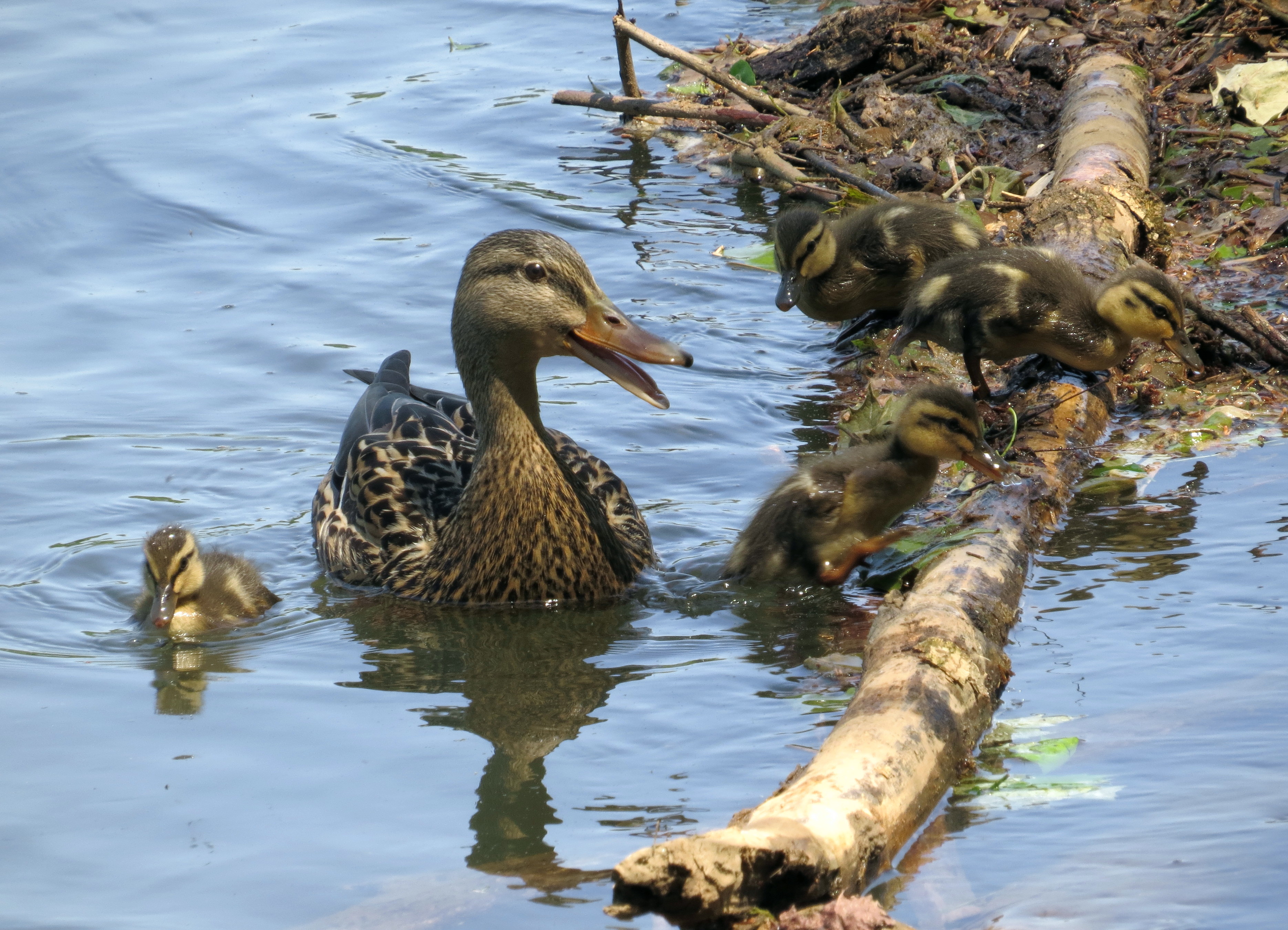
This time of year I am overrun with pictures. I have a terrific shot of a snake with a mud-covered face sticking its tongue out to figure out what’s going on. Maybe I’ll save that for another post. Meanwhile – more babies. Here’s a mother mallard with four babies. One is quietly paddling on her right. She’s “talking” to the three on her left. See how well they are camouflaged? 

She appears to be giving them a talking to. But who am I to say.

She appears to be giving them a talking to. But who am I to say.

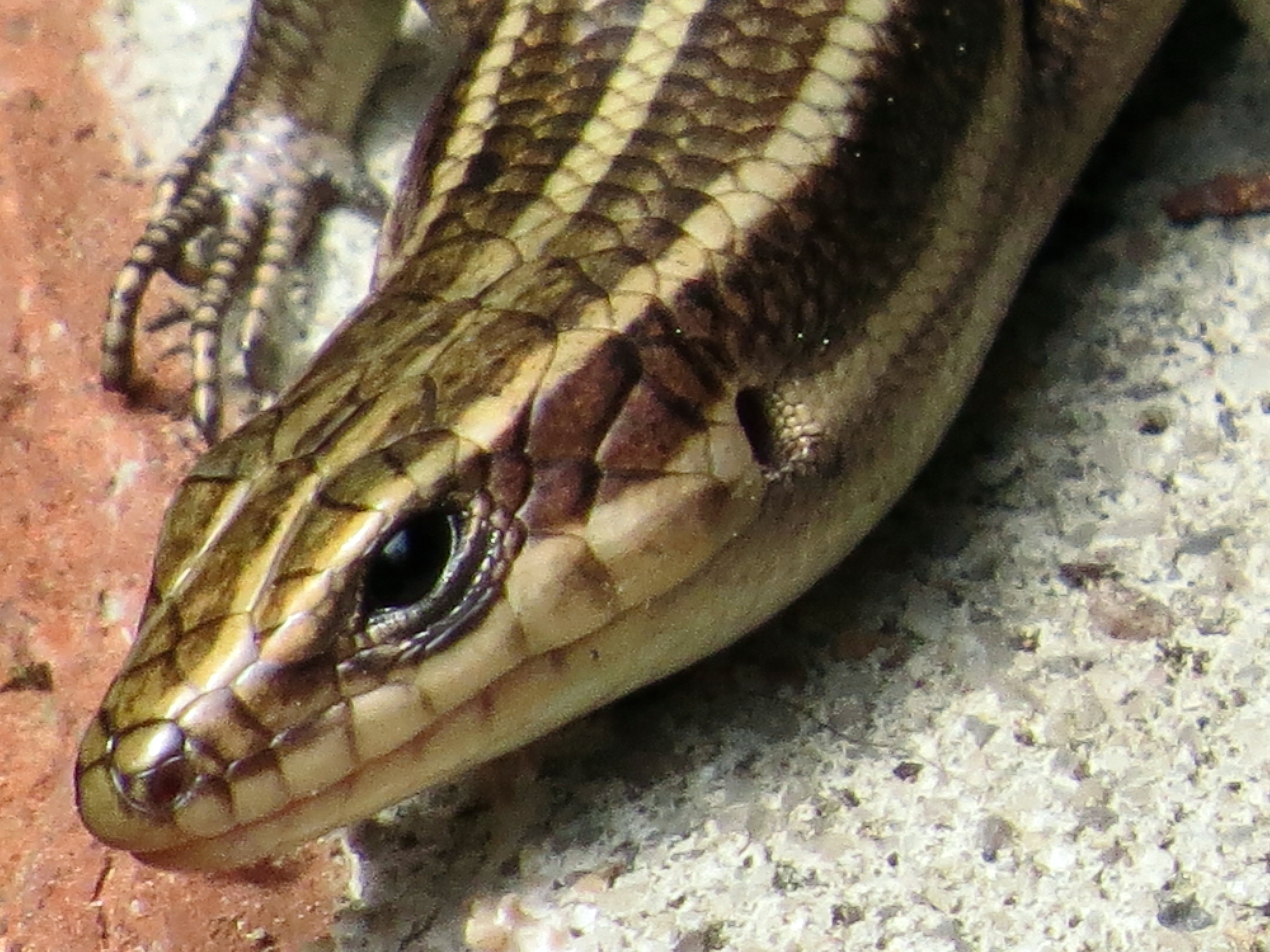
almost left one of my favorite pictures off this post. It slipped my  mind because I took this picture about six feet from my front door. This is a  “common five-lined skink“(Plestiodon fasciatus). Some of you may be squeamish. But this guy eats lots of spiders and  other insects you are perhaps also un-fond of. I prefer to think of it as organic pest control: 

Is it just me? Does he have an expression on his face?

Is it just me? Does he have an expression on his face?

Enough for this week! I hope you’ll visit again next week! All best, 

Jay 


Posted in Birds, Dogs, Flowers, Fun, James River, Pony Pasture, Rivers, squirrels, Turtles | Tagged , , , , , , , , , , | Leave a comment

You’re only as good as your last gig…

3 May, 2015              You’re only as good as your last gig 

Or so I’m told. I have had (by my standards) a lot of “gigs” this week, e.g. I’ve been doing lots of stuff besides my usual day-to-day. My last gig finished (for me) a few minutes after 11:00 this morning at Lake Anna State Park in Spotsylvania, VA. I finished the High Cloud PeasantMan Triathlon after (I think) around two hours of swimming and bicycling and running. Too much talk – here’s a few of pictures to begin – 

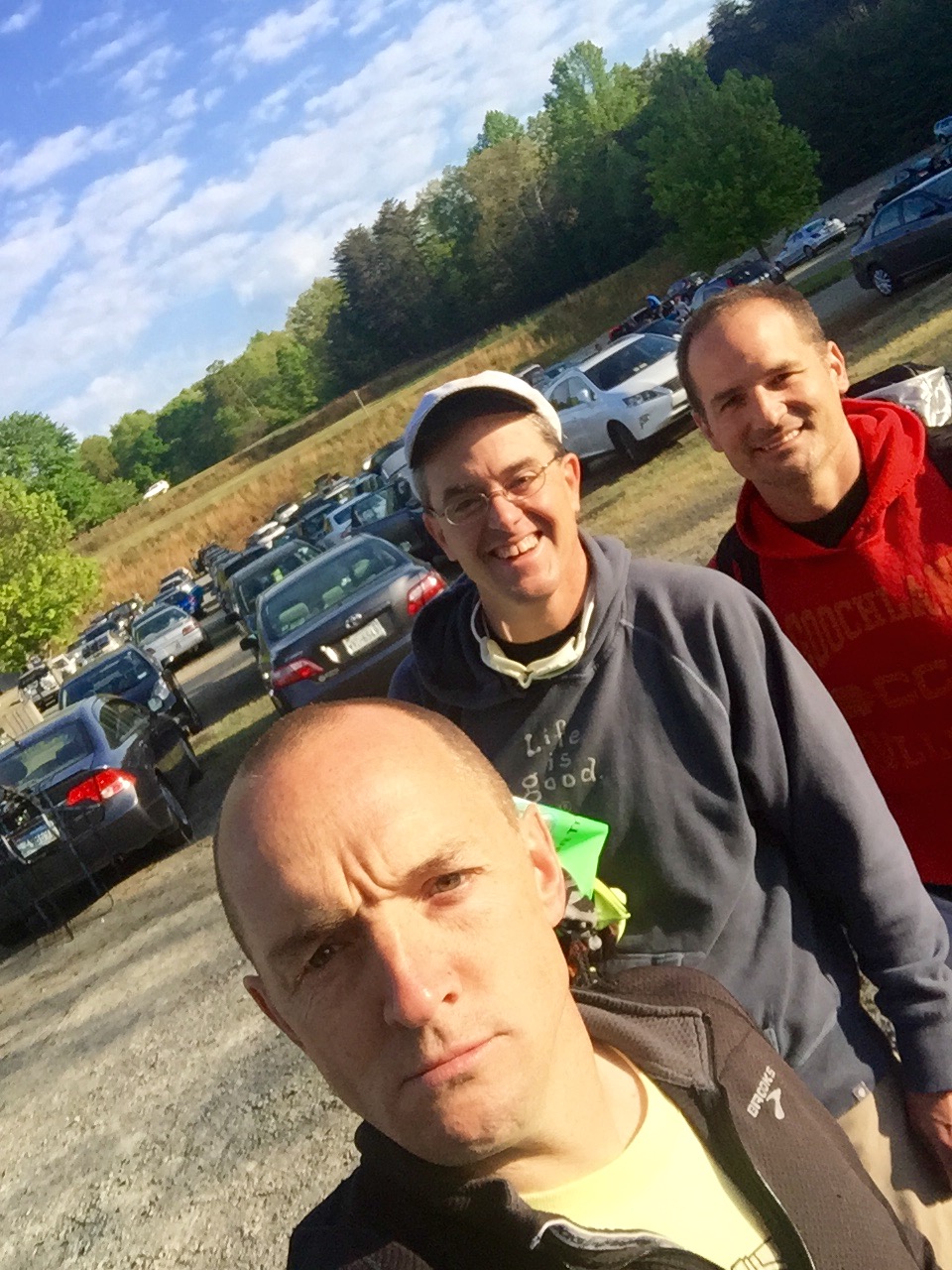
Me, Travis, Andrew, Sarah - post race, with Lake Anna in the background.

Me, Travis, Andrew, Sarah – post race, with Lake Anna in the background.

Same crowd, better light: 

Sarah, me, Travis, Andrew

Sarah, me, Travis, Andrew

Slightly modified crowd, pre-race: 

Andrew, then me, then Jeff - pre-race

Andrew, then me, then Jeff – pre-race

For people who did that race (or not) and are considering going long distance, I did a blog post about a long triathlon I did two years ago. The pictures aren’t terrific but it’s a fun post. I race a lot but I don’t take it seriously. The race I wrote about was a 2.4 mile swim, a 112 mile bike and a 26.2 mile run. It took me 15 hours and 58 minutes! Take a look at the blog post here: Owl pajamas, candy corn, a beautiful day – Beach2Battleship 2013

The race I did this morning – by way of comparison – was a ½ mile swim, an 11 mile bike and a 3.1 mile run. There was also one held concurrently that was all of that, twice. That’s what most of my friends did.

Earlier “gigs” this week included a great engagement party for my friend Pat’s son Daniel. I’m not a great party photographer so I left my camera in the car. But Daniel is a flight instructor and I’ve gone flying with him twice. As a passenger, not as a student. The first time was in August of last year; you can see that blog post here: I went flying yesterday!

We went again a week before Christmas: Unforeseen circumstances

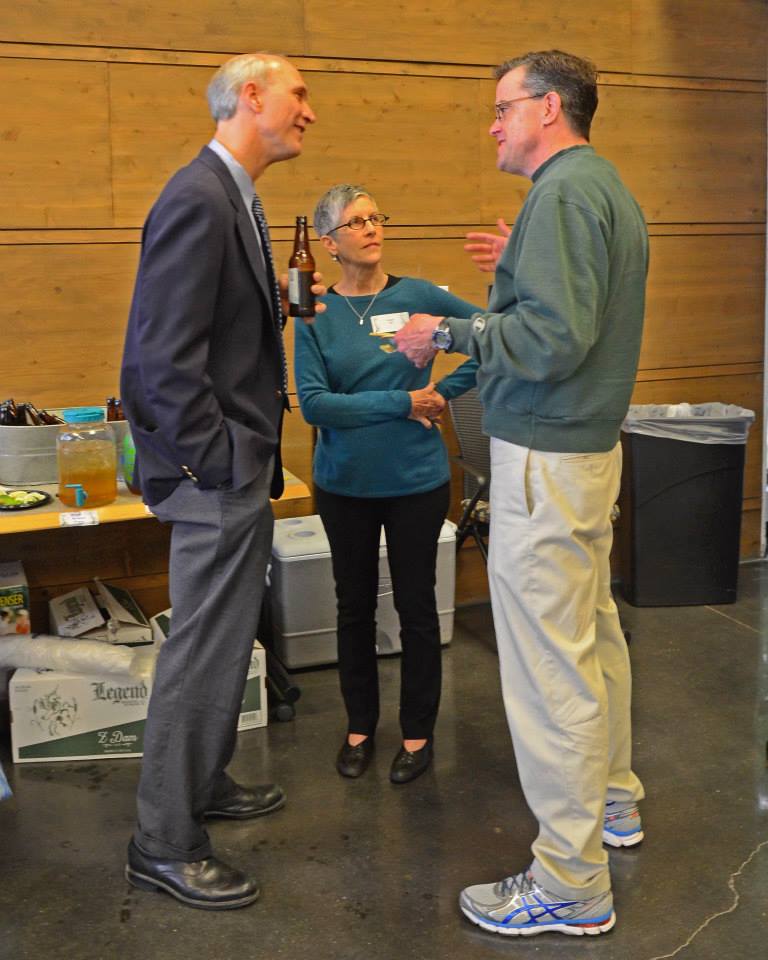
Another “gig” this week – Evelyn and I went to the Ralph White River Hero Awards Celebration Thursday evening. It was at the VCU Rice Rivers Center in Charles City County. I didn’t get any pictures! But Rich Young took this picture of Evie and me talking with Phil Dawson, fellow triathlete, pediatrician and president of the Friends of the James River Park:

Phil, Evie, me - VCU Rice Rivers Center

Phil, Evie, me – VCU Rice Rivers Center – photo by Rich Young

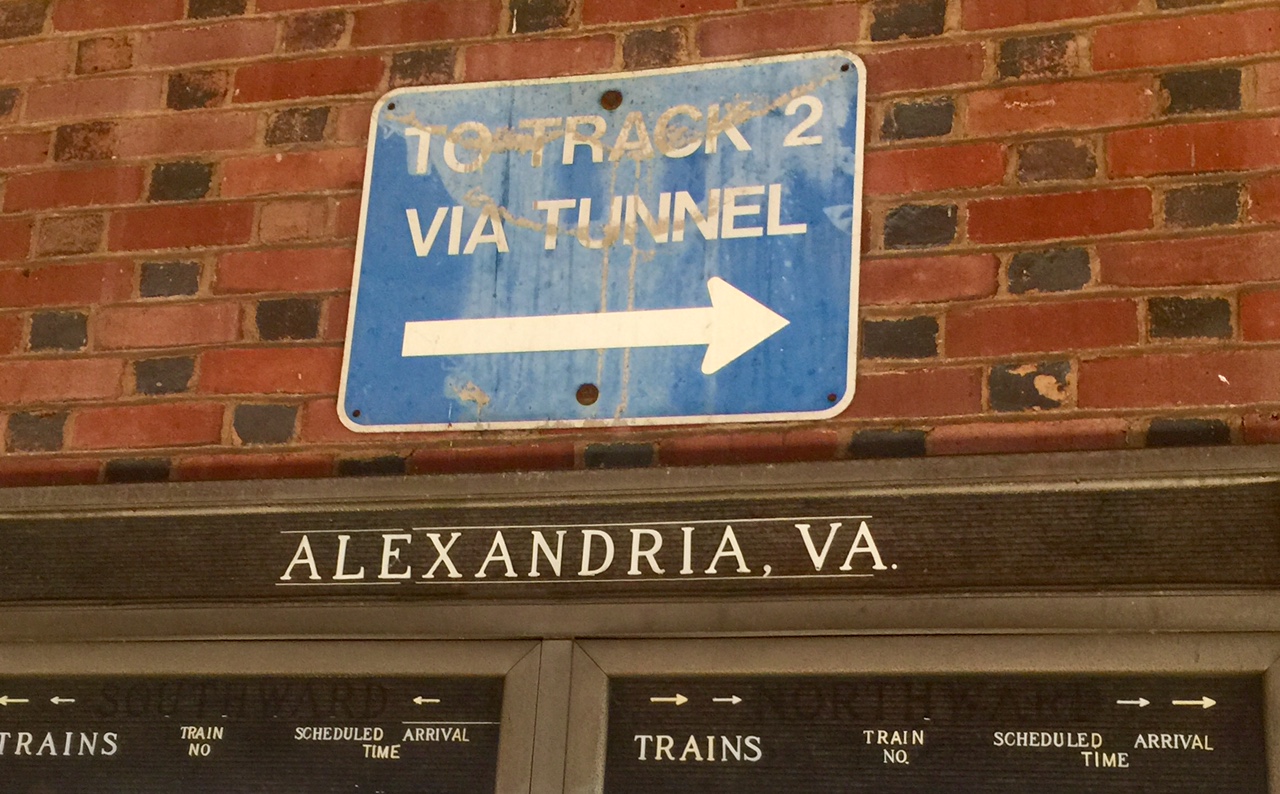
Last (sort of) but not least (definitely) of my “gigs” this week was the experience I had presenting at a conference in Alexandria on Wednesday. The conference was good but it was about research and somewhat dry. I had a great (to me) surprise when I got there. I took Amtrak from Richmond to Alexandria. When I was growing up in the 1960’s and early 1970’s in that area my grandparents would take us to that station to watch trains. And there was a pedestrian tunnel under the train tracks to go from one set of tracks to the other. My grandfather used to walk down there with us when we were kids and a train was going over. It would make this huge, terrifying rumble and we would scream, but it was fun-screaming, the kind little kids do when they’re scared but know they’re really safe. I said no way that junky tunnel and useless tunnel is there all these decades later. I couldn’t even find it on google, and I am an obsessive googler. So I stepped off the train and I see this sign:

This was a promising sign, believe it or not

This was a promising sign, believe it or not

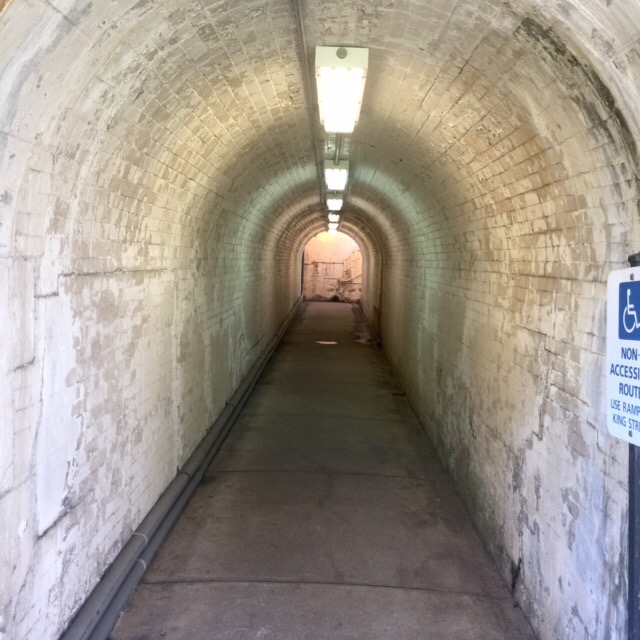
And I walk down the steps and there it is – unchanged in every way – same peeling paint, puddle on the floor, fluorescent lights, everything. I walked through it before going to the Alexandria Hilton to present at this conference. Nothing stays the same for forty years. But this tunnel is identical. It was so unchanged it was peculiar. I couldn’t stop thinking about it for that whole presentation. I’ve always been peculiar that way; this is nothing new: 

Scene of delightful childhood terror, four decades ago. What a flashback.

Scene of delightful childhood terror, unrecalled for most of my life. What a flashback.

Anyway, crazy.

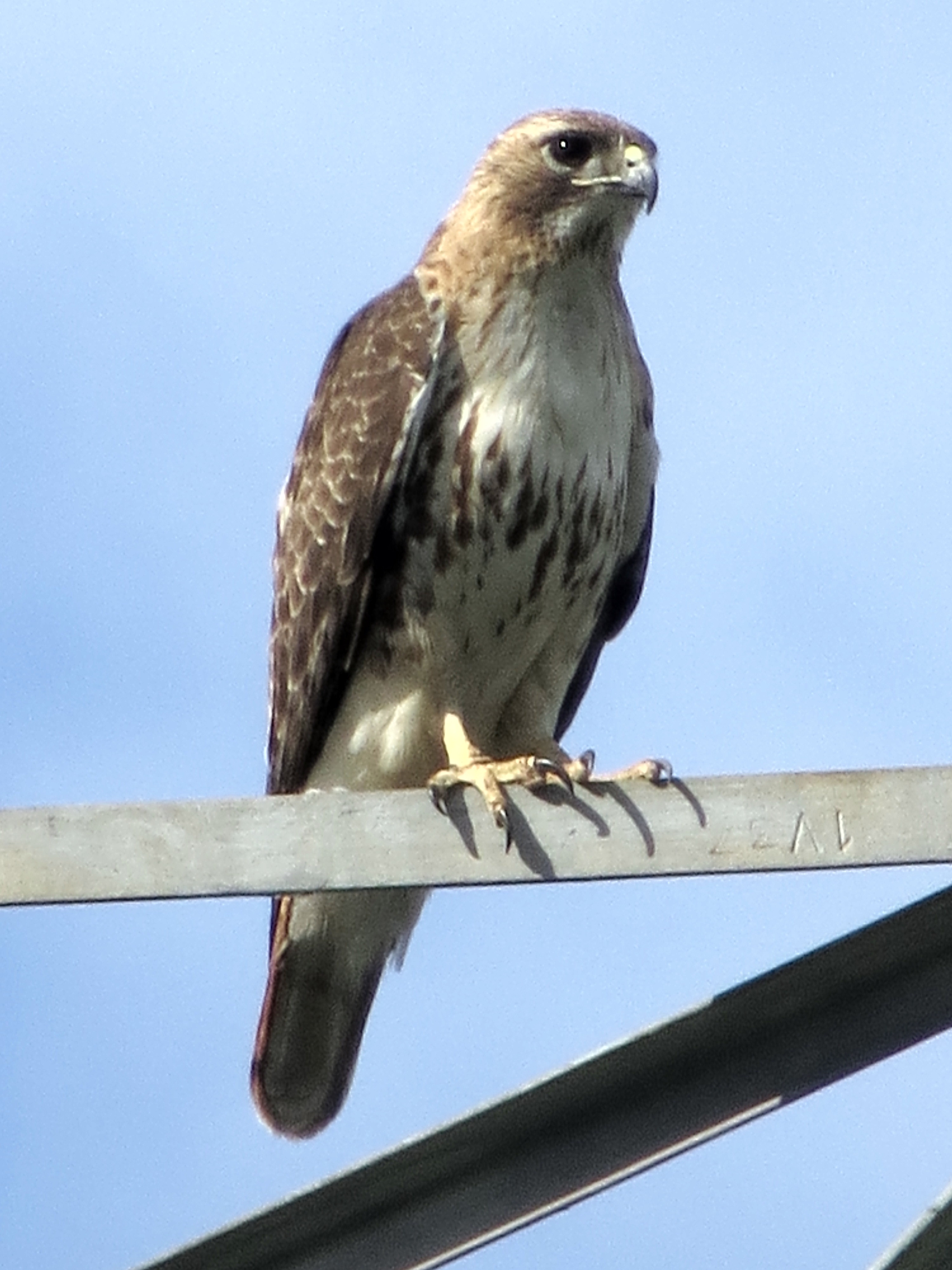
I put these blog posts up on Sunday evening, and on Monday morning I start a draft for the following week on Google docs. Then I change it all week. This post was originally called “Walking distance.” Earlier this week I walked to the end of my street and went across and took a picture of a Red-tailed Hawk (Buteo jamaicensis). This is the opening sentence of the first draft: “Tierra del Fuego is in walking distance – it would just take a really long time.” Here’s the hawk: 

Red-tailed hawk. In view from the end of my street - I was and am amazed.

Red-tailed hawk. In view from the end of my street – I was and am amazed.

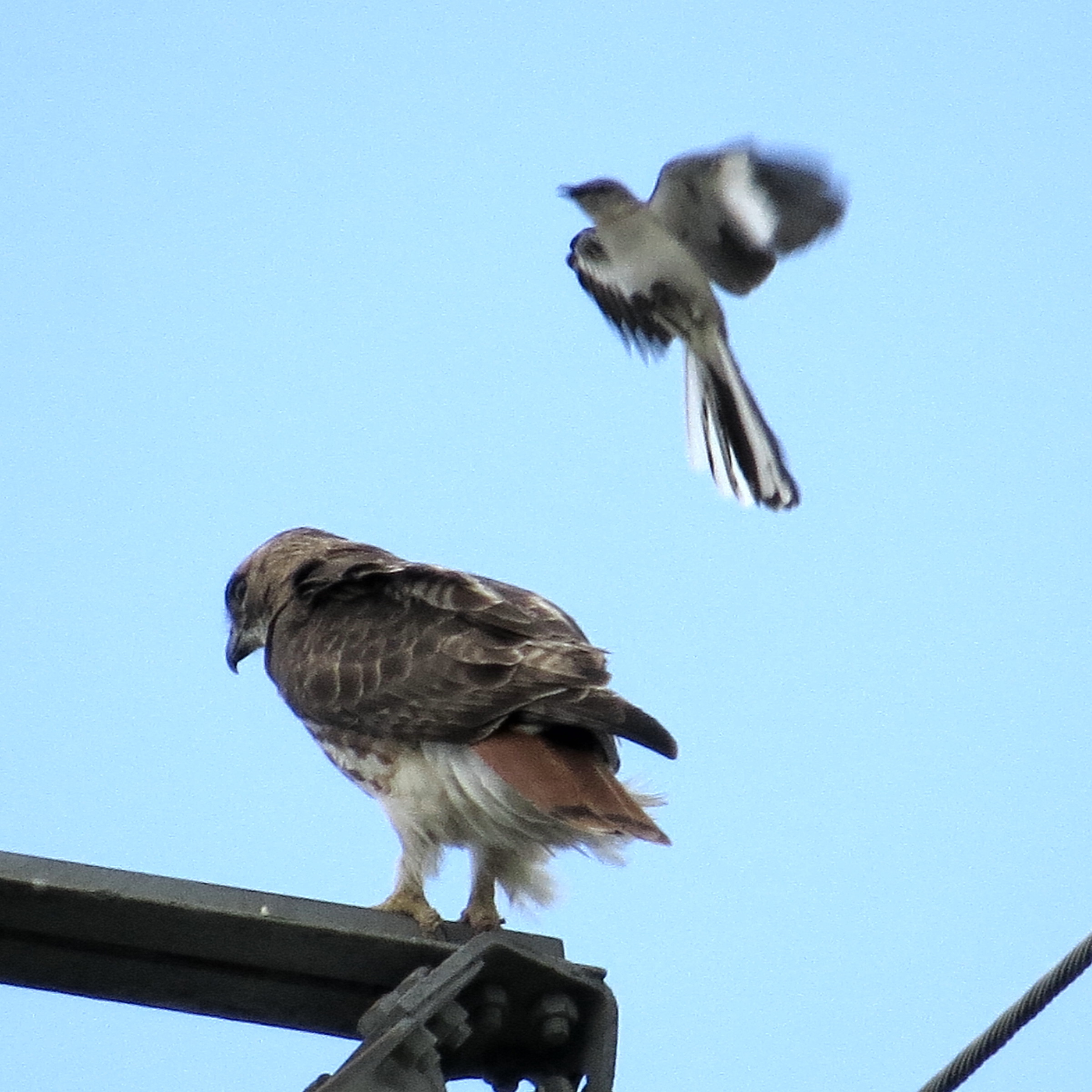
While the hawk sat there, a mockingbird swooped in to harass it. Everything is preying on everything else this time of year – they’re all trying to feed their babies. To pass on their DNA. Obeying their evolutionary mandate. This isn’t a perfect picture but it’s kind of cool: 

Songbird attacking a raptor. It's just amazing.

Songbird attacking a raptor. It’s just amazing.

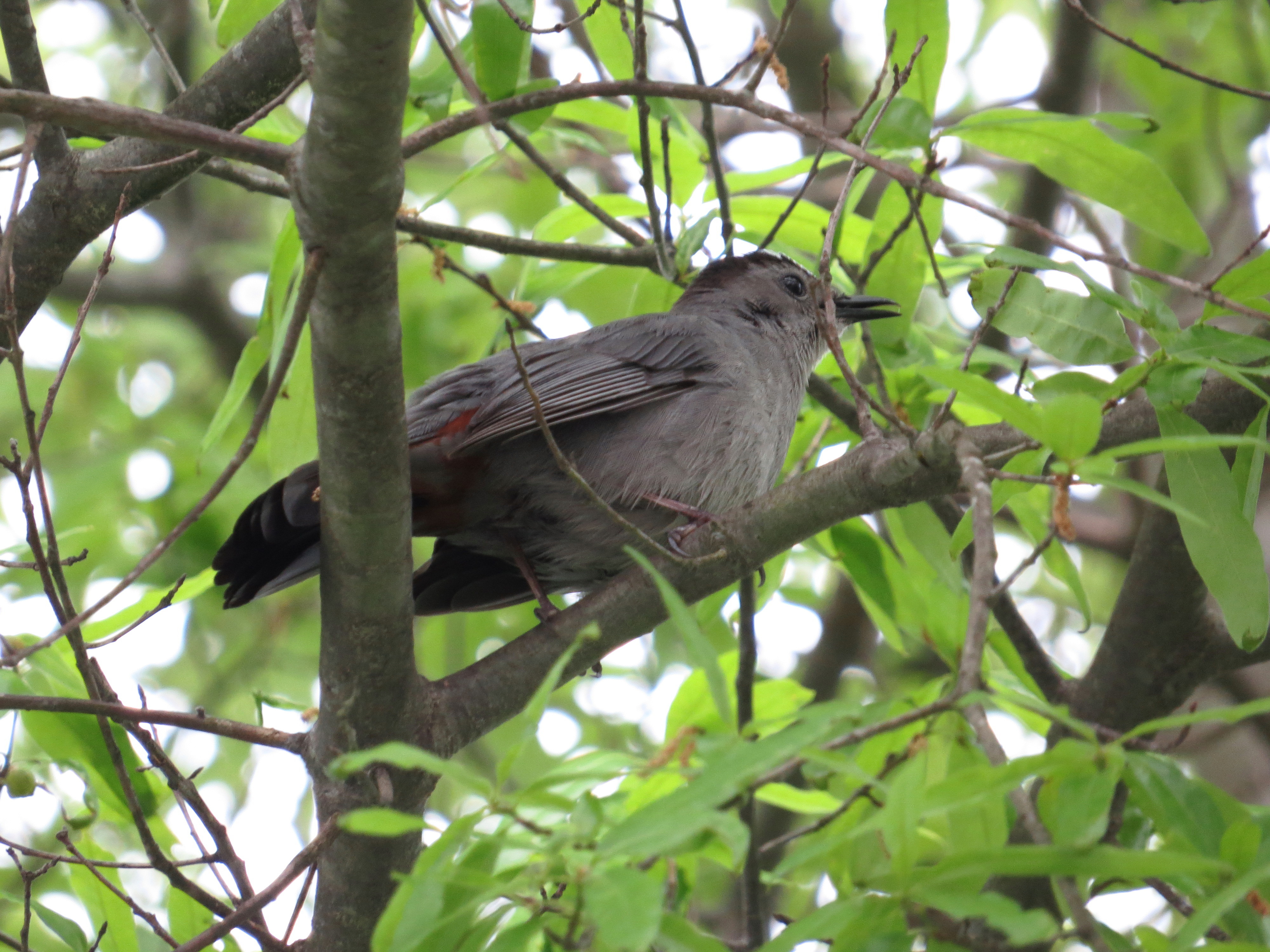
Standing in the same place five minutes later I heard a bird song I don’t normally hear. I looked up and saw a  Gray Catbird (Dumetella carolinensis): 

Catbird

Catbird

They’re not at all uncommon – I just don’t see them. And as much time as I spend at Pony Pasture, I hardly ever walk near my house. Look what I’m missing!

Have a great week,

Jay
=======

Posted in Birds, Endurance, Flowers, Fun, People, Rivers, Smiles (including "dog smiles"!), Trains | Tagged , , , , , , , , , , , , , , | 1 Comment

Fascinating / boring

26 April, 2015 Fascinating / boring

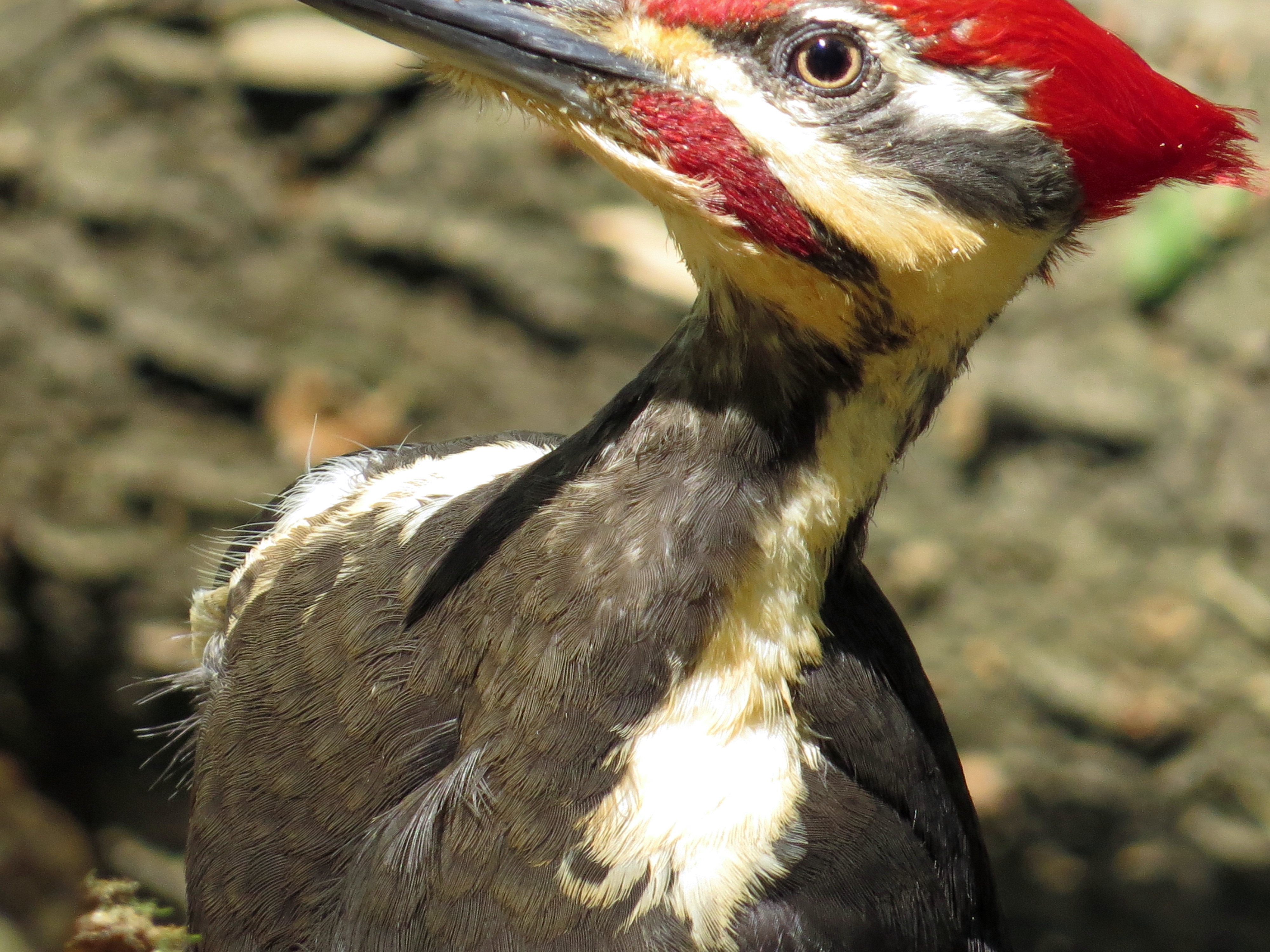
As my “Every living thing” project evolves, some if it is fascinating and some of it (possibly you’re painfully aware) is boring. This is not what I was referring to, but I was ten feet from this male Pileated Woodpecker (Dryocopus pileatus) for over ten minutes while I watched him dismember a rotten log:

Adult male Pileated woodpecker tearing up a rotten log at Pony Pasture. Look at that eye. Amazing.

Adult male Pileated woodpecker tearing up a rotten log at Pony Pasture. Look at that eye. Amazing.

That was never boring – it was only fascinating. But I was so close I had to stand still as a statue because I didn’t want to scare him away. I’d been photographing turtles (more boring than it sounds, and it sounds boring) and standing quite still. I had dark clothes on and blended in with the background and I was standing on the dogs’ leashes. He swooped in and landed almost at my feet. It was a cool experience. If you’ve looked at any other blog posts where I’ve posted pictures of Pileated Woodpeckers, perhaps you’ll remember this. You can tell this guy’s a male by that red mark just below his eye. Females are otherwise identical except it’s black right there. 

I am the world’s worst videographer. Maybe by next year at this time I’ll be better. But I was standing there with my lens cap off and the bird wasn’t leaving so this is my first video (don’t get your hopes up). It only lasts 17 seconds. About 9 of the seventeen are cool: Pileated woodpecker at Pony Pasture

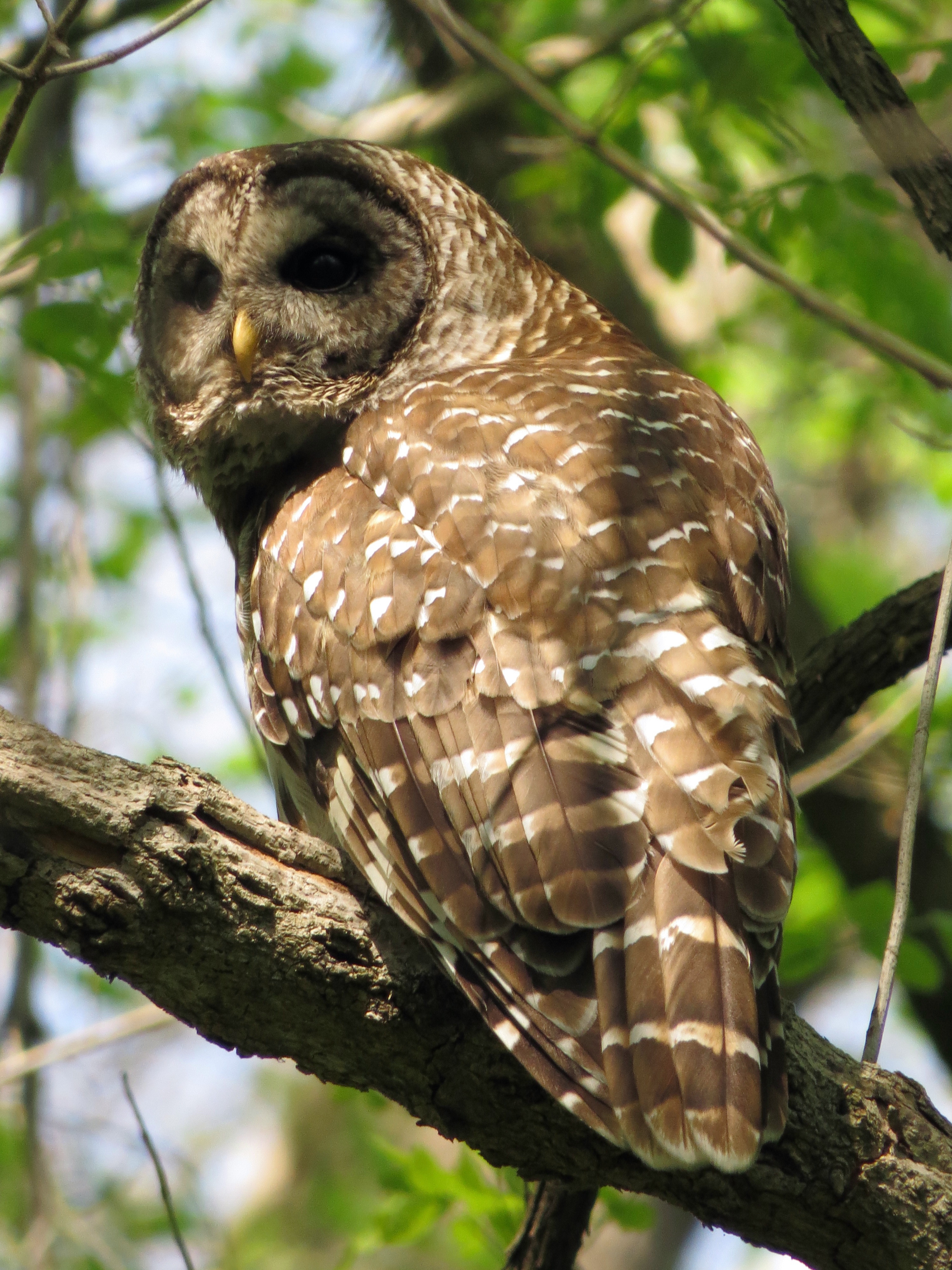
I was also fortunate to get a good look at a Barred Owl (Strix varia) this week. This was in Pony Pasture just before the big footbridge: 

Barred owl at Pony Pasture. A Barred owl can tell a male from a female - I, however, am unable.

Barred owl at Pony Pasture. A Barred owl can tell a male from a female – I, however, am unable.

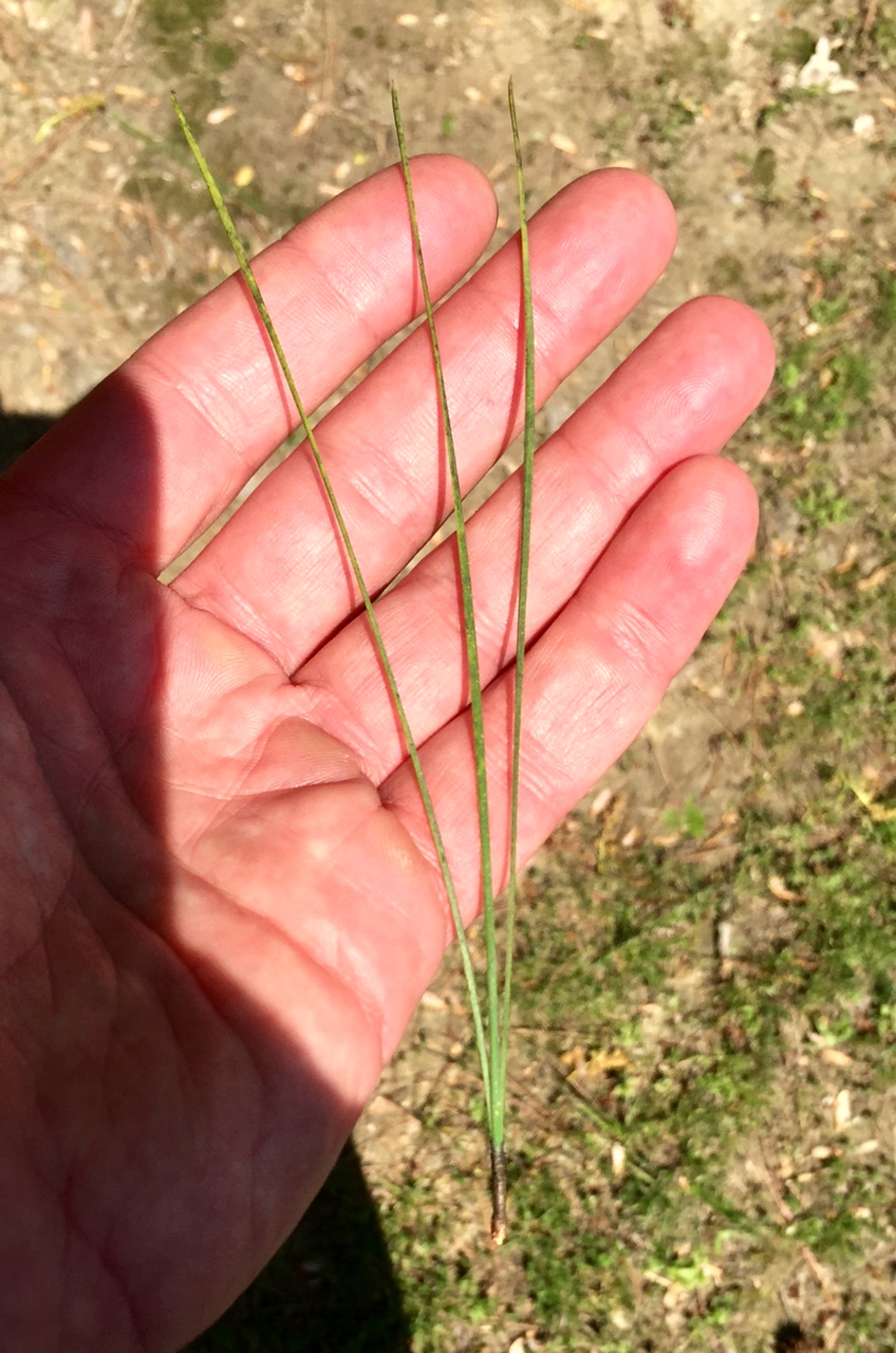
Assuming (perhaps incorrectly) you’re not already bored, let me get to the “Fascinating / boring” part of the post. “Every living thing” is fascinating – until it’s not. But this week, in pursuit of more knowledge for this project, I finished reading my second consecutive non-fiction book about trees in the mid-Atlantic region. Of all the trees I’m learning about, Loblolly pines (Pinus taeda) may get (or may have gotten) my vote as least fascinating. But if you live in the Richmond, VA area and you go anywhere today, you’ll probably see one. They’re generally tall and gangly and have zero branches anywhere near the ground. If they’re 8” or a foot thick, there’s not a branch closer than thirty feet above the ground. But look up – they’re thick with needles. Here’s a picture of loblolly pine needles – followed by an explanation of why I find it “Fascinating / boring”: 

The three needles of a Loblolly pine.

The three needles of a Loblolly pine.

When you look up at Loblolly pines and see all those needles, almost every single one of them is in a clump of three needles just like that. Not of one, not of two or four or five or six – they’re all in clumps of three. Wherever you see a Loblolly pine, wherever you go. I would have lived my entire life – rest assured – and never known that. It’s fascinating, because it seems so unlikely, but it doesn’t change anything, so it’s kind of boring. It’s also fascinating because it makes me wonder what else I don’t know.

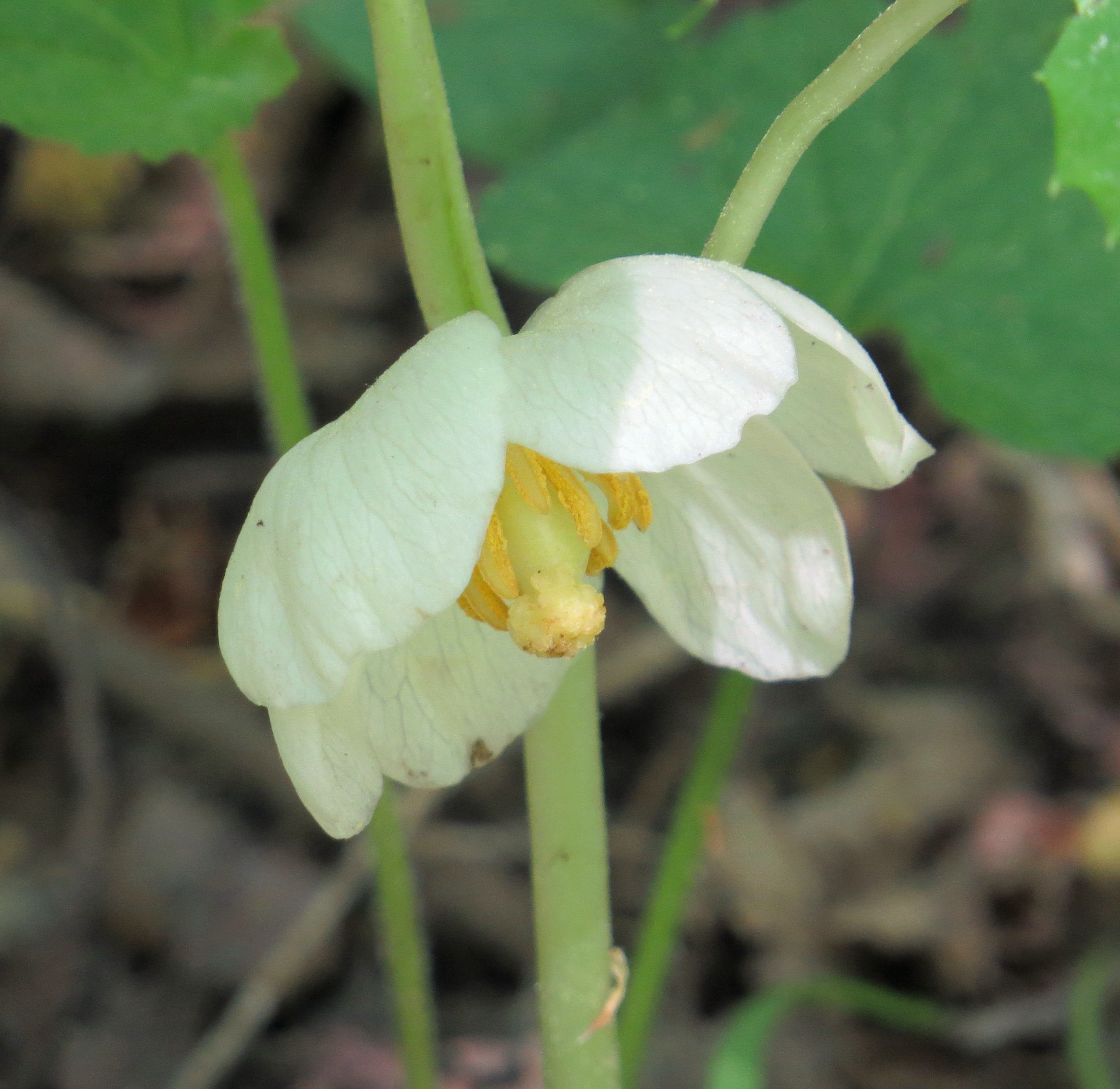
Two weeks ago (April 12, 2015, Feeling sluggish) I posted a picture of a May apple  (Podophyllum peltatum). Back then it was just the leaves. The flowers are out now. I’m sure somewhere there’s a picture of one in bright sun. But they grow in shade and this is the brightest I could find:

May apple flower

May apple flower

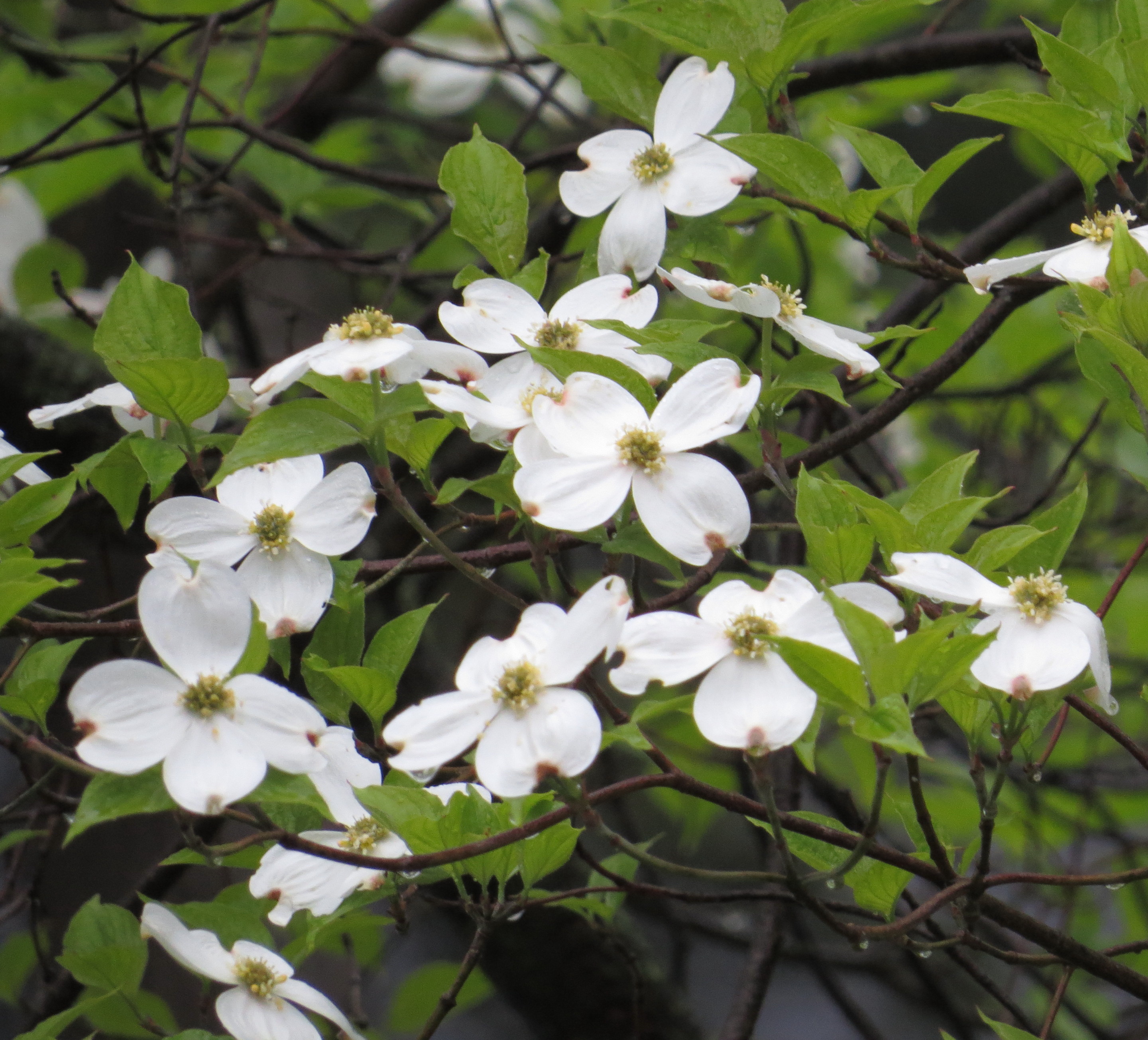
And speaking of flowers in April in central Virginia, the Flowering Dogwood (Cornus florida) is the state tree and flower of Virginia. My Dad loved dogwoods. Several grew naturally in the woods in front of our cabin when we were younger. Our Dad had us pulling honeysuckle and English Ivy out of those trees beginning around 1975. I just searched on the Google Ngram Viewer, which tracks the frequency of word use in the English language beginning 1800. The expression “invasive species” appears precisely zero times before 1995. In hindsight, I will always wonder how my Dad managed to “see around corners” into the future. I guess he just saw this nasty vine tearing down his beloved dogwoods and wanted it to go away. No magic involved. 

If you click on the dogwood link above, you’ll read that the dogwood “is common in the woods; perhaps more common in suburban yards.” This picture is not from the woods; it’s from a suburban yard (mine): 

Dogwood dripping cold April rain

Dogwood dripping cold April rain

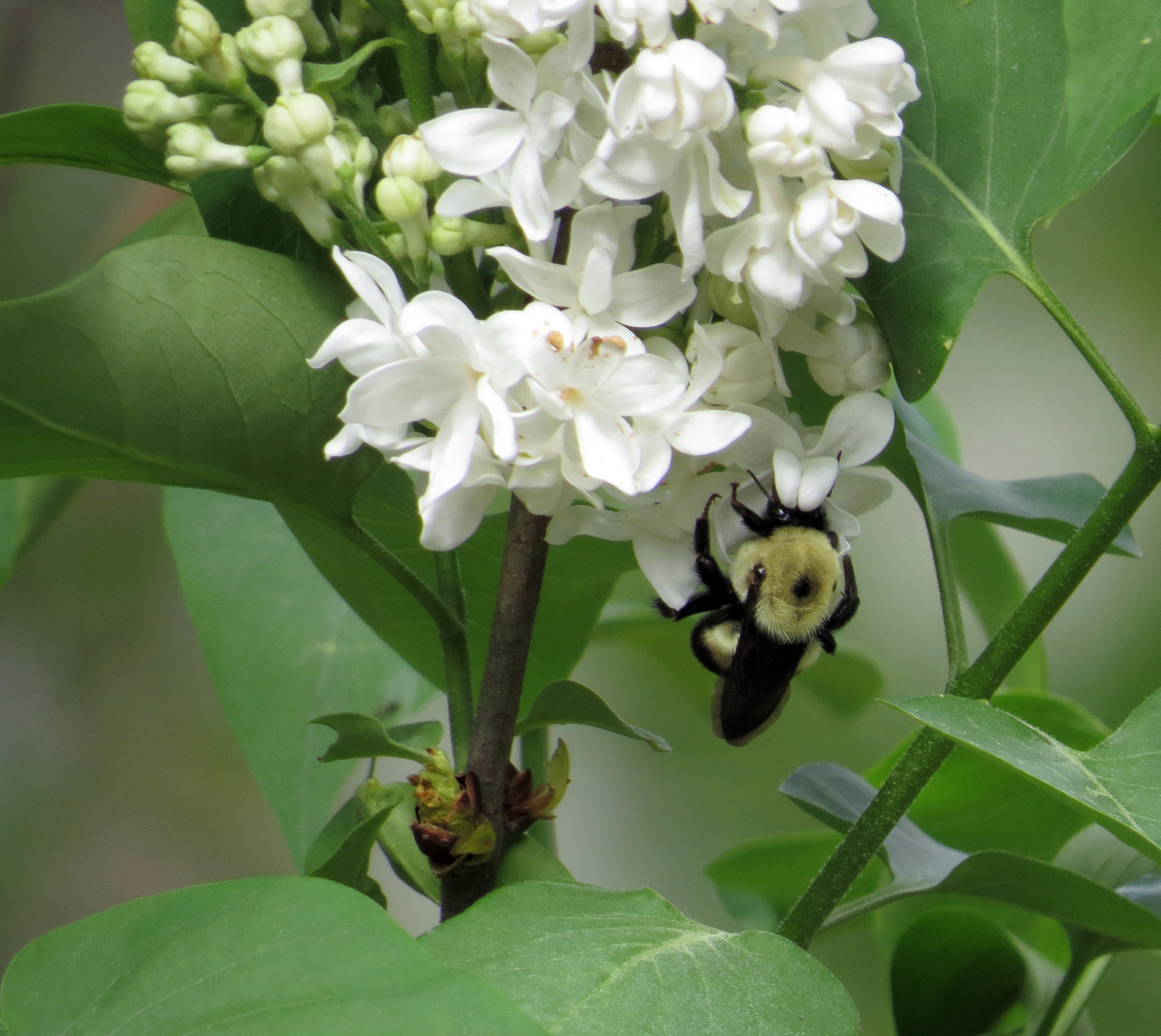
Another stunning (and fragrant) April flower is growing in my yard – this beautiful Lilac (Syringa vulgaris). This picture is actually from last week. This bee discovered it the same time I did:

If I was that bee I would never want to leave.

If I was that bee I would never want to leave.

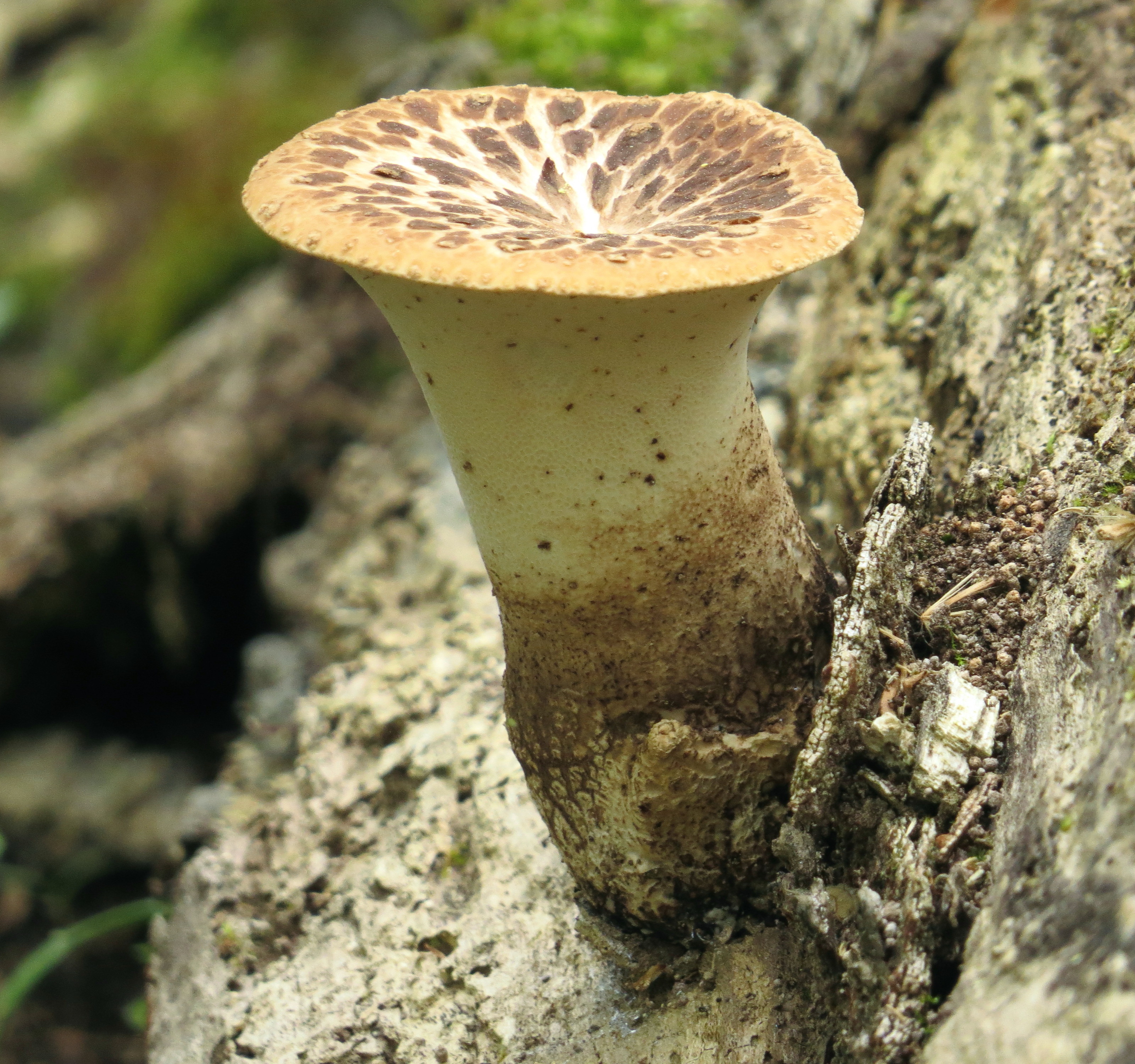
I didn’t put this picture in last week because I ran out of room. Also because I haven’t yet identified it. But this is a great looking mushroom:

Unidentified but terrific looking mushroom.

Unidentified but terrific looking mushroom.

My friend and mentor Betsy has suggested four plants for me to find at Pony Pasture (see All means all) and last week I had two of them. This week I found a third, this delicate and comely Star chickweed (Stellaria pubera).

Star chickweed (count the petals before you read any further)

Star chickweed (count the petals before you read any further – it’s Fascinating / boring)

This suggests another item that is (in my view) fascinating/boring. At first glance (if your first glance lasts longer than e.g. 0.001 second) you’ll notice that each flower has ten petals. That’s what I noticed, anyway. Then I read about the plant. And the truth is, those flowers each have not ten but five petals – they’re “V” shaped or “U” shaped. See how (okay, maybe this is just me) that’s fascinating and boring? As in, you could go for your whole life and never know that, and it wouldn’t matter at all. So it’s sort of boring. But now we know something we would never have known. And every time we see that, we’ll know something we didn’t know. To me that is undeniably fascinating. 

Anyway. The Spring migration is still on. I have not yet seen any Cliff Swallows (Petrochelidon pyrrhonota) underneath the bridge near Brown’s Island. I saw them last year for the first time during May so hopefully they’re still on their way north from their winter roosts in South America from Venezuela to Argentina. Purple Martins (Progne subis) have arrived at Bryan Park. I haven’t gotten any pictures I’m proud of but here’s one that’s adequate. There are two females (lighter) and one male (dark); he’s slightly in the background and slightly ruffled. I talked with the guy who built the Purple Martin house. This is at Bryan Park – filled with raptors. He said last year a Cooper’s Hawk (Accipiter cooperii) had been perching there and taking babies out. Red in tooth and fang, right? Yikes. So this year he put in a double wall of wire. The Martins flit in and out while you watch: 

Three Purple Martins perching on a house at Bryan Park.

Three Purple Martins perching on a house at Bryan Park.

I hope you’ve enjoyed this week – and I hope you’ll come back next week! All best,

Jay

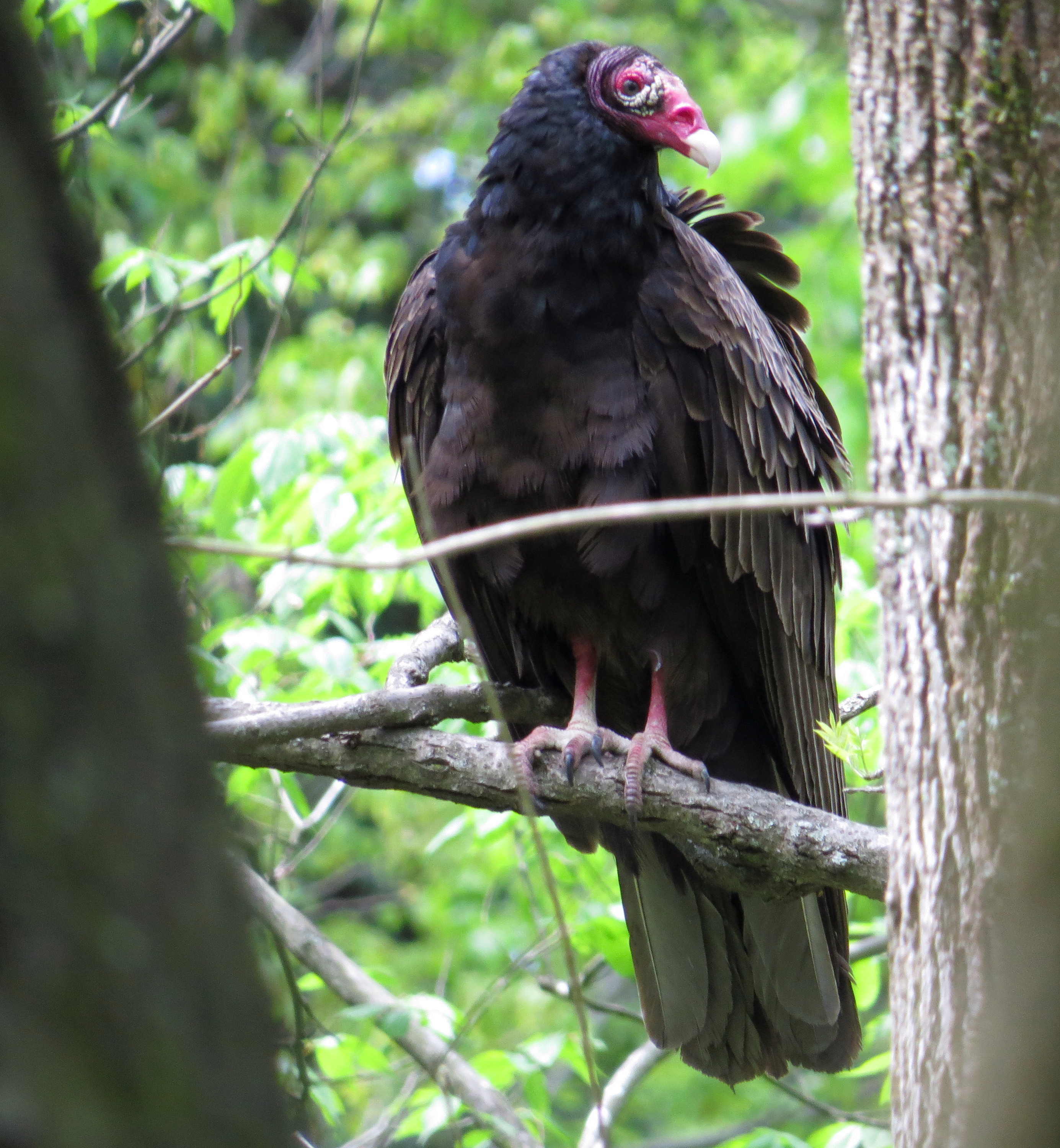
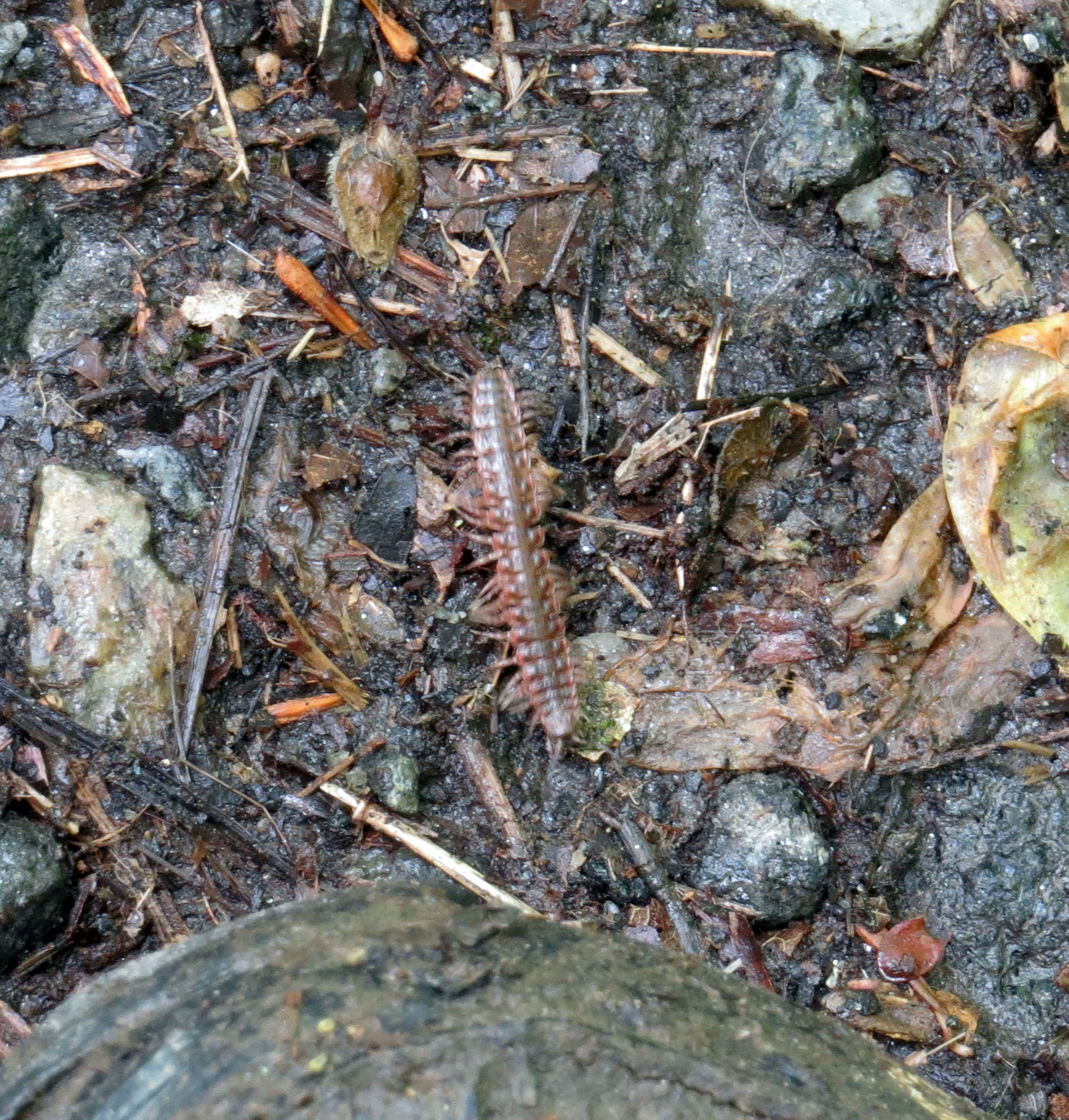
PS – This just in – I wrote all of the above last night and early this morning when it was raining. It cleared up around noon so Evelyn and Mackey and Turner and I took a muddy but pollen-free hike at Pony Pasture. We were rewarded (not everyone would agree) with having a flock of seven or eight Turkey vultures (Cathartes aura) land in the trees while we were walking through the Wetlands. None of the images were brilliant but this one is ok. Plus a few minutes later Evelyn noticed a millipede. Or a centipede. More Pony Pasture Fauna! I haven’t figured it out yet but I posted it on BugGuide.net a few minutes ago. I’ll post it on “Pony Pasture Fauna” when they let me know. First the vulture, then the insect.

Turkey vulture in the forest on a Sunday afternoon.

Turkey vulture in the forest on a Sunday afternoon.

Centipede or millipede Ev pointed out this morning. That's the toe of my shoe in the bottom of the frame.

Centipede or millipede Ev pointed out this morning. That’s the toe of my shoe in the bottom of the frame.

Posted in Birds, Flowers, Fun, Insects, James River, People, Pony Pasture, Rivers | Tagged , , , , , , , , , , | 3 Comments

All means all

19 April, 2015               All means all

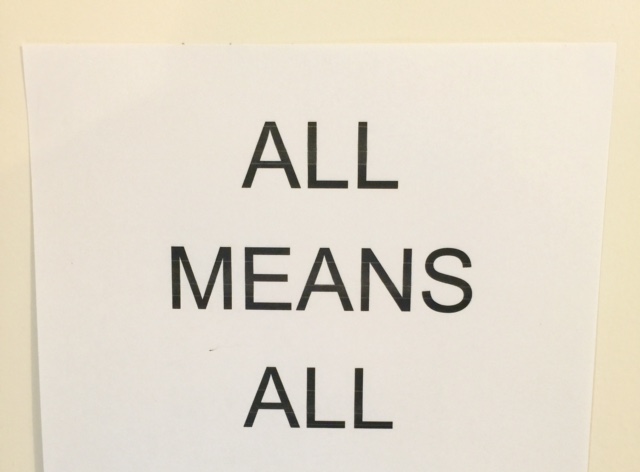
I used to have a boss who had this sign hanging on her office wall: 

ALL MEANS ALL

ALL MEANS ALL

And when you start a nature photography and cataloging project called “Every living thing,” that means every living thing. When you start that project in December, as I did, there are not a lot of living things in evidence. Now that it’s April there are living things everywhere! Isn’t it great? And it’s not even May yet! 

Allow me to begin with a picture of a Prothonotary warbler (Protonotaria citrea ) I took at Pony Pasture on Thursday at noon. This image will brighten up anything:

Prothonotary warbler at Pony Pasture

Prothonotary warbler at Pony Pasture

I have a subscription online bird guide called “Birds of North America” (BNA) also by the Cornell Lab of Ornithology. It goes into a bit more depth than All About Birds. BNA goes on to say about the Prothonotary warbler that it “resembles the bright yellow robes of papal clerks (prothonotaries) in the Roman Catholic church.” In the same space it notes that it “also holds a place in recent U.S. history by being partly responsible for the conviction of alleged spy Alger Hiss and the corresponding political rise of Richard Nixon.

Although Hiss repeatedly denied ever knowing Whittaker Chambers, the ex- communist who accused him of espionage, Chambers had testified that the men were friends. To verify this, Chambers admitted knowledge about many personal issues, including that Hiss was an amateur ornithologist who had been excited at seeing a Prothonotary Warbler along the Potomac River. When asked later, Hiss independently admitted that he had seen the warbler along the river. As a member of the House Un-American Activities Committee investigating the Hiss allegations, freshman congressman Richard Nixon played a prominent role in proving that the two men knew each other and that Hiss had perjured himself.” You just never know what you’re going to come up with when you start watching birds.

I’ve been reading a lot about trees since I began my Every living thing project. This afternoon – after Evelyn and the dogs and I got home from Pony Pasture – I finished a book called Seeing Trees: Discover the Extraordinary Secrets of Everyday Trees by Nancy Ross Hugo and Robert Llewellyn. In the Afterword Ms. Hugo quotes a woman named Mary Newcomb saying “It seems to me that the pleasure is in the finding out, not in being told the facts.” Ms. Hugo later goes on to write that “what gets me up in the morning is not the new information now catalogued in my brain but the questions for which I still don’t have answers and phenomena I still haven’t seen.” The warbler made me think of that. I walked into the woods on Thursday just like I always do. Took some pictures, came home, did a bit of superficial research. As a result of that – how could you make this up? – I now know about papal clerks, alleged spies, and the rise of Richard Nixon. It is unimaginable that this will ever become not-fascinating.

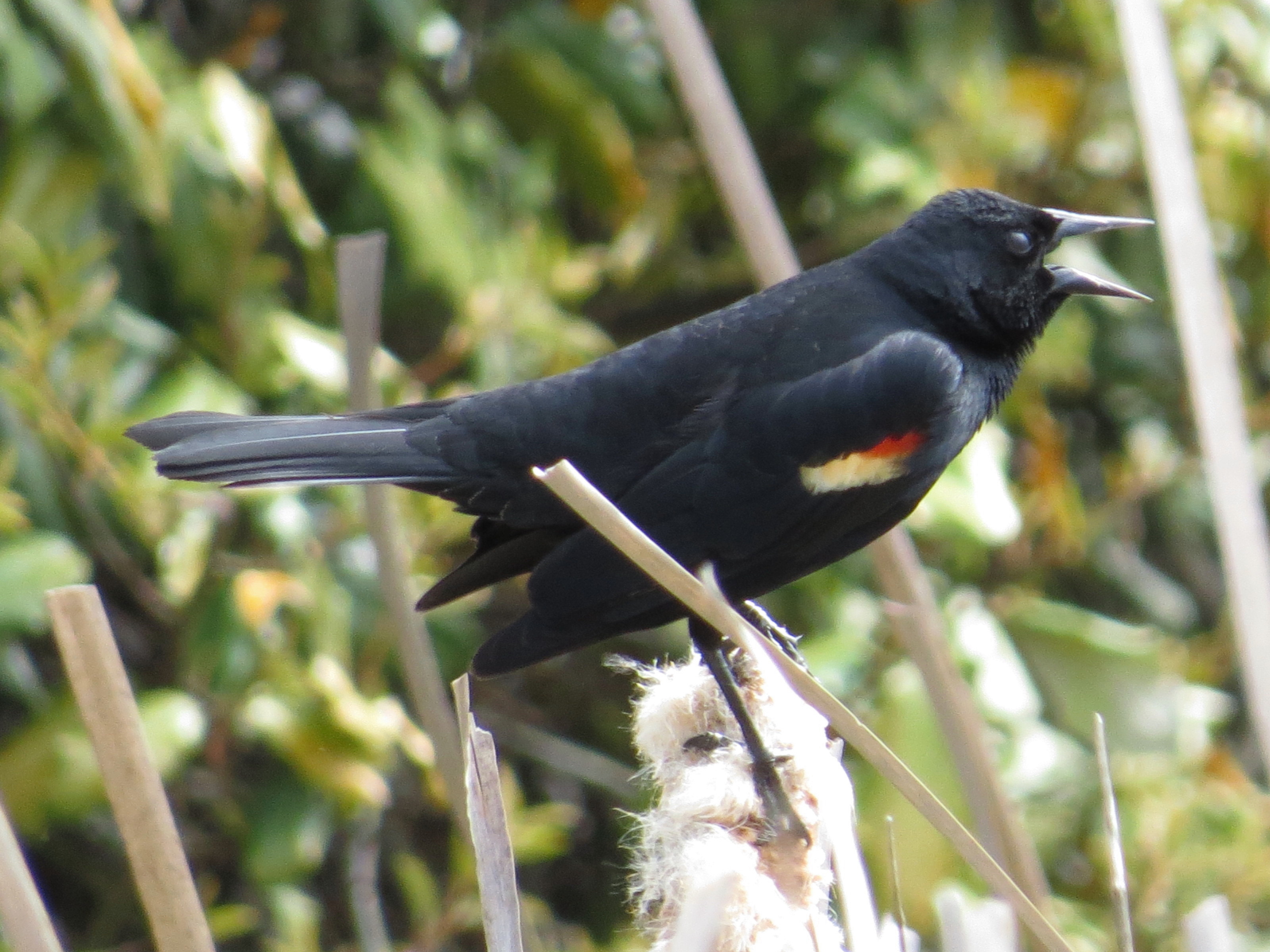
Here is a bird I photographed this week not at Pony Pasture – but I will. I photographed this Red-winged blackbird (Agelaius phoeniceus ) in front of the Tuckahoe YMCA off of Patterson Avenue:

Red-winged blackbird at the YMCA!

Red-winged blackbird at the YMCA!

Please pardon another brief digression. The Afterword of Seeing Trees is worth the price of the book by itself. Ms. Hugo talks with a birder named Linda Cole about missing trees that are obvious. Then once you see them, you see them everywhere. It is amazing how often that happens birding. Ms. Cole says ““Once you know it, it’s got neon on it.” With birds, they’re invisible, then suddenly they’re not. It’s fun.

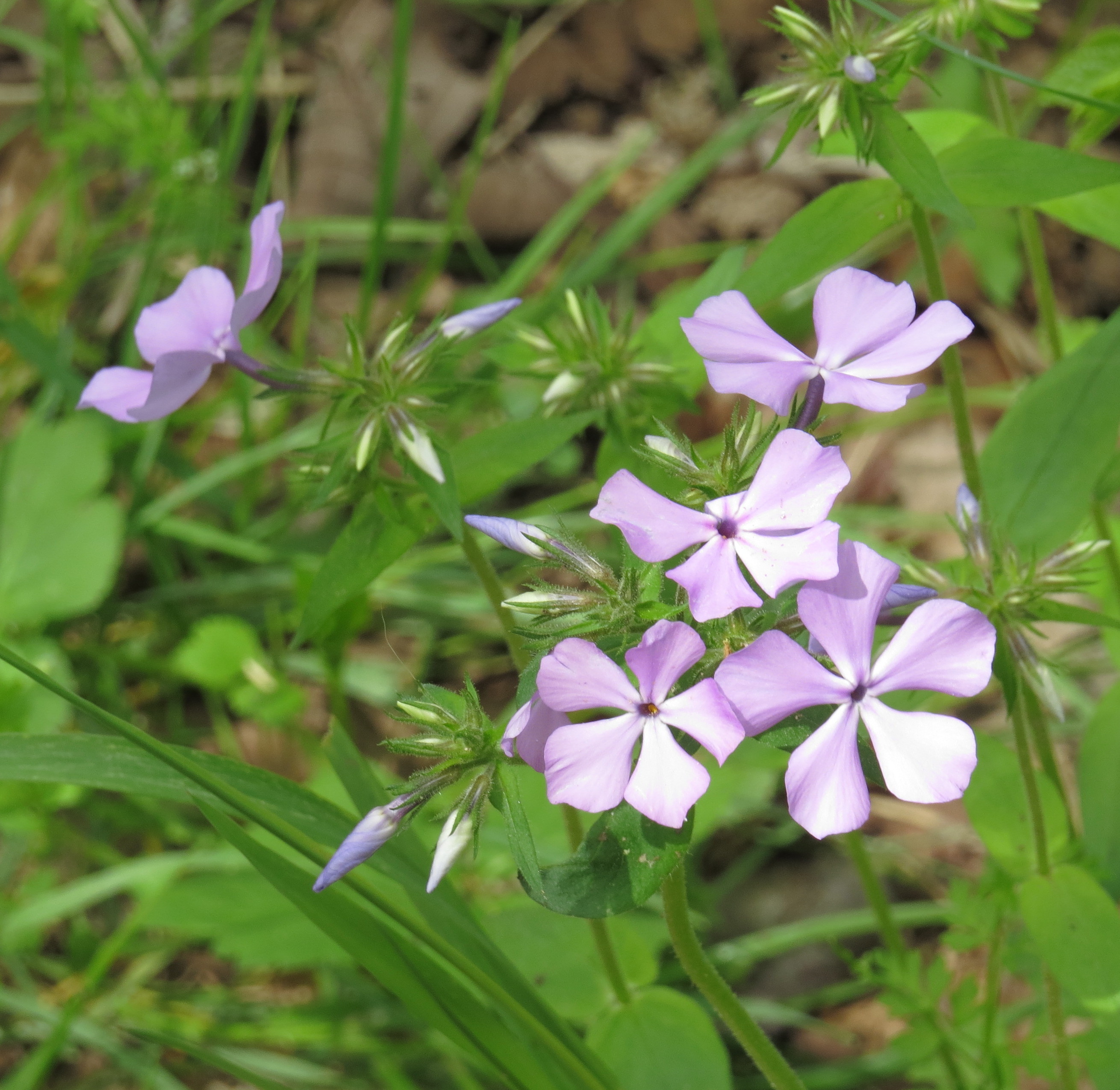
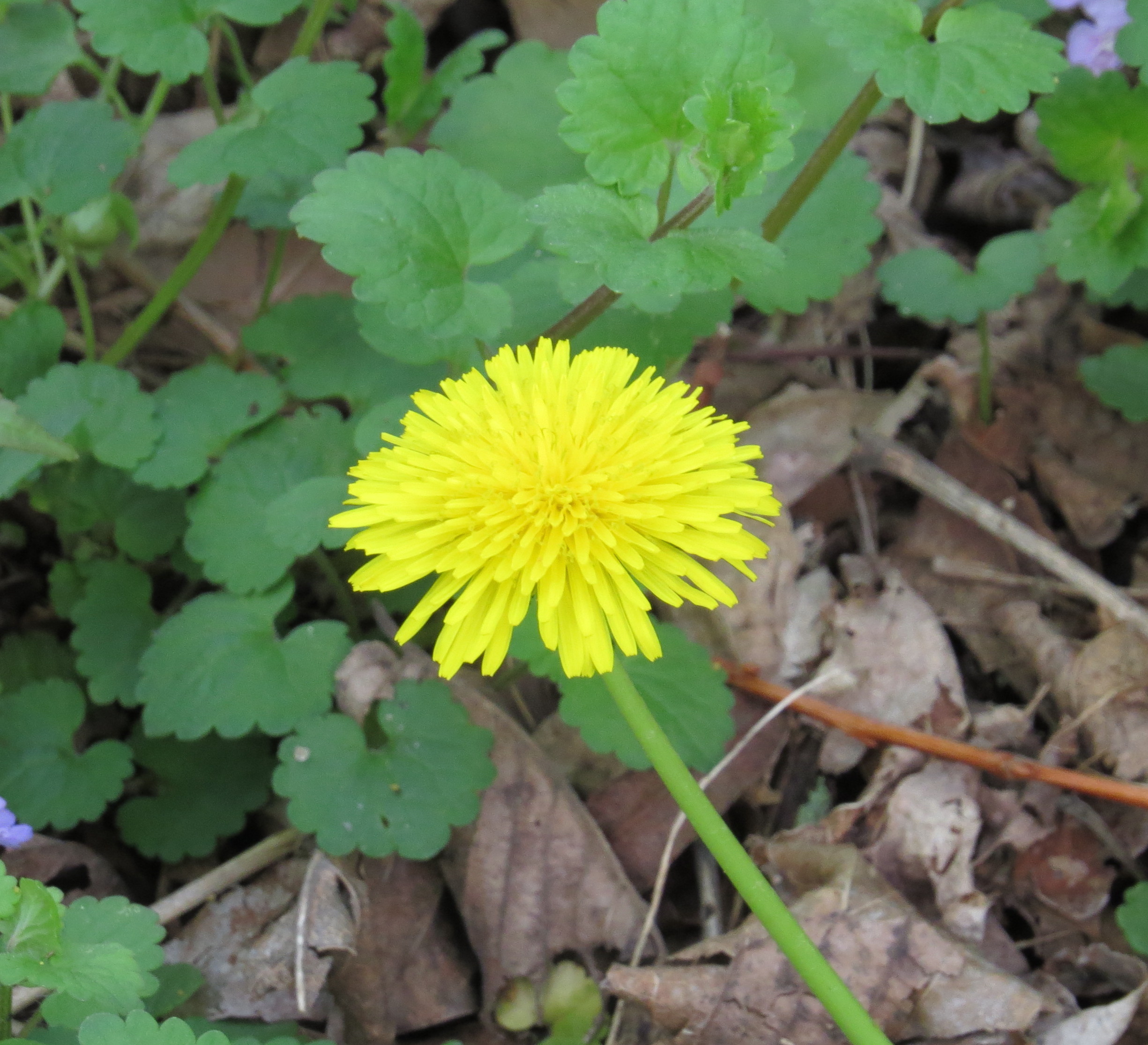
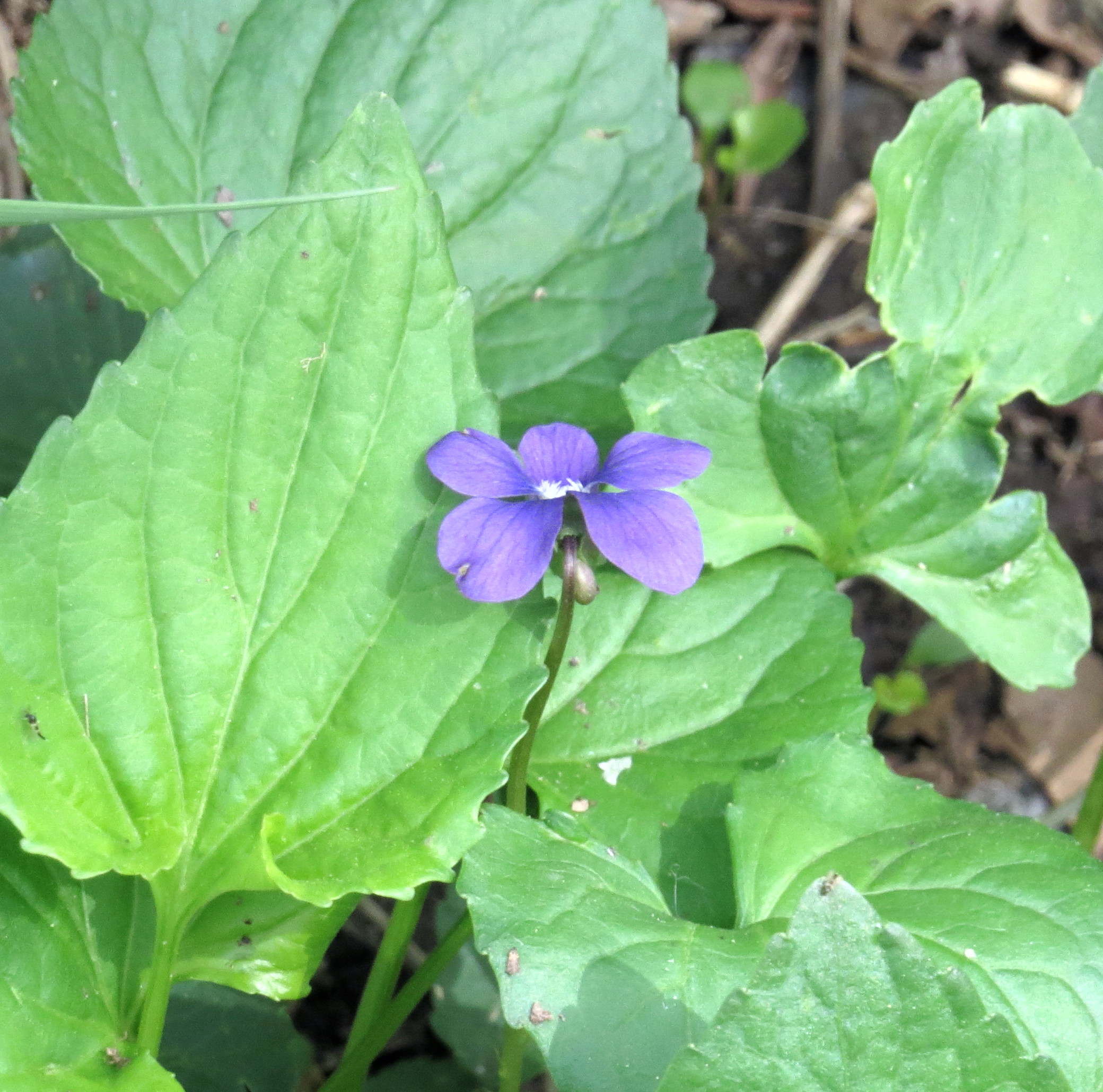
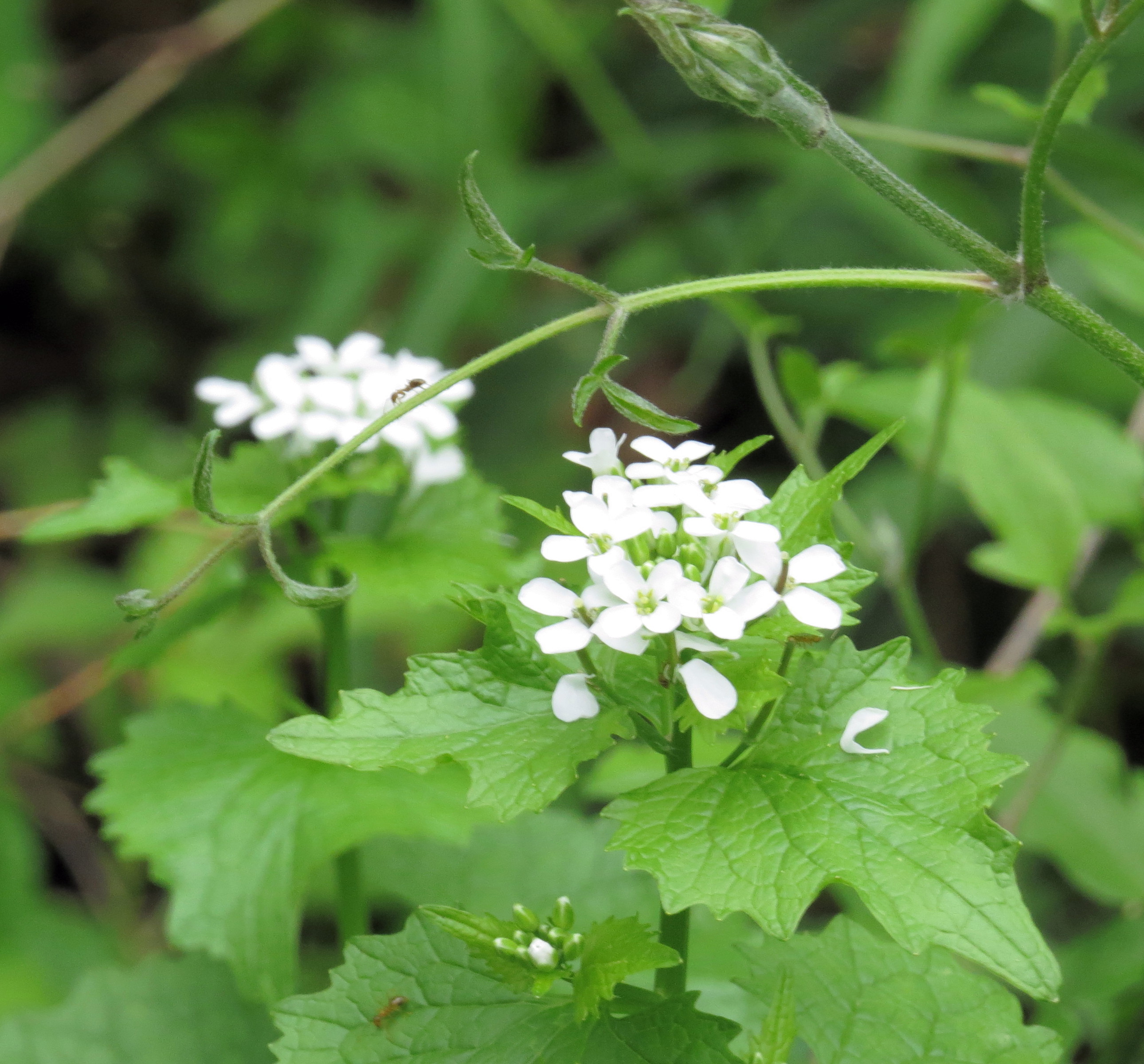
But – this post is called All means all and that’s because I’m cataloging the “boring” stuff too – although boredom is in the eye of the beholder. This week I’ve photographed dandelions and poison ivy and violets along with several other common plants. Because All means all. My friend (the James River Park System’s friend) Betsy recommended I be on the lookout for Cutleaf toothwort, Star chickweed, Garlic mustard (Alliaria petiolata) (invasive) and Woodland phlox (Phlox divaricata). I “found” the toothwort but I “lost” it before I could get a picture (that means I forgot where it was). I’ll get it when I stumble across it again. But I have gotten the Garlic mustard and the Woodland phlox. 

Garlic mustard

Garlic mustard

Woodland phlox

Woodland phlox

All this time you thought they were only in your front yard.

All this time you thought they were only in your front yard.

Violets - no shortage on the banks of our lovely river!

Violets – no shortage on the banks of our lovely river!

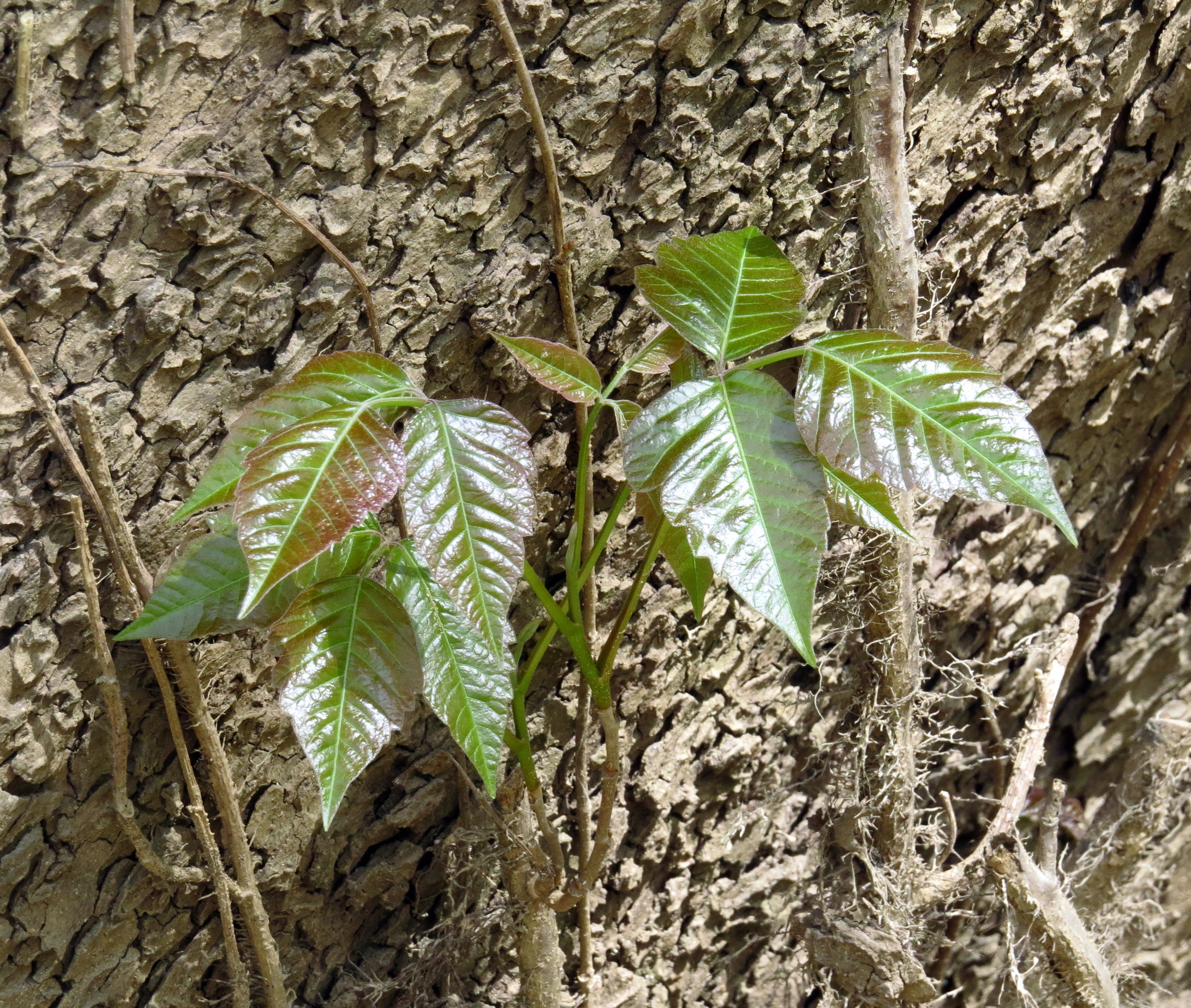
Here is another plant that always thrives at Pony Pasture. Not many people have nice things to say about poison ivy. Lots of birds enjoy it. Perhaps we could convert it to bio fuel: 

Poison ivy climbing a tree

Poison ivy climbing a tree. Poison ivy always strikes me as disconcertingly eager. Some plants look shy. Poison ivy is not one of them. 

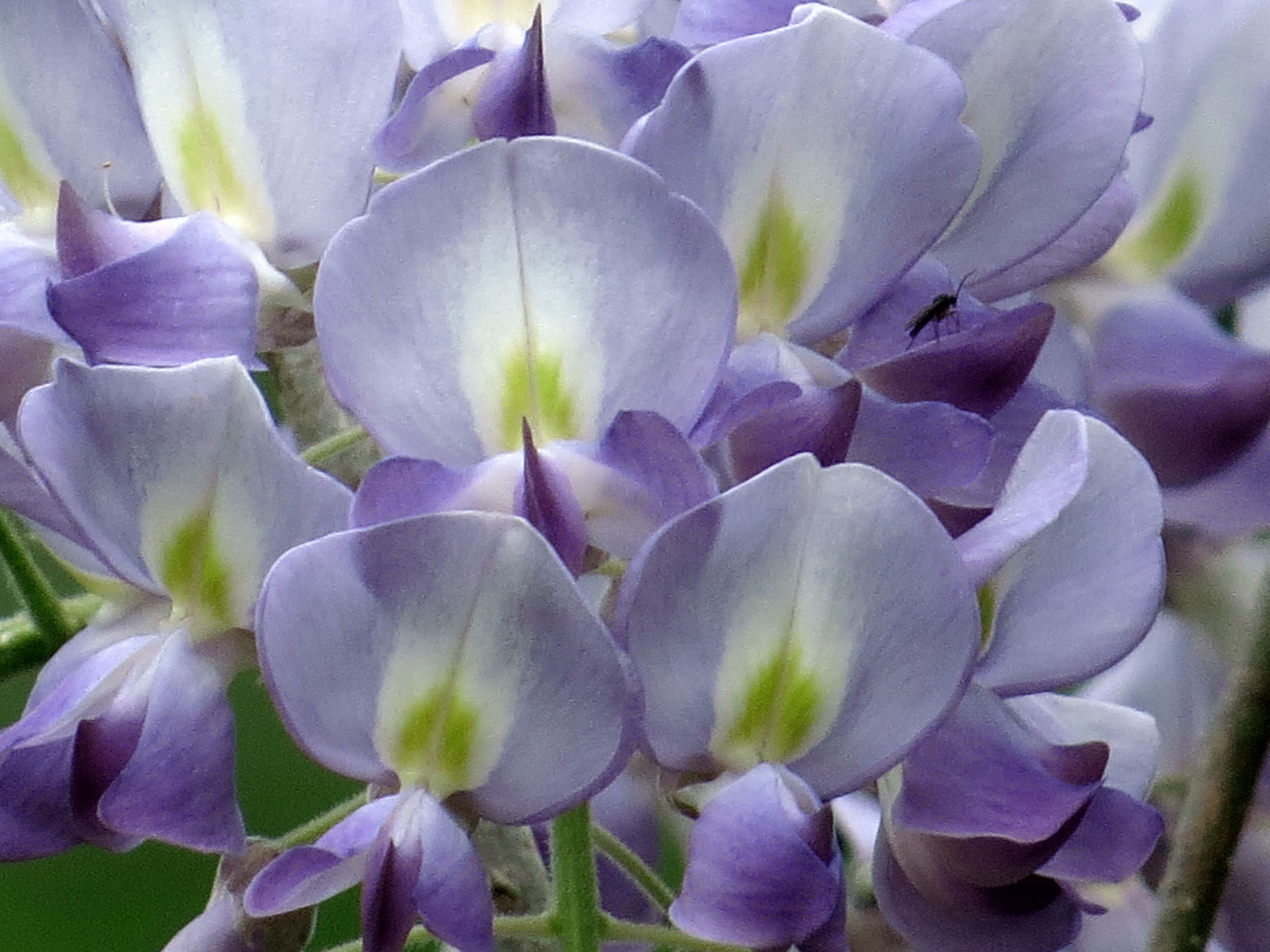
I’ve taken a thousand hikes at Pony Pasture and today, Sunday, April 19, 2015 was the first time I ever knew there was wisteria in the park. Crazy. It is so gorgeous and smells so heavenly. This just in – thanks for the heads up Betsy: this is not Wisteria frutescens, a native Wisteria. This is an invasive that doesn’t belong at Pony Pasture. It’s either Chinese wisteria (Wisteria sinensis) or Japanese wisteria (Wisteria floribunda). Whichever it is, it is on the list to be eradicated from Pony Pasture. After Betsy tipped me off to correct my misidentification I did more research. I found an article from a January, 2011 e-publication called the James River News Hub. The article was called HandsOn volunteers helping to restore Pony Pasture’s native plants. In that article I found this quote from the inimitable Ralph White: “People’s hedges have washed down here and settled during annual floods,” said James River Park manager Ralph White. “Density of invasive species has a negative impact on native species. Sunlight cannot reach the native plants, the unwanted plants catch all the light.” That guy is a born teacher:   

Wisteria

Wisteria

That’s not a great picture for identifying wisteria – it hangs in bunches like grapes. But sometimes hack photographers like me all in love with their pictures too much and just decide to put them up. What can I say. 

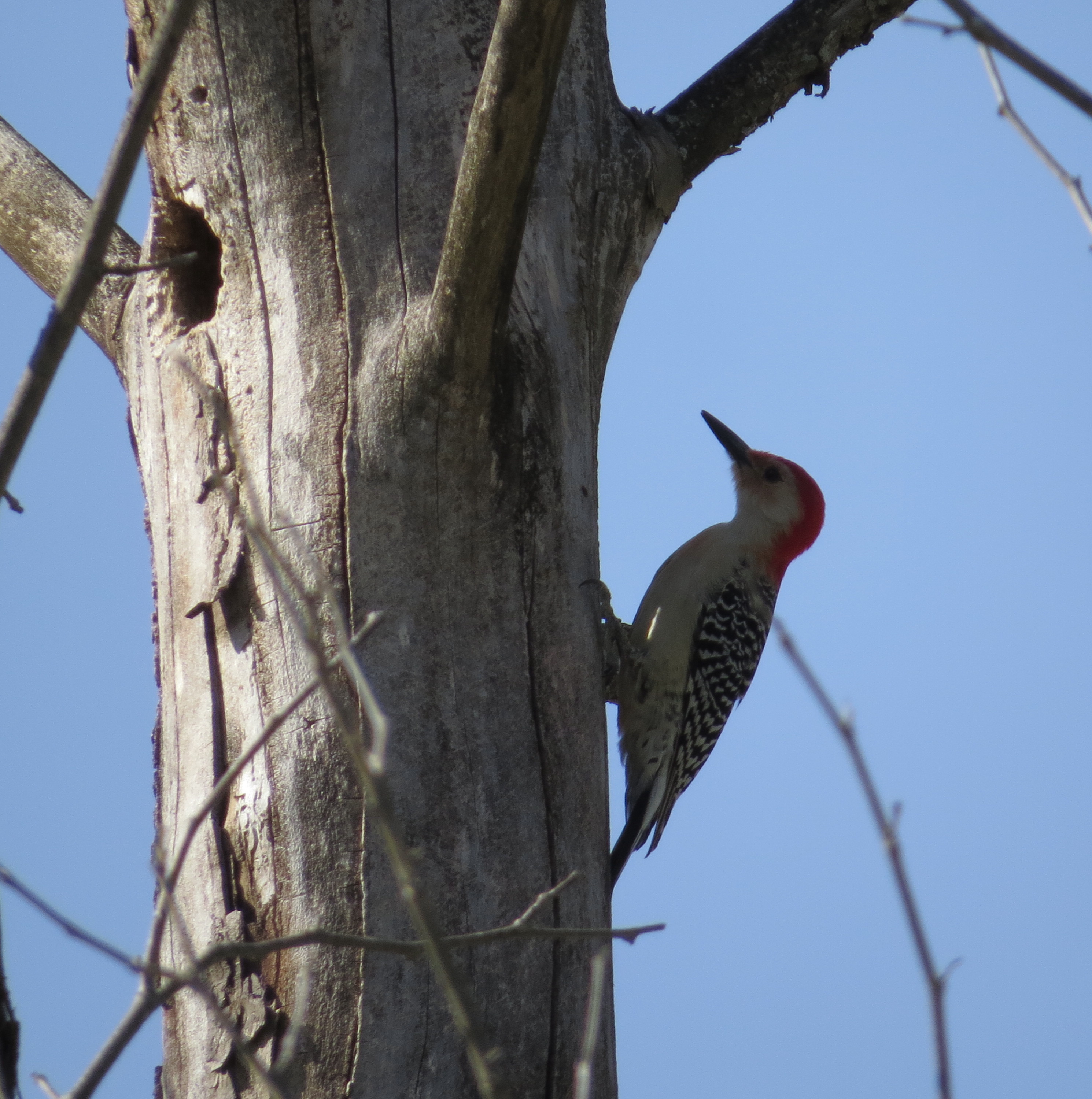
And just because I’ve overloaded on plants a little bit this post, here’s one more bird. It’s a subpar picture but I like Red-bellied woodpeckers (Melanerpes carolinus) a lot. And I’ve been unable to get any high quality images so far this season. This is an adult male:

Adult male Red-bellied woodpecker

Adult male Red-bellied woodpecker

Maybe I’ll get a better one next week! I hope your week is a great one! All best,

Jay 

PS I am inexpert at identification – of plants and of animals. I do my best to put up correct  information but my accuracy rate is considerably <100%. I encourage any corrections either in the blog comment section or by email if you have my address. If I learn I have posted incorrect data I will revise it immediately. Thanks in advance for the help! 

Posted in Birds, Flowers, James River, Pony Pasture, Rivers | Tagged , , , , , , , | 7 Comments

Feeling sluggish

12 April, 2015 Feeling sluggish

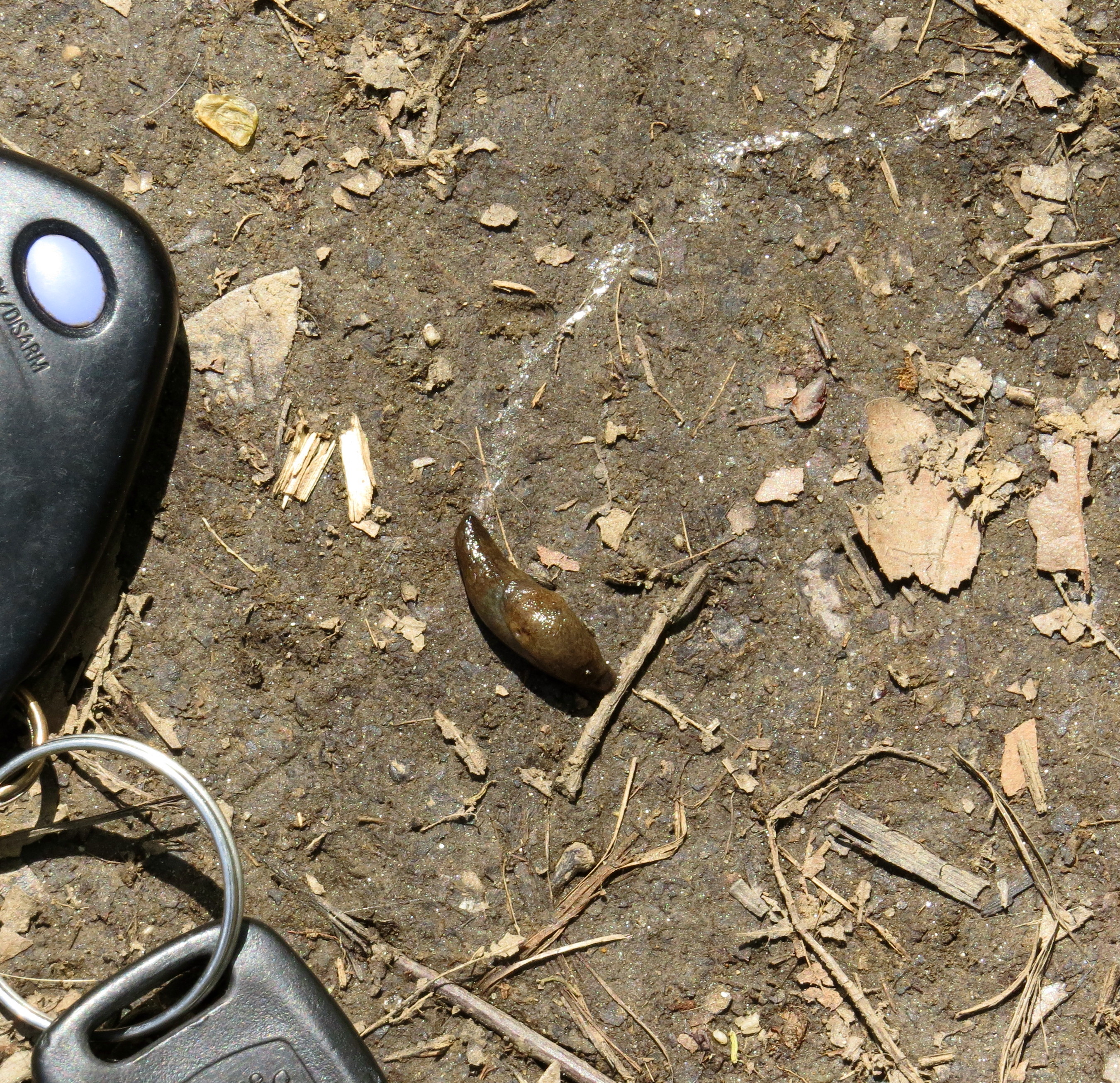
When I began my Every living thing section in December of last year, I documented many of the most beautiful animals and plants in Pony Pasture. This morning I got my first… slug:

Terrestrial gastropod mollusc. AKA slug.

Terrestrial gastropod mollusc. AKA slug.

As of today, all I can tell you is that’s a slug. Embarrassingly, that’s all I can tell you. It’s a living thing. It’s an animal, not a plant. I first thought they were insects; they’re not. They’re terrestrial gastropod molluscs. Sycamore trees and Whitetail deer, the signature flora and fauna of Pony Pasture, you can’t miss. When you get down to slugs, it’s getting a little challenging to identify. I’ll get to it though. 

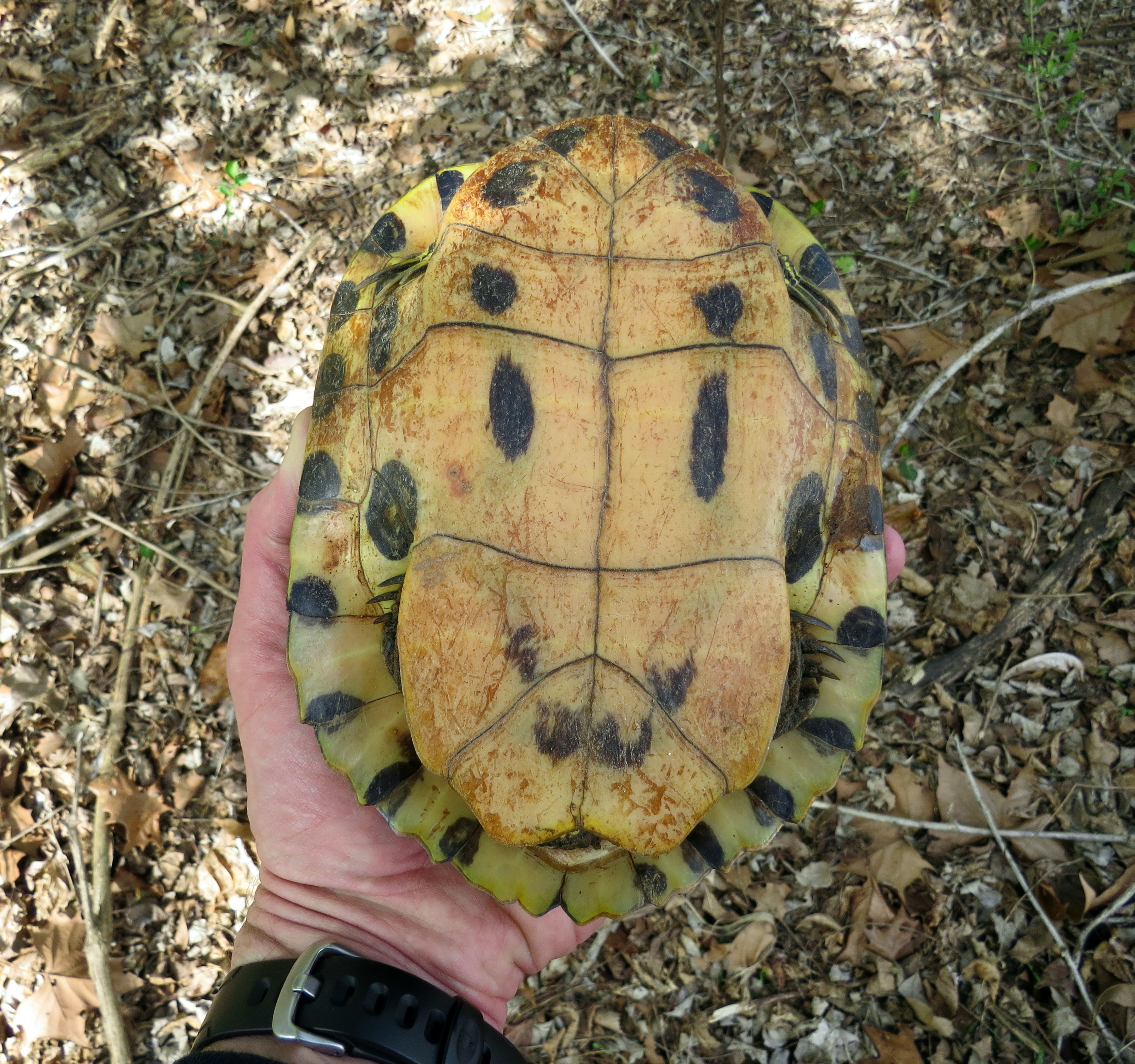
Here’s a member of Pony Pasture Fauna that is easier to identify. And it’s a first for my list and blog page! Vocabulary and a warning first. The vocabulary word is “ophidophobia,” or fear of snakes, “possibly the most common subcategory of herpetophobia, or fear of reptiles.” To give ophidophobes a moment to avert their eyes, I’ll first post a less anxiety producing reptile photograph – and another first for this blog. What the heck, a new (for some) vocabulary word too – the bottom of a turtle’s shell is called a plastron and I got a picture of one on Monday!

Plastron. Remarkable.

Plastron. Remarkable.

We’re more used to seeing the top, or carapace. This is what the rest of the as-yet-unidentified turtle looked like. I believe it’s a male, based on his long claws. My friend Kim was surprised I was able to catch him. We surmised he must have been moving slow due to the still cool weather. Pony Pasture is on the south bank of the James River. The south bank stays cooler longer than the north bank. In Chinese philosophy, when you learn about “yin and yang,” the “yin” is represented by the south bank of rivers because it gets less sunlight. Not that that has anything to do with turtles. But the south bank gets less sun so the turtles warm up slower – so you can catch them! Here’s the rest of the turtle:

Male turtle (long claws) slowly warming up on the south bank of the river.

Male turtle (long claws) slowly warming up on the south bank of the river. His carapace appears to be resting on his forehead. That’s of course just an illusion. 


When I was looking for that definition I found an old favorite poem of my Dad’s, which I will include here for all of our edification (another favorite word of Dad’s):

The turtle lives ‘twixt plated decks

Which practically conceal its sex

I think it clever of the turtle

In such a fix to be so fertile.

-Ogden Nash

Dad liked to quote Ogden Nash. More on that in a future blog post.

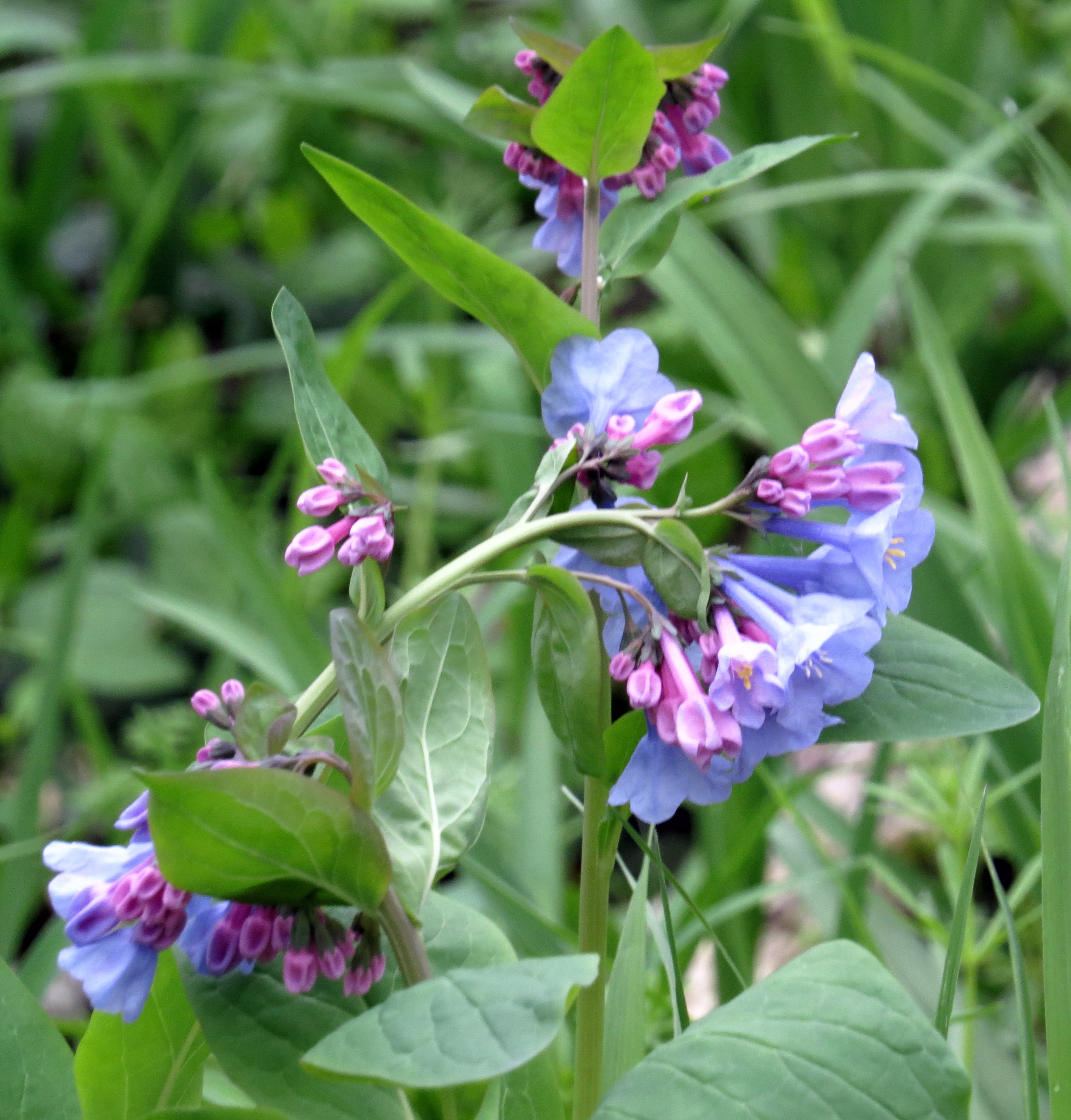
Virginia bluebells (Mertensia virginica) are blooming: 

Virginia bluebells

Virginia bluebells

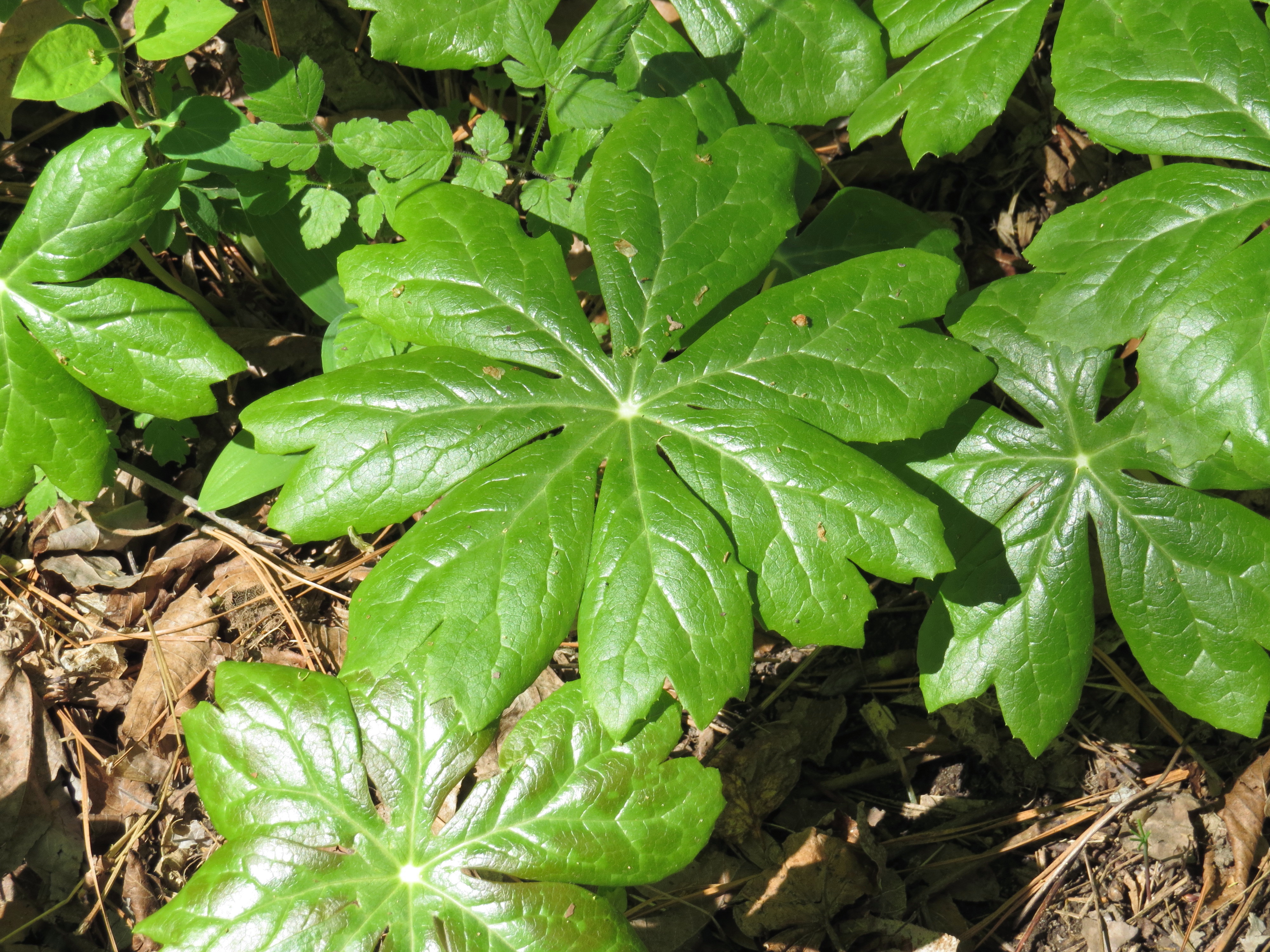
May apple plants are out; the “apples” themselves are not visible yet. Soon, though:

May apple

May apple

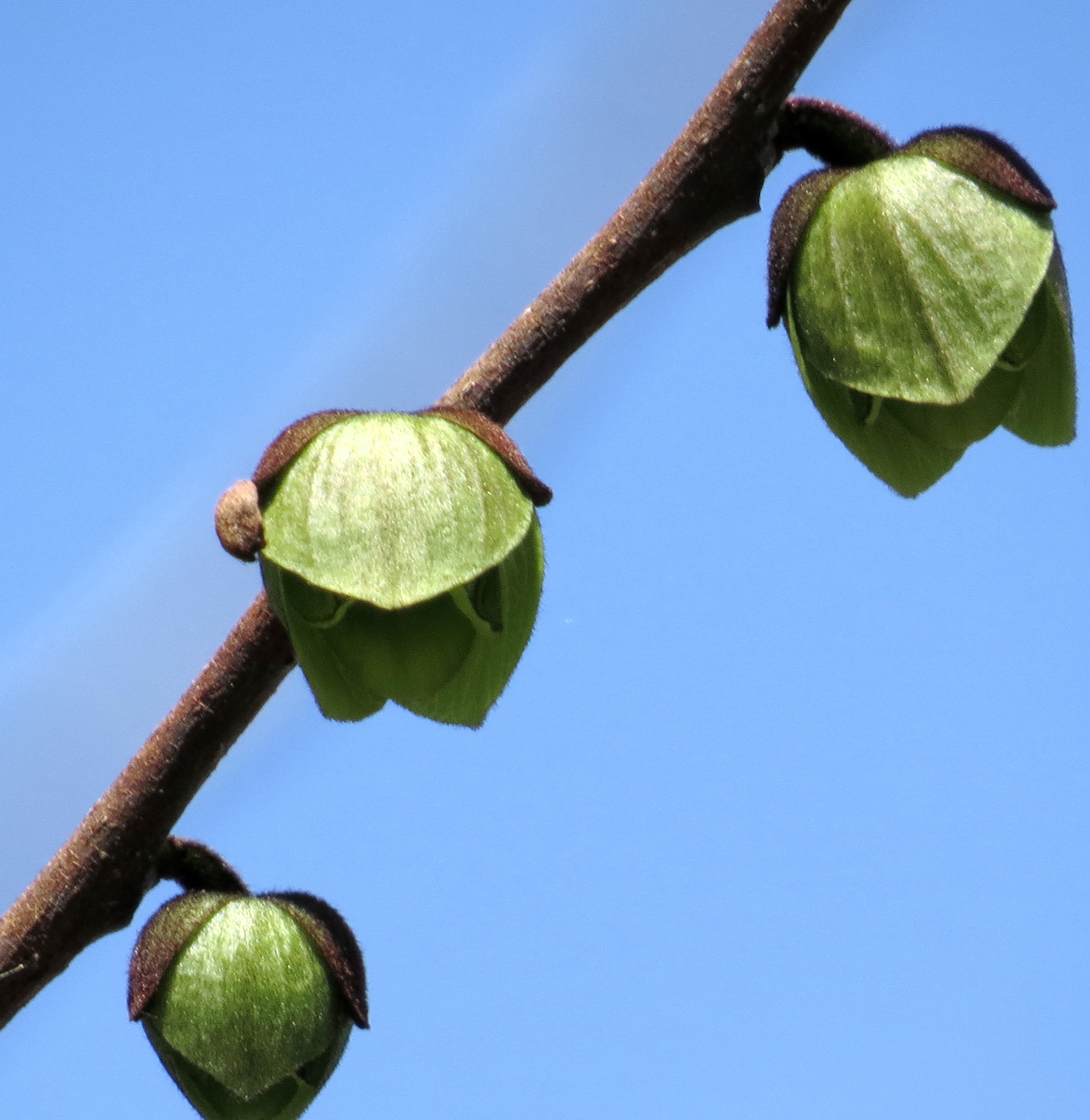
Another perennial favorite of mine is beginning to appear, pawpaws (asimina triloba). As summer wears on, they will leaf out and dominate the understory at Pony Pasture. Currently they’re just brown buds:

Pawpaw buds

Pawpaw buds

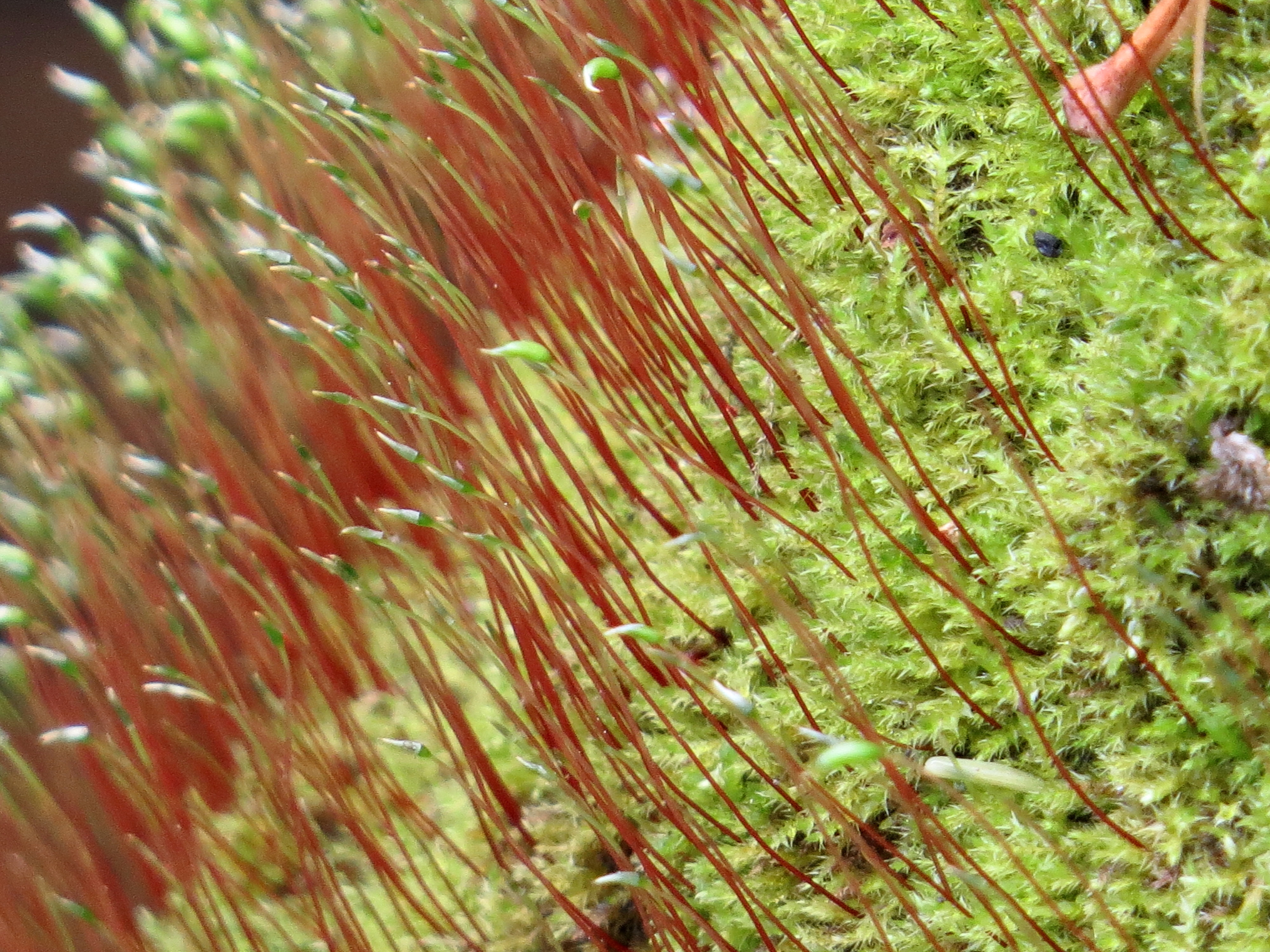
I’m embarrassed again (though not so embarrassed I won’t post it) to put up yet another picture of an unidentified plant. A moss, this time. They’re budding and this is such a pretty picture: 

That's moss!

That’s moss!

Isn’t it remarkable that’s moss? I’m finding so many examples of things that look so different in a photograph as to become nearly unrecognizable. It’s fun. 

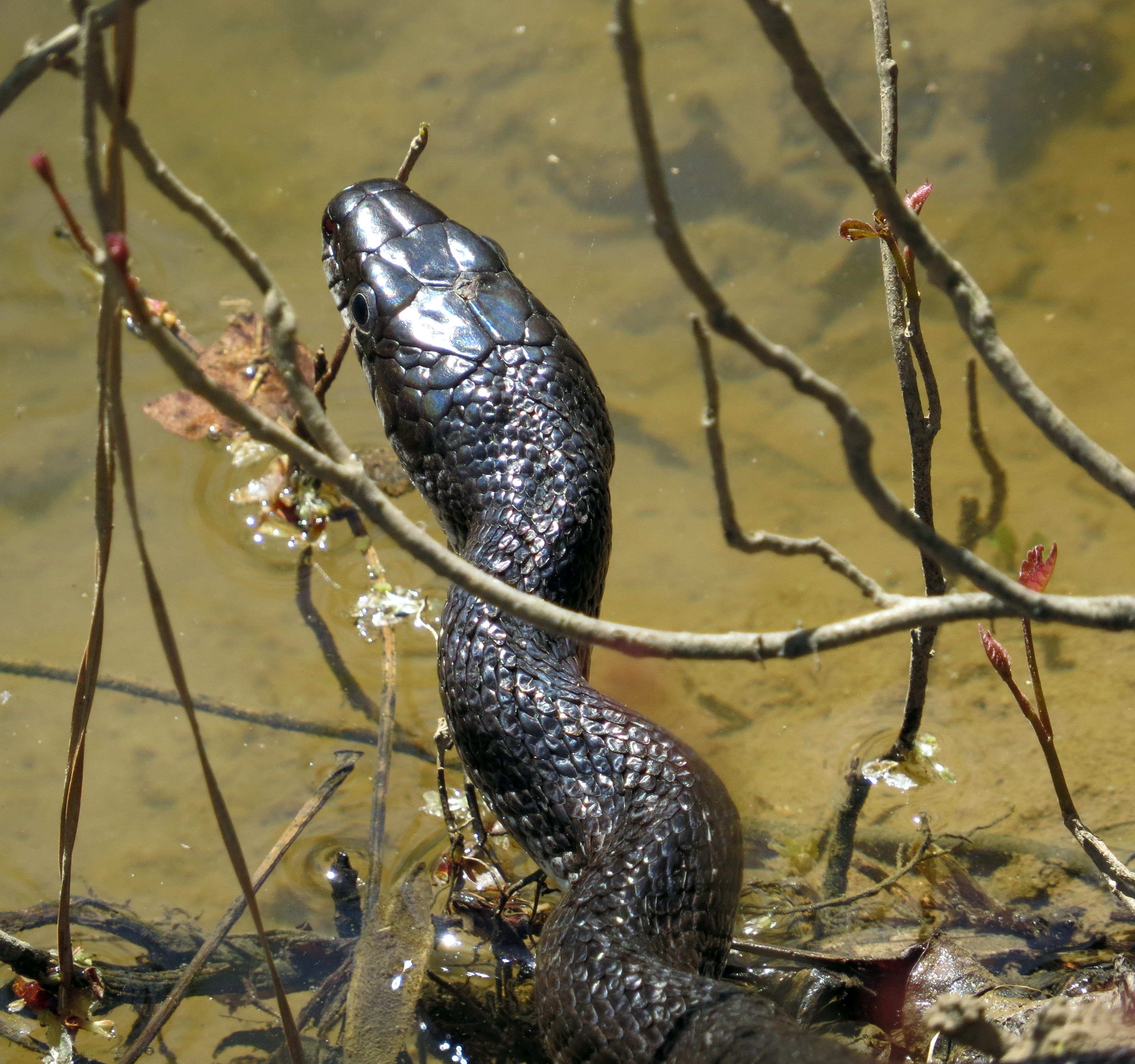
Anyway, snakeophobes, a.k.a. ophidophobes, I warned you, this is where the rubber meets the road. In a manner of speaking. This is a snake so harmless it’s actually beneficial. That’s true of most snakes. But this is (I believe) a Northern Black Racer. But I have not yet received confirmation so Kim or Betsy or Katie or whoever, put a comment on here or shoot me a note and I’ll correct it. Hope you can do it from the head only although I have body pictures if you need one: 

Snake preparing for a swim

Snake preparing for a swim

It was about three feet long and slender, and the water there was ten feet wide and a couple of feet deep. And that snake went straight into the water and swam to the other side like it was part fish. 

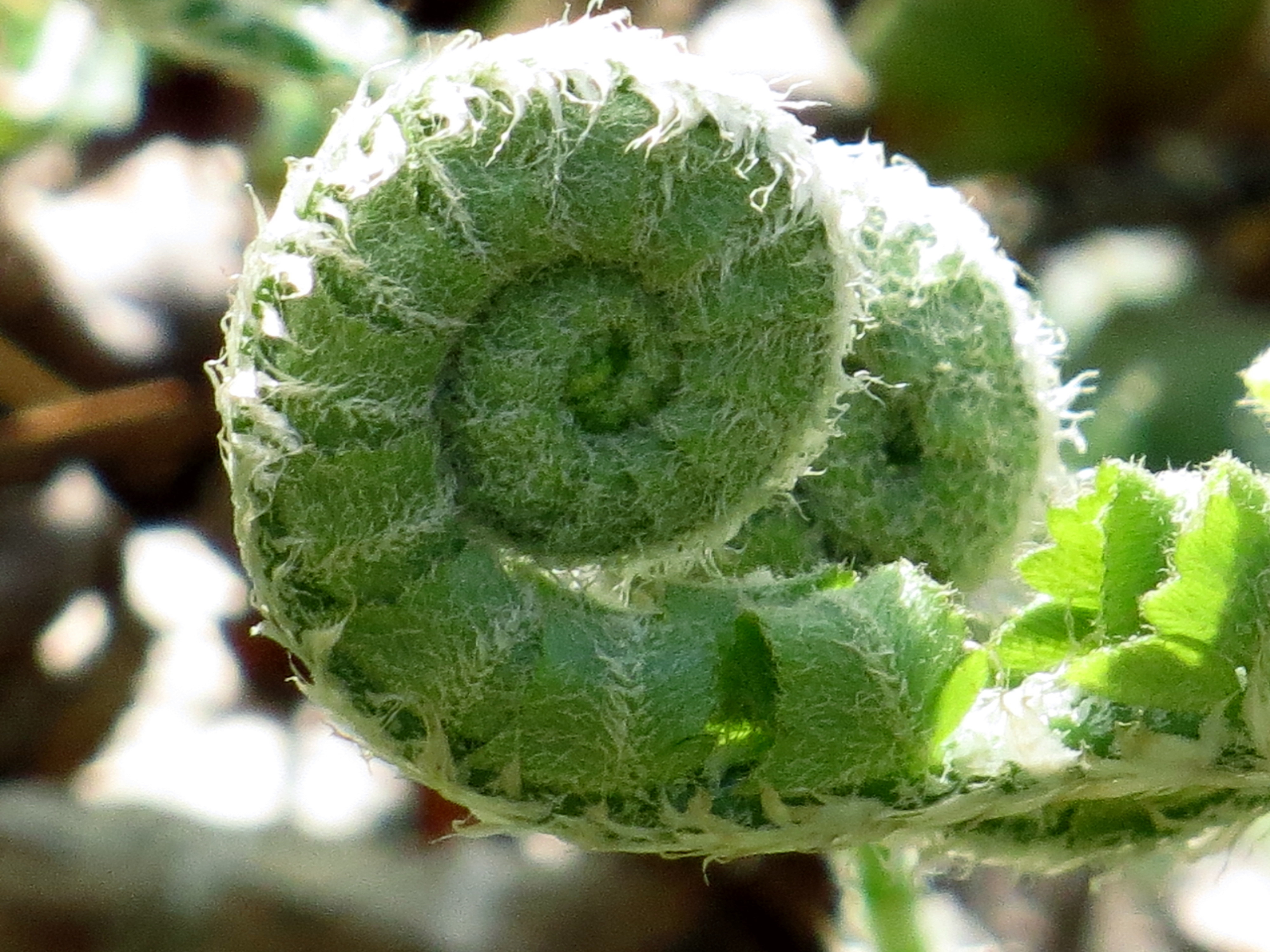
Two more quick pictures then it’s off to bed – got started much too late. The first is a fiddlehead fern. But “fiddlehead” is not a type of fern. It’s a growth stage. This is a Christmas fern or something I have not identified, but this is referred to as its “fiddlehead” stage. You can see why: 

Fiddlehead fern. I am continually amazed and delighted at how gorgeous this all is.

Fiddlehead fern. I am continually amazed and delighted at how gorgeous this all is.

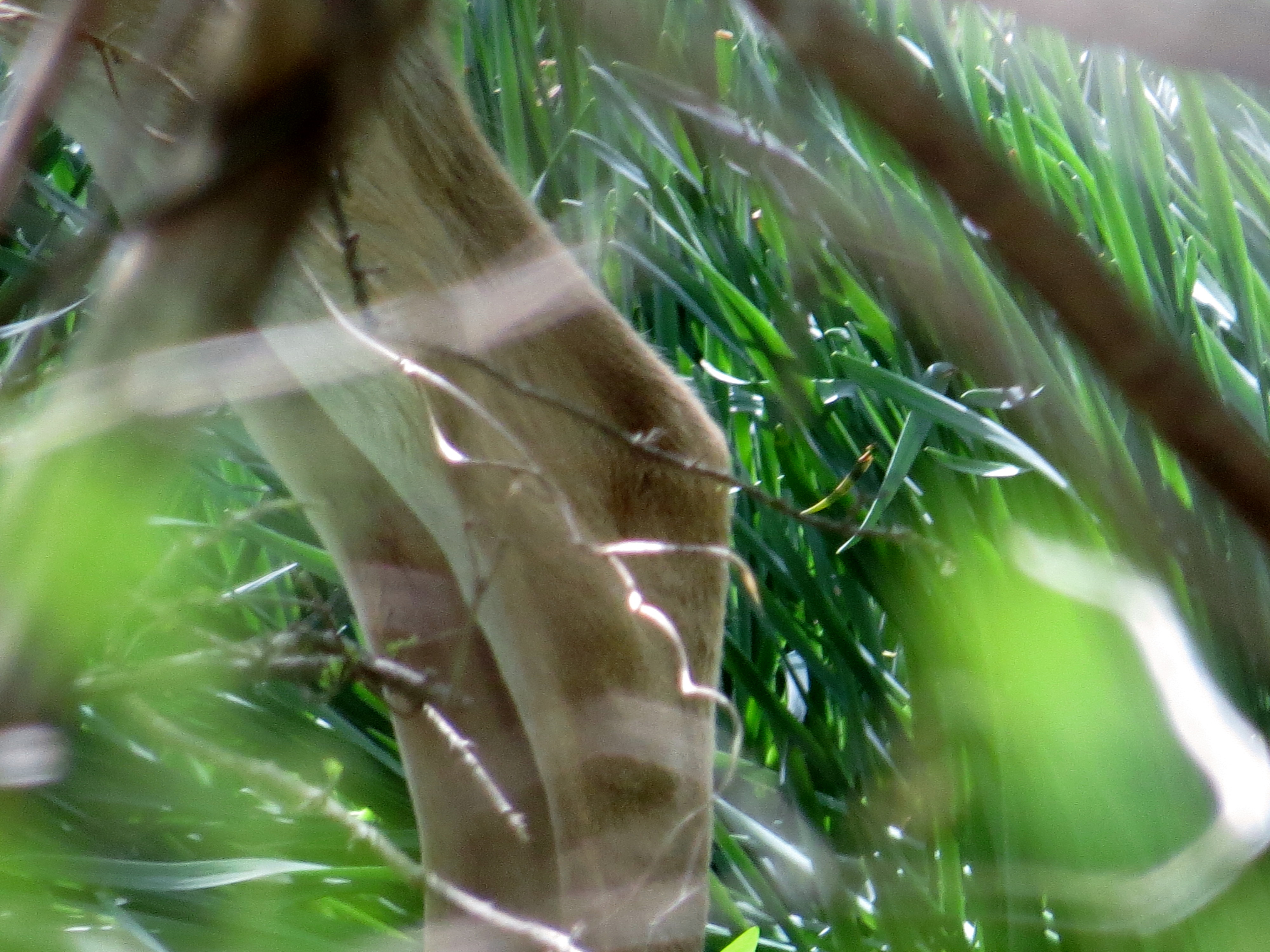
Very late in the hike, nearly within sight of Charlie’s Bridge, I always check for deer and they’re nearly always there. Today was no exception. It gets leafier every day and more difficult to see. There was at least one doe in there. Possibly more; I only saw this one beauty. I played around and got some shots but none worthy of publication. But see what you think of this one. They are effortlessly (in my opinion) graceful and elegant animals. They blend in so beautifully with their surroundings. This is her elbows. I love this picture. And I hope you have a great week:

Nice elbows. She is a natural beauty.

Nice elbows. She is a natural beauty.

See you next week, 

Jay 


Posted in Flowers, Fun, James River, Pony Pasture, Rivers, Smiles (including "dog smiles"!) | Tagged , , , , , , , , , , | 9 Comments

“The most beautiful place on earth.”

5 April, 2015 “The most beautiful place on earth.”

“This is the most beautiful place on earth. There are many such places.” – Edward Abbey, Desert Solitaire: A Season in the Wilderness

There are many such places in central Virginia in April. Pony Pasture is certainly one of them.

At Pony Pasture this week, there were a lot of couples getting ready for Easter Eggs: 

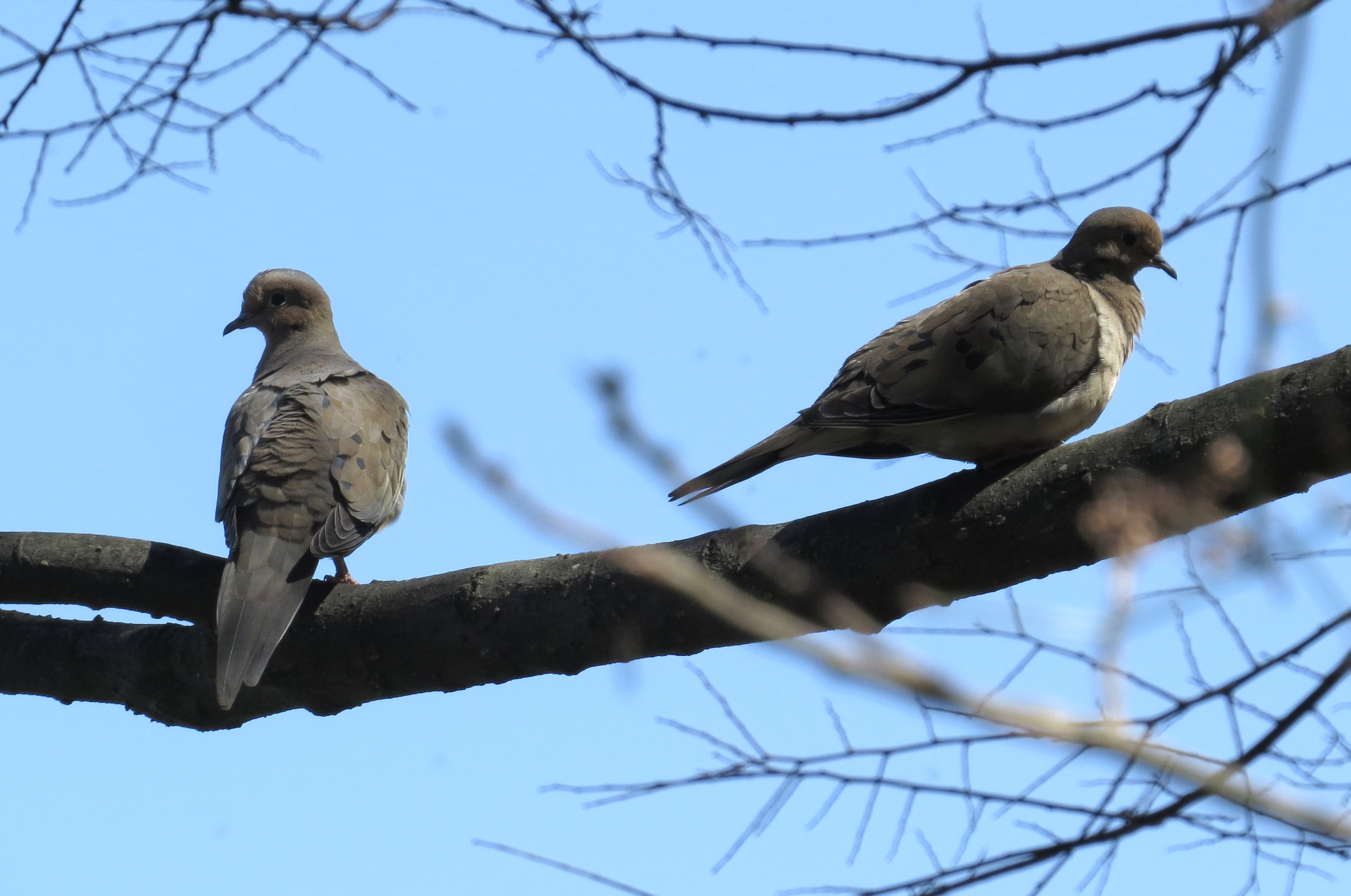
A pair of mourning doves:

A pair of mourning doves:

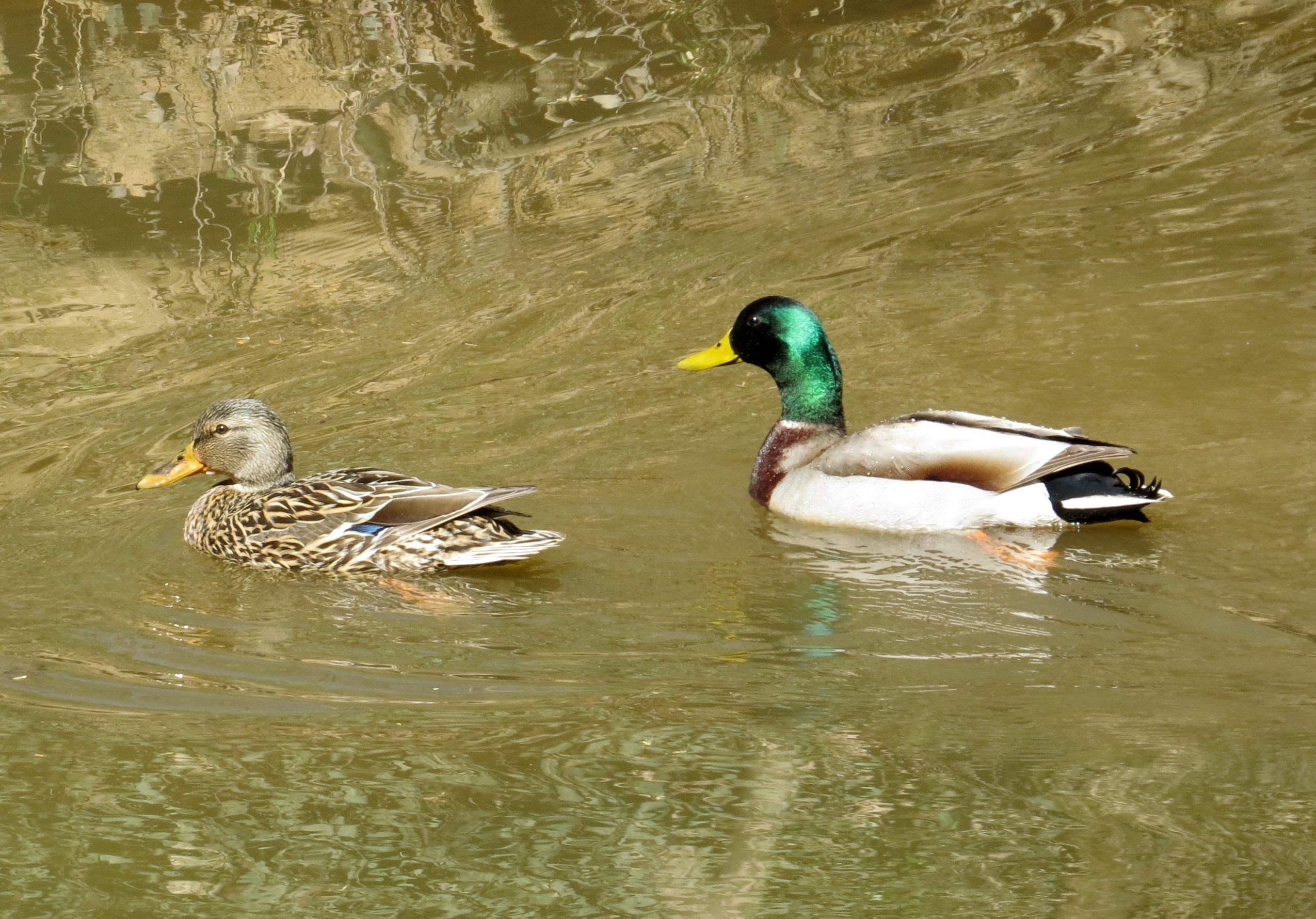
A pair of mallards

A pair of mallards

But there’s always a Serpent in the Garden:

Tiny Northern Water Snake

Tiny Northern Water Snake

That’s a Northern Water Snake (Nerodia sipedon) – entirely harmless. Will grow up to eat lots of mice and keep vermin under control. A couple of wise guys suggested it was trying to steal my car. I said that is impossible – my car is a stick shift. There’s just no way that snake could hold the clutch down while it turned the key. My other car is an automatic, though. I’ll have to keep the keys to that car away from the snake. 

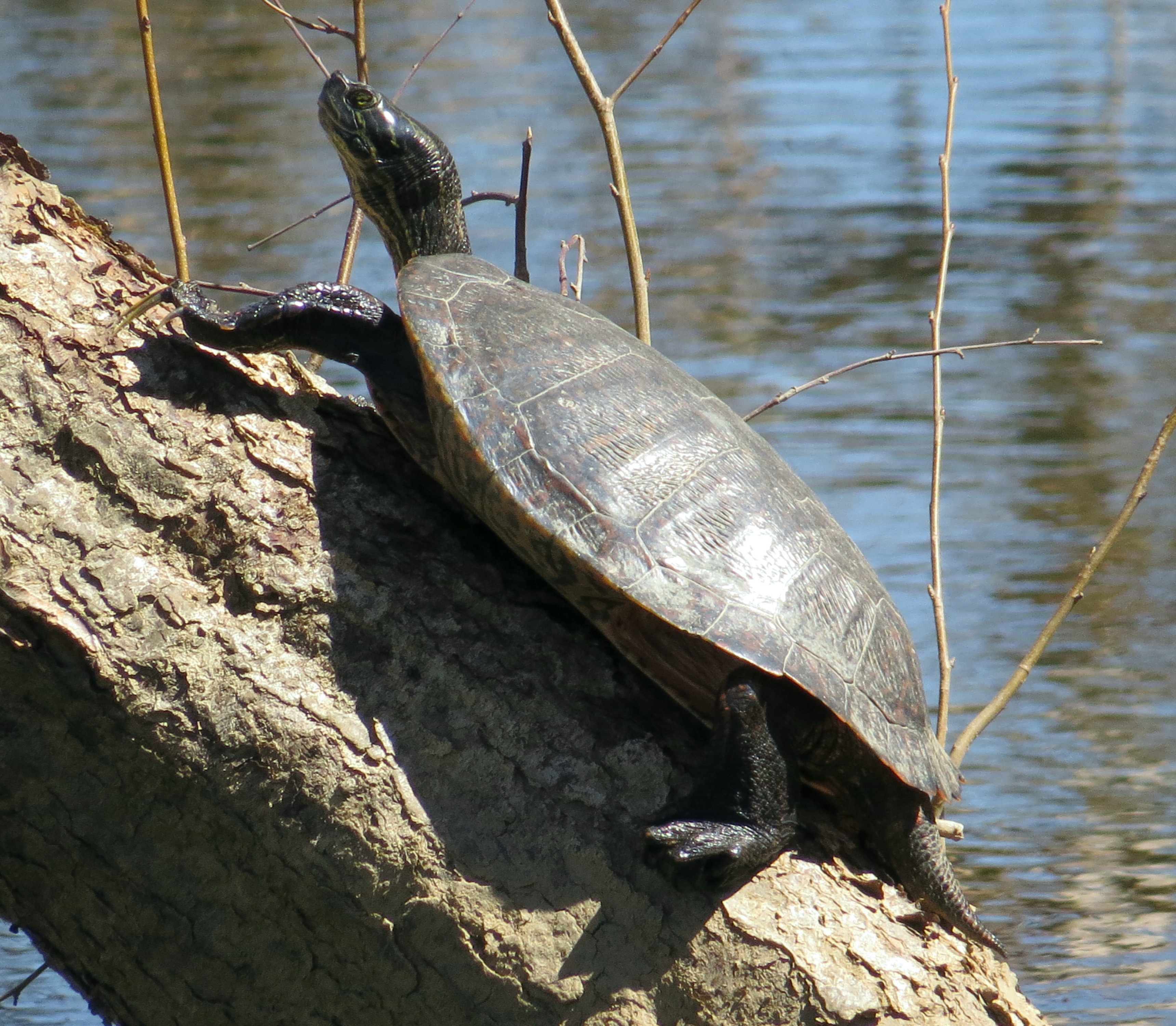
Other reptiles are sunning themselves at the river:

Basking

Basking

I apologize I have not yet identified these turtles. I’ve been disorganized. I just got Special Publication Number 4 from the Department of Game and Inland Fisheries, A Guide to the Turtles of Virginia. Next week I’ll know more. There will be abundant turtles every day at the river between now and about Halloween. 

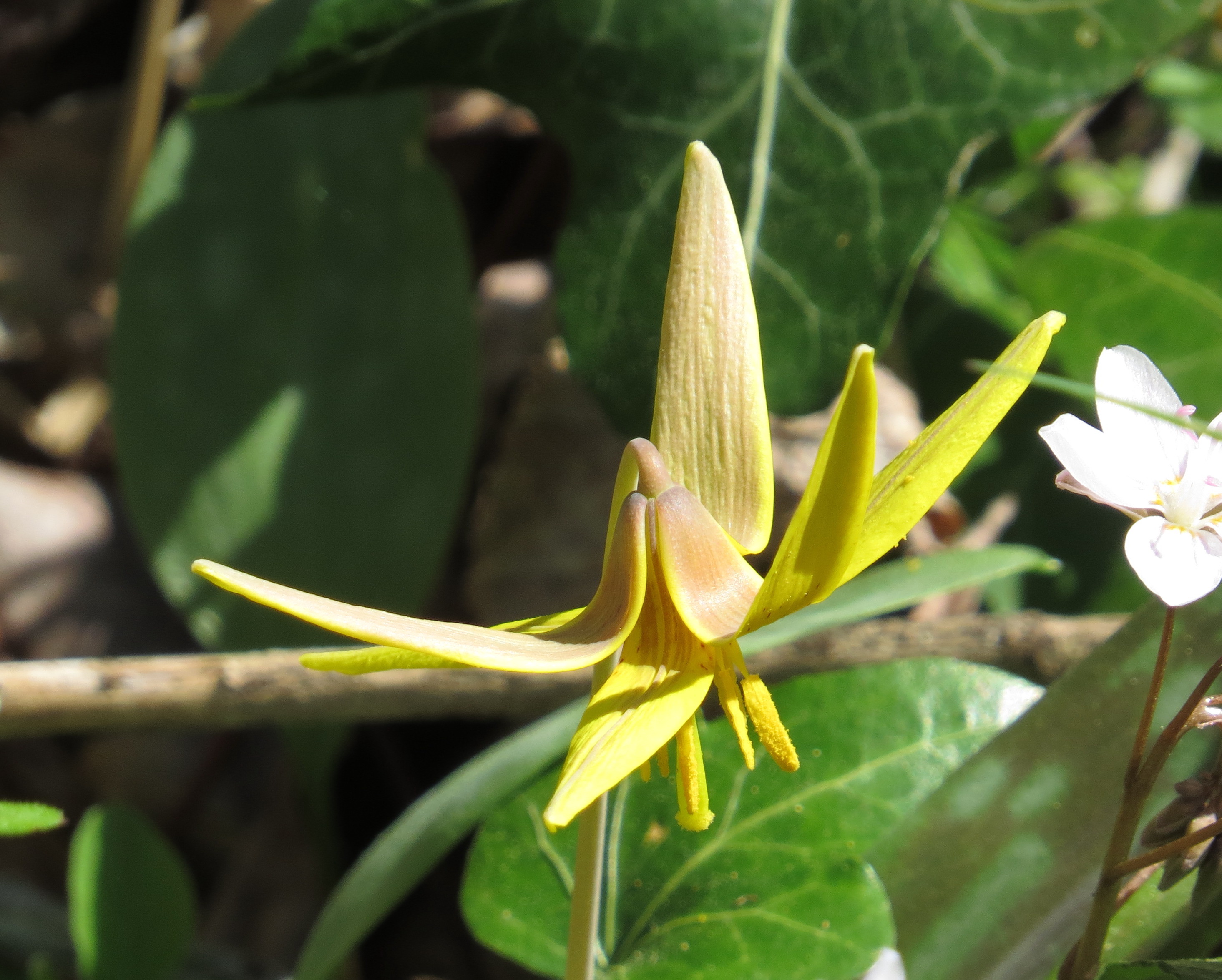
Much to my delight this week I discovered a new (to me) flower in the woods at Pony Pasture. This is a Trout lily (Erythronium americanum). Thanks for the ID Betsy!: 

Trout lily - isn't that a beauty?

Trout lily – isn’t that a beauty?

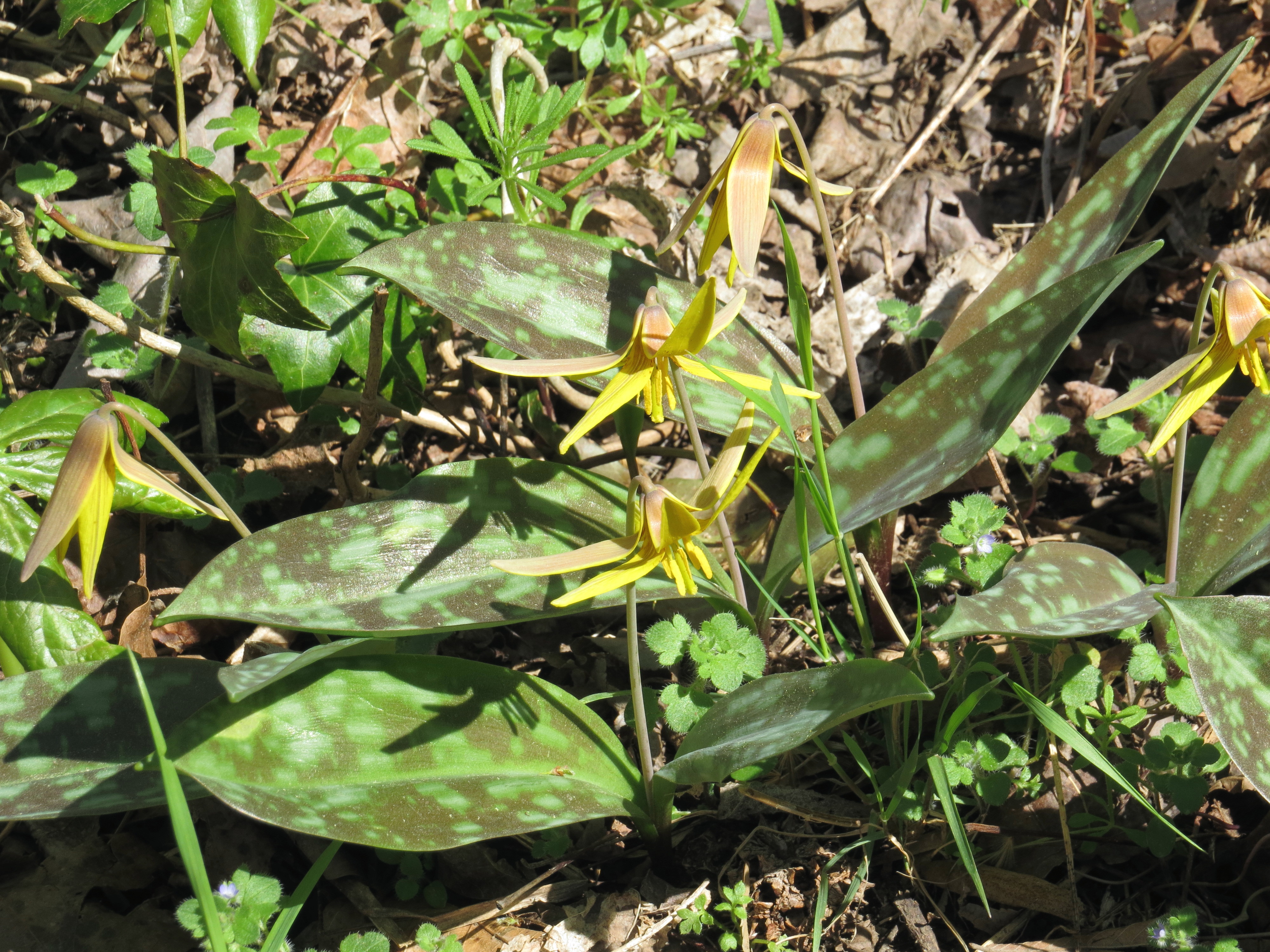
Here’s another for perspective:

Trout lily from a different angle

Trout lily from a different angle

Right in the middle of the forest!

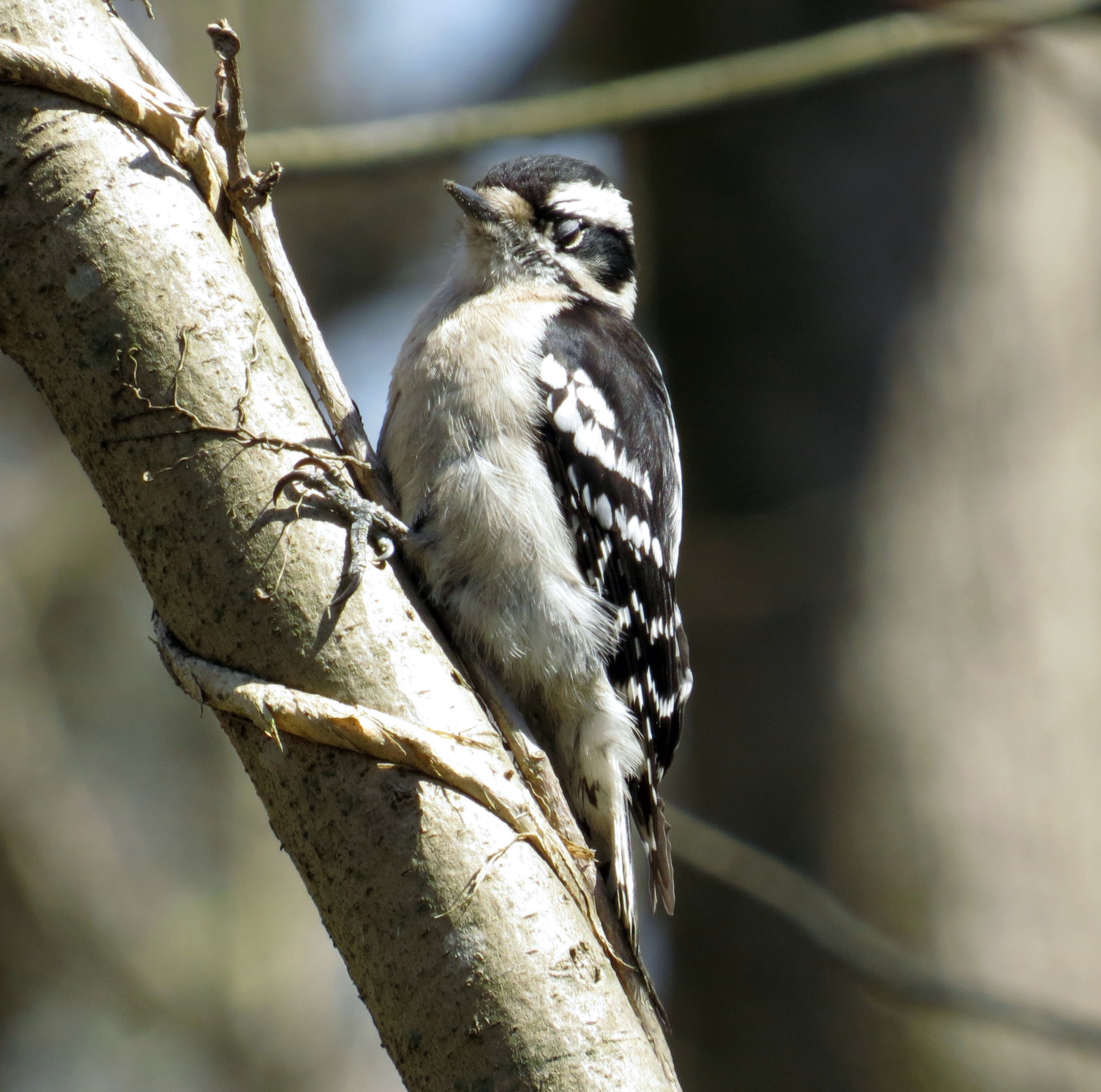
Another female Downy Woodpecker in the bright Spring sun. This shows a peculiarity of my shoot-from-the-hip style of outdoor photography. Have you ever taken a picture of someone or had your picture taken when you blinked? I am reasonably certain she blinked just as I pressed the shutter:

Striking:

Striking:

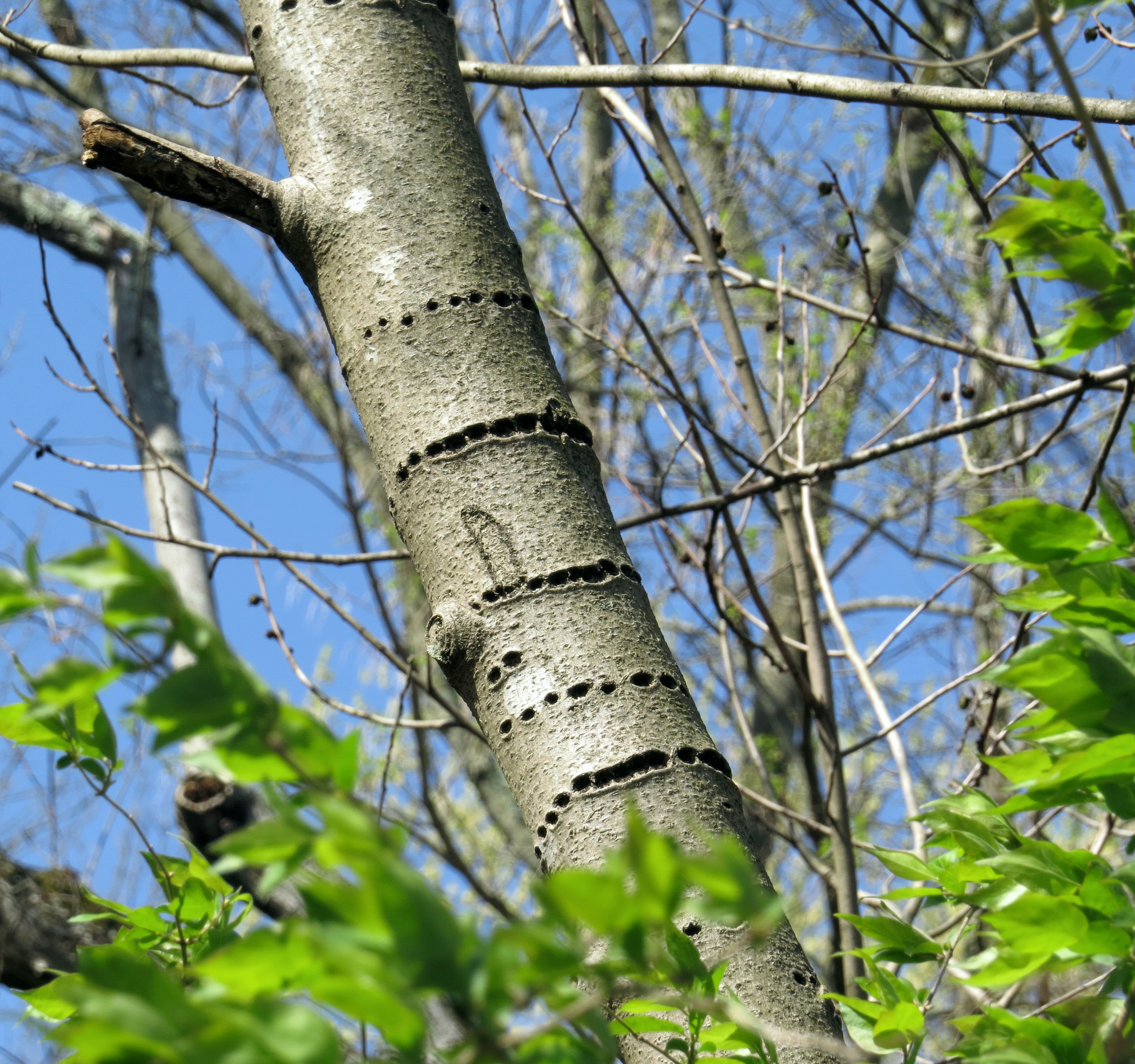
I have not yet seen a Yellow-bellied Sapsucker (Sphyrapicus varius ) at Pony Pasture. Or possibly I’ve seen one and mistaken it for something else. But rings of holes in trees like this are caused by Yellow-bellied Sapsuckers. This tree is on the edge of the river bank about halfway between the big parking lot and the golf course: 

Calling card of a Yellow-bellied sapsucker

Calling card of a Yellow-bellied sapsucker

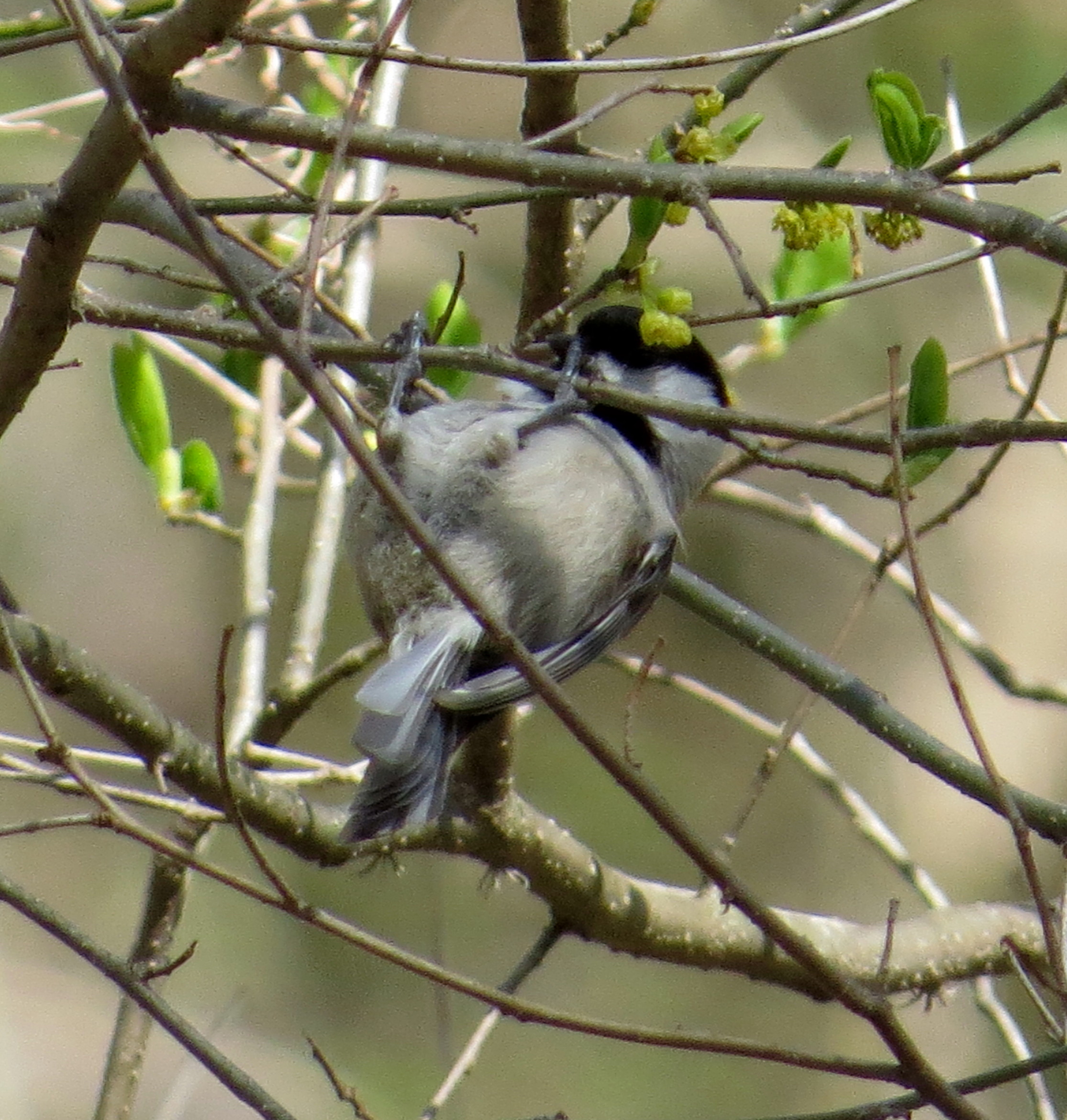
A chickadee worked for a long time on the same bush near Charlie’s Bridge this week. It was so involved I just stood there and took pictures. This picture is not flawless, but it’s a pose you don’t see every day. It looks like a little avian trapeze artist:

Avian trapeze artist

Avian trapeze artist (never uses a net) 

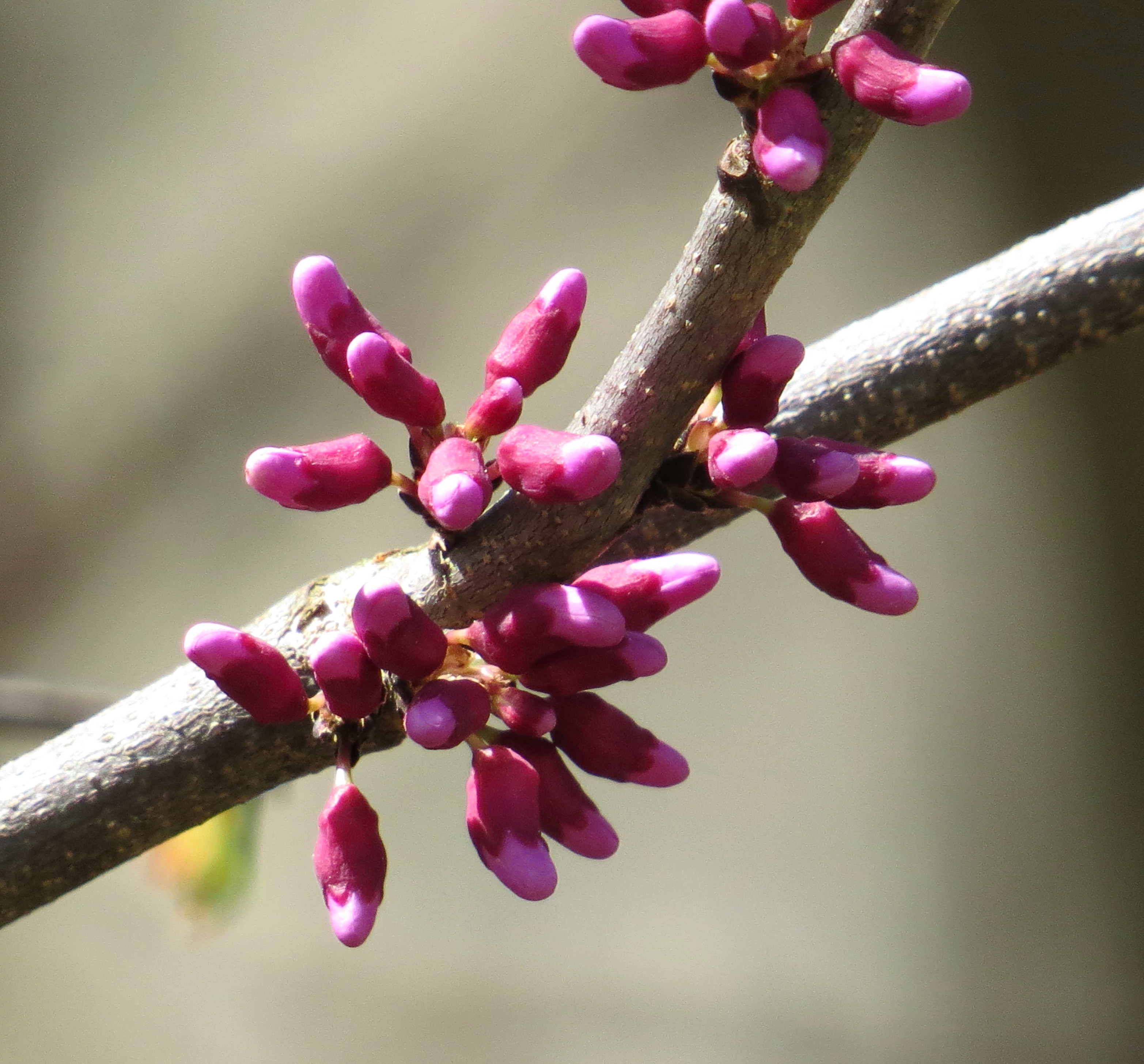
There are a lot of ways to announce the arrival of Spring. There is a precise official meteorological date and time. There has to be. But I know it’s Spring when I see my first redbuds of the year. I used to always see them on the Appalachian Trail. Now I see them at Pony Pasture. They’re edible. So another way Spring begins is when I taste the first redbud bloom of the year. These still haven’t even opened up, but they are delicious and the taste of Spring:

Redbud

Redbud

One great thing about my ongoing Every living thing project is how much new stuff I’m noticing. And learning about. It’s possible I would have lived my whole life and not known about Trout Lilies. And now I do. Learn something new every day, hopefully. Even the title of this blog post came from research for that project. I first began reading a book about trees (Seeing Trees by Nancy Ross Hugo) and it led me to another book about trees (Teaching the Trees by Joan Maloof). Ms. Maloof’s book led me to another great book – and that was Desert Solitaire, which led me to the title of this blog post. I gave away my television about a year ago so I have to have a constant supply of great books. And this project led me to three in a row – an unexpected benefit.

So, brief post today. I drove up to Maryland this morning and had Easter Brunch with my older sister and her husband and my two oldest nieces plus her husband’s family. Edward Abbey would refer to it as another of the most beautiful places on earth. But there’s no place like home! Have a great week,

Jay
Posted in Birds, Flowers, Fun, James River, People, Pony Pasture, Rivers, Smiles (including "dog smiles"!) | Tagged , , , , , , , , , , | Leave a comment

Wonders never cease

29 March, 2015 Wonders never cease

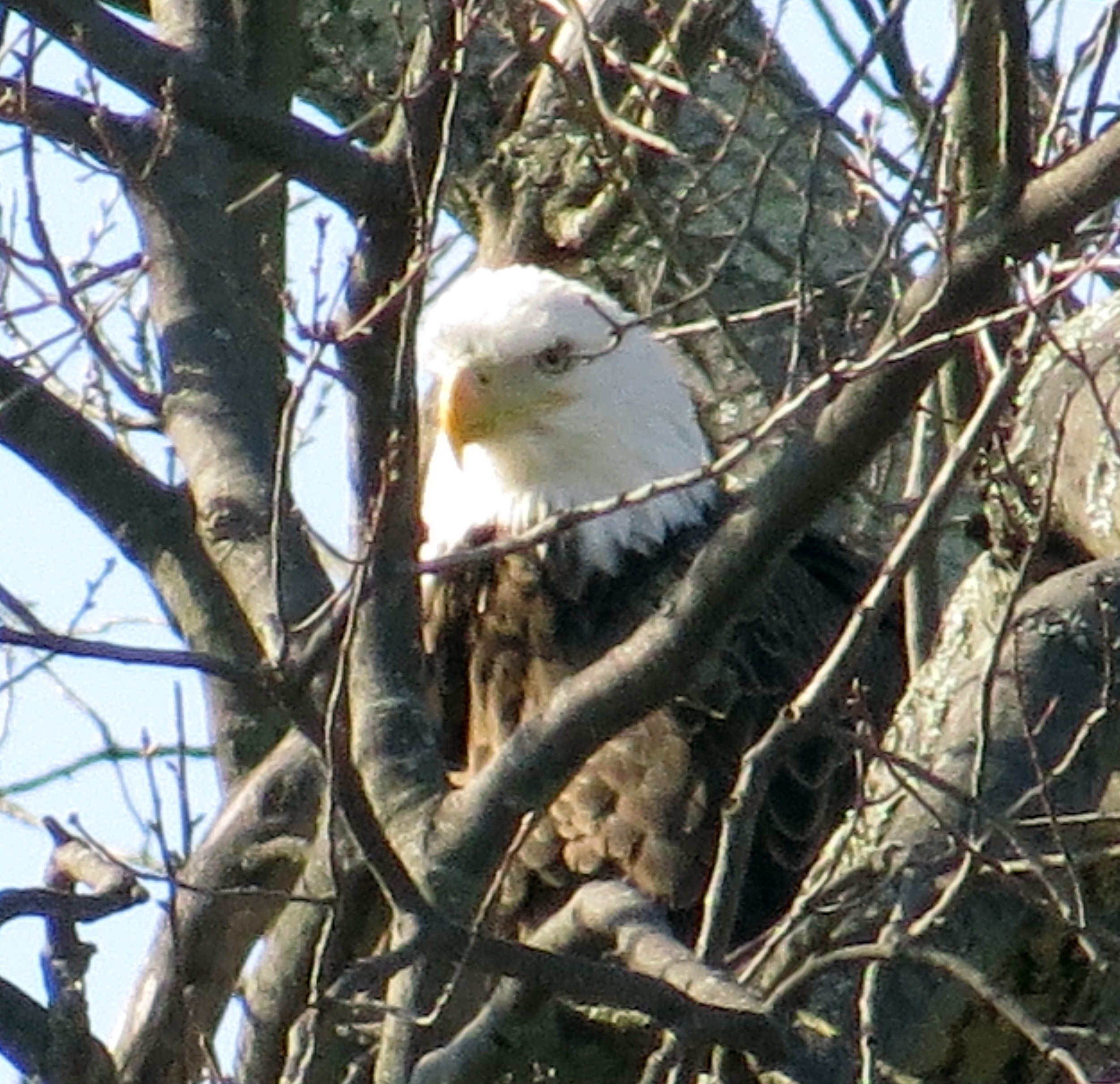
A week ago at 5:00 PM I published a blog post called “We can discover the wonders of nature…”. Six miles away and 24 hours later I clicked the shutter on this picture:

Bryan Park, Richmond, VA, March 23, 2015

Bryan Park, Richmond, VA, March 23, 2015

Isn’t that just remarkable? That you can muse about discovering the wonders of nature and before the end of the next day take a photograph of a Bald Eagle? Inside the city of Richmond? That is a wonder of nature. I was very enthusiastic about that eagle picture and sent it around to a few friends. The response is remarkable:

One wrote: “All of nature is waking up and showing its great optimism for the future.”

I sent it to another friend (a talented photographer) and wrote that this was “not an elite quality photograph”. My friend responded that “elitism is overrated. Seeing a bald eagle is not.”

Still another wrote “”What a wonderful spring treat!!!  Seeing an eagle always gives me chill bumps.”

A fourth person wrote that it’s “Really neat to see that Eagle, which seems it should be capitalized no matter what.”

Often when I read the news I have the sense that people are jaded about this or discouraged about that. But the reality I’m experiencing does not reflect that sense. So maybe my sense is wrong! Hmm…

I take the majority of my pictures at Pony Pasture. But I don’t care where you are if you have a camera – if you watch a big bird come winging in and get bigger and bigger and land in a tree and it’s a Bald Eagle – you’re going to take pictures like crazy. It was a 100% surprise.

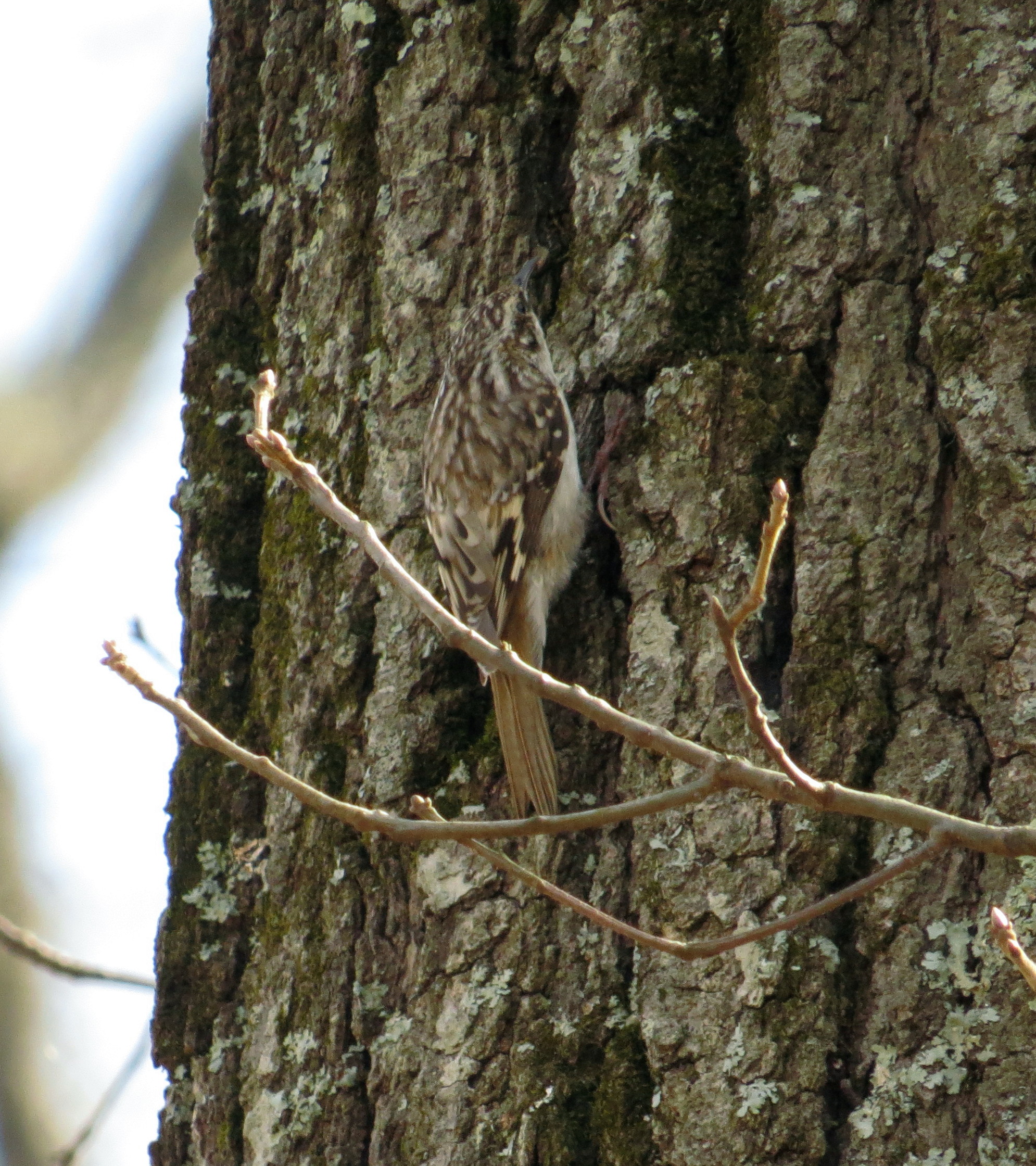
Also this week at Bryan Park I took a picture of a bird I’ve never seen before! I continue to be amazed. More wonders of nature. The bird is tiny – around four inches long, and it weighs as much as a penny and a nickel together. It’s called a Brown Creeper (Certhia americana). Here’s a blurb about it from Birds of North America: “The brown creeper, as he hitches along the bole of a tree, looks like a fragment of detached bark that is defying the law of gravitation by moving upward over the trunk, and as he flies off to another tree he resembles a little dry leaf blown about by the wind.” They go on to refer to it as “One of the continent’s most inconspicuous songbirds” although it’s widespread. Another site says it flies to the bottom of a tree and works its way up, “sometimes passing downward-facing nuthatches along the way.” Isn’t that fun? Here is the picture I was fortunate to take; you’ll see why it’s so inconspicuous. In this picture it’s about in the center, just above that small branch:

Brown Creeper - in the center, facing up. Can you believe how small and invisible that is?

Brown Creeper – in the center, facing up. Can you believe how small and invisible that is?

It is highly likely I would have lived my whole life and never known that bird existed. That is a wonder of nature. I watch birds! And I never even knew. What a treat.

I will insert a caveat here – with both the Eagle and the Brown Creeper, I was hiking with my friend Ethan who is still in high school and has much better vision than me. Even with the eagle, I’d look down at my camera or something and look back and be unable to find it. And I’d say to Ethan “where is it again?” and he’d show me. It’s great to go birdwatching with a person who has great vision. Plus I really should finally get bifocals…

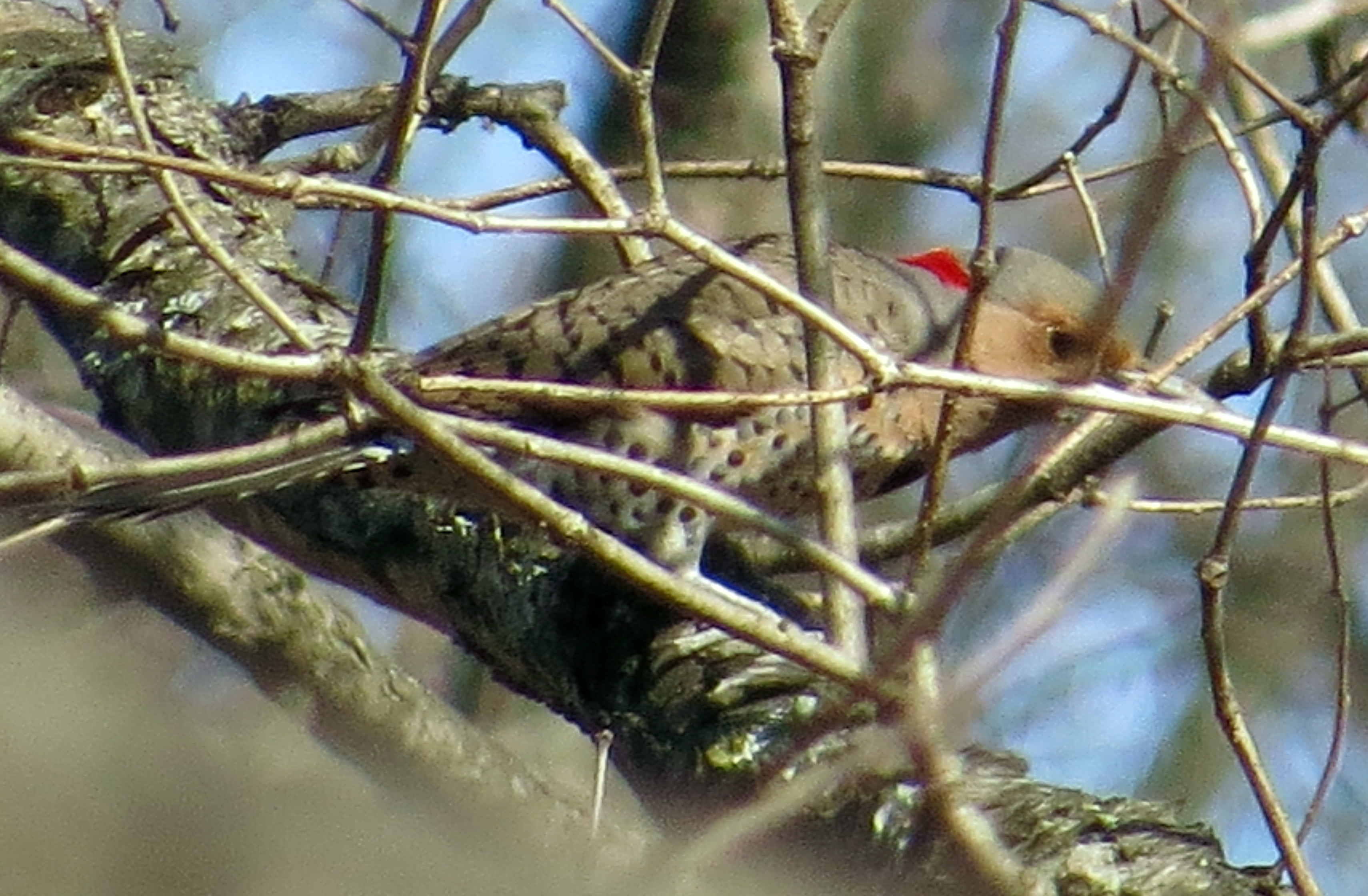
I did get one other “first” bird this week, although it wasn’t the first one I’d ever seen. On the same day we “got” the Eagle at Bryan Park I “got” my first Northern Flicker (Colaptes auratus). I knew there were Flickers around and I’d seen them but this was the first time I’ve ever caught one with my camera. This isn’t a terrific picture but I’ll get better now that I know how to get pictures of them. I’m finding that’s the way it works with outdoor photography. This is vague, but I don’t know how to “see” something until I finally actually see it in real life. You can look at all the books and magazines and field guides you want, but you don’t really learn to see a wild animal until you actually begin to see it in the wild. Then, suddenly, you begin to see it a lot. Here is my first poor quality image of a Northern Flicker. Watch this space for improvements:

Flicker in a tangle

Flicker in a tangle

In Richmond now there are daffodils everywhere you turn – it’s a joy. And I have taken a million pictures. I used to think there was a “perfect” picture to be had. After I became a moderately competent photographer I began to seek it. Should you ever be so foolish to seek perfection in any pursuit, please take my advice and forget it. I finally did and it’s been a big relief and my pictures have improved a great deal. Here’s a daffodil I got this week:

I could do an all-daffodil blog post, and all the pictures would be perfect. Or not. It's in the eye of the beholder.

I could do an all-daffodil blog post, and all the pictures would be perfect. Or not. It’s in the eye of the beholder.

I won’t waste our time with more examples of “perfect” daffodil pictures – there is an infinite number. I’ve gotten a “perfect” frog and a “perfect” bumblebee but in nature photography you can shoot any subject a million ways and have a million perfect pictures.

I have a lot to say about this – I think about it incessantly – but I know it can get boring (possibly it already has!). Many of you know that among my favorite writers is the late David Foster Wallace. The quality of my photography will never equal the quality of his prose. But in the book Quack This Way he had this to say about perfection in writing. You could substitute “photography” for “writing” in these quotes and understand more clearly what I’m saying: 

“…the fact of the matter is that good writing [or photography] isn’t a science. It’s an art, and the horizon is infinite. You can always get better.” […]

“Like any art, probably, the more experience you have with it, the more the horizon of what being really good is . . . the more it recedes . So a great deal of now being in my 40s and having done this pretty seriously for 20 years is I now have a much better idea of the ways in which I’m not really very good . Which you could say is an important part of my education as a writer [or of mine as a photographer]. If I’m not aware of some deficits, I’m not going to be working hard to try to overcome them.”

Garner, Bryan; Wallace, David Foster (2013-10-14). Quack This Way

So anyway, watch this space – lots of imperfect pictures to come. 

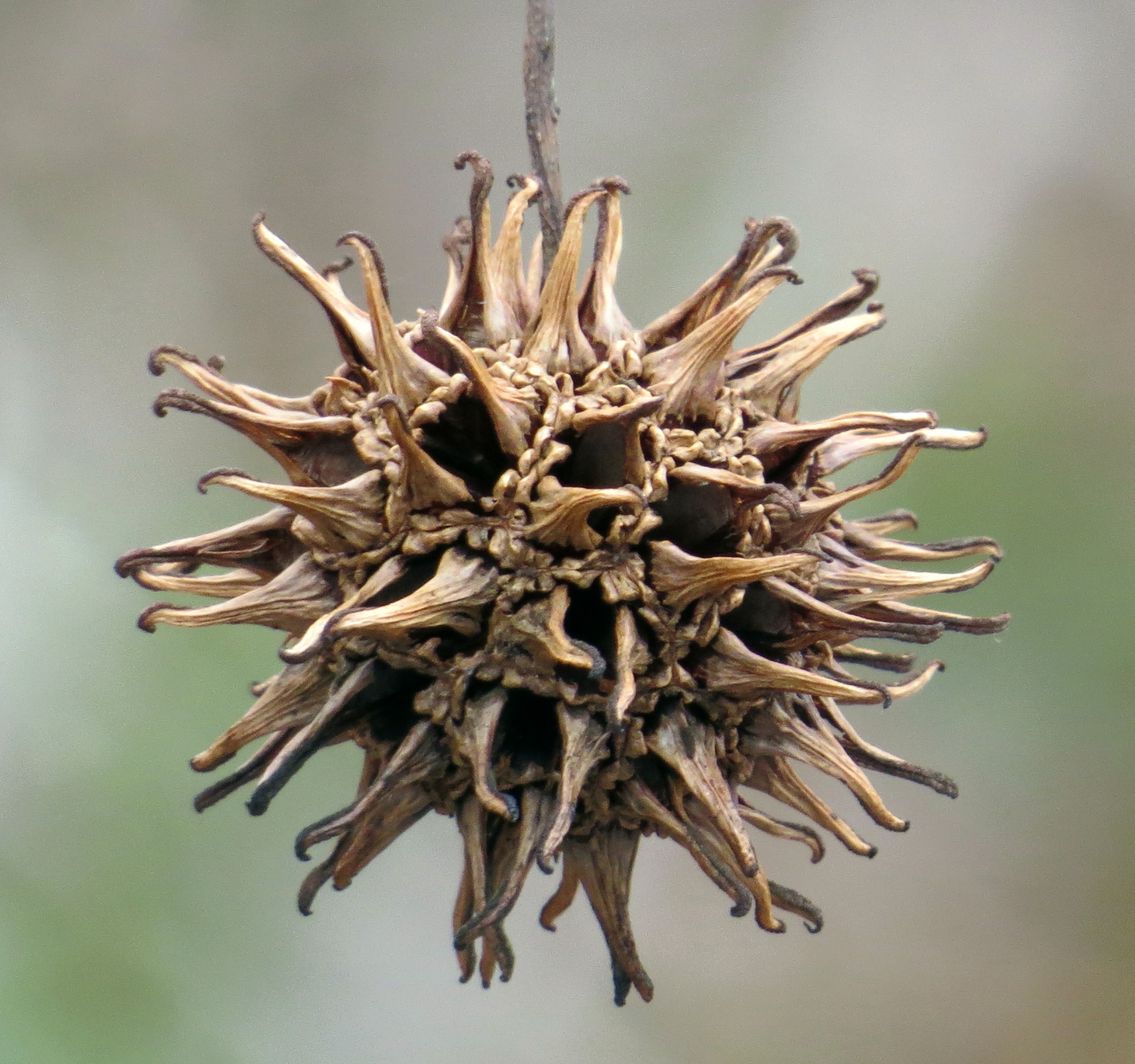
I got a neat picture of a gumball this week:

Perfect? Possibly. But you may prefer it in green. Or against a blue sky. The choices are infinite.

Perfect? Could be. But you may prefer it in green. Or lying on the snow. Or against a blue sky. Better focused. In a trashcan. The choices are infinite.

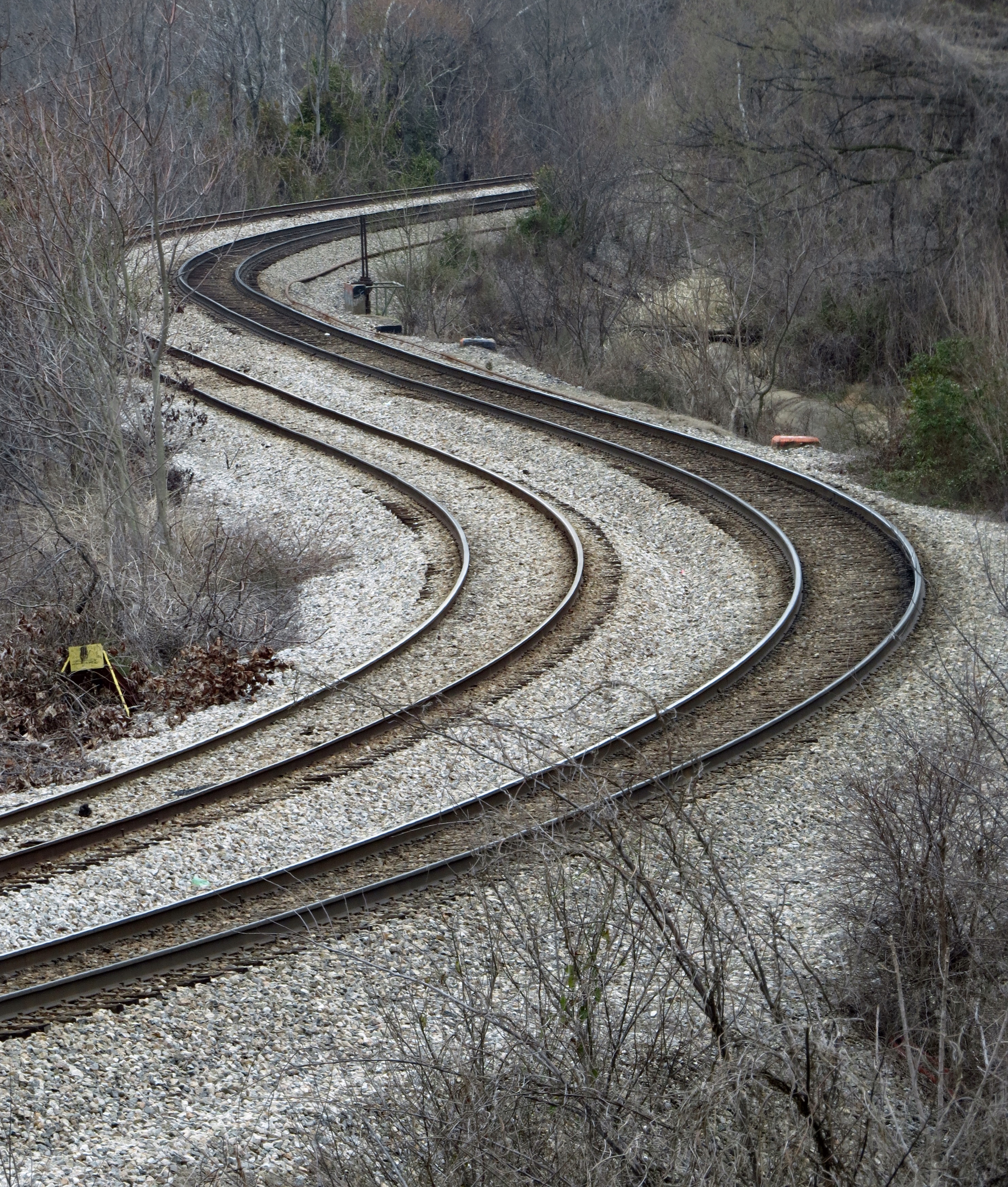
I also got a neat picture of train tracks! Really unnatural! But a graceful curve: 

100% unnatural, 100% graceful

100% unnatural, 100% graceful

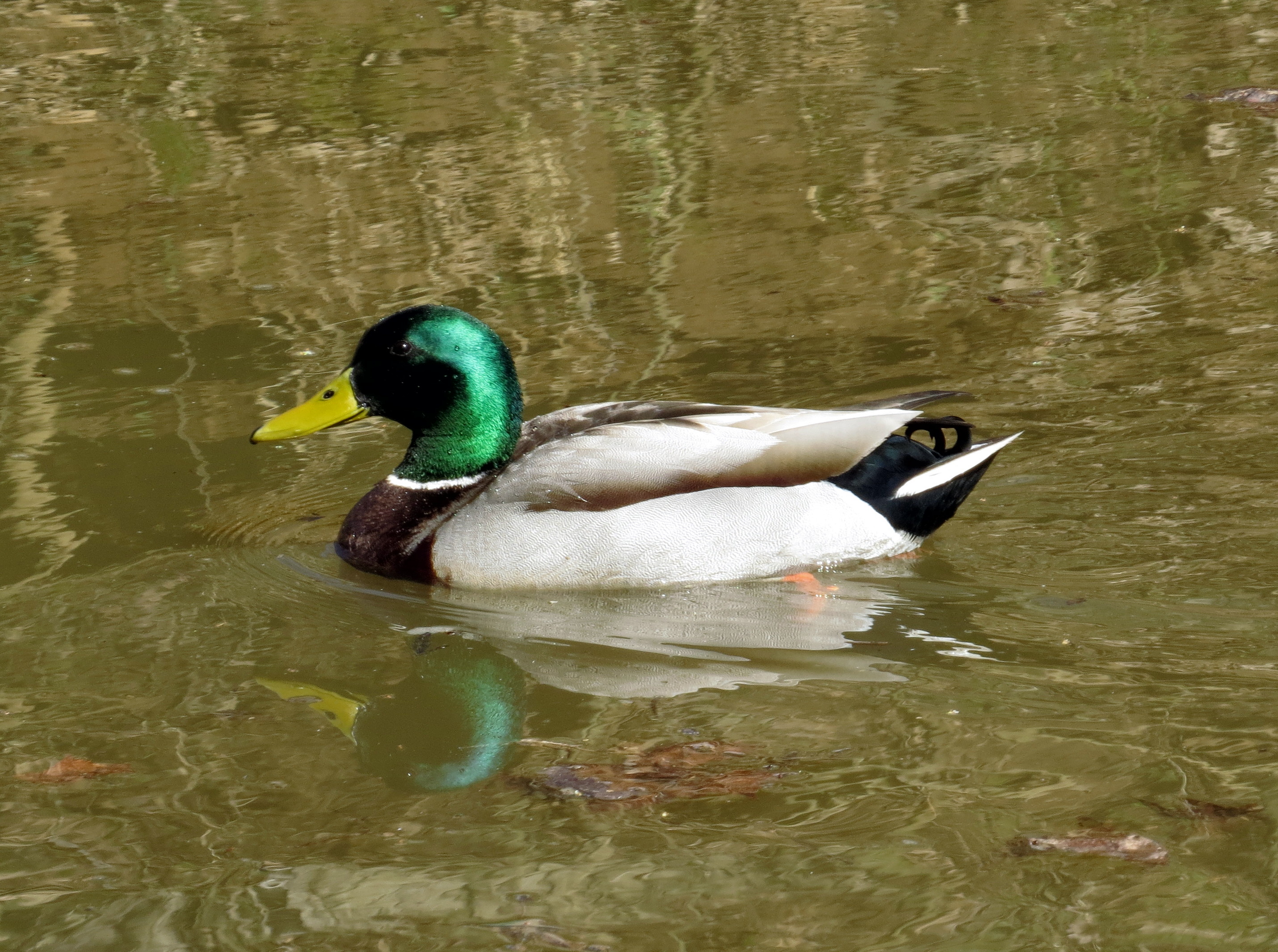
Took a picture of a male mallard today too. If you’ve seen one male mallard  you’ve definitely seen them all but I never tire of this shade of green. If I saw this color anywhere other than on the head of a bird I would swear it was artificial: 

How did evolution select for this color?

How did evolution select for this color?

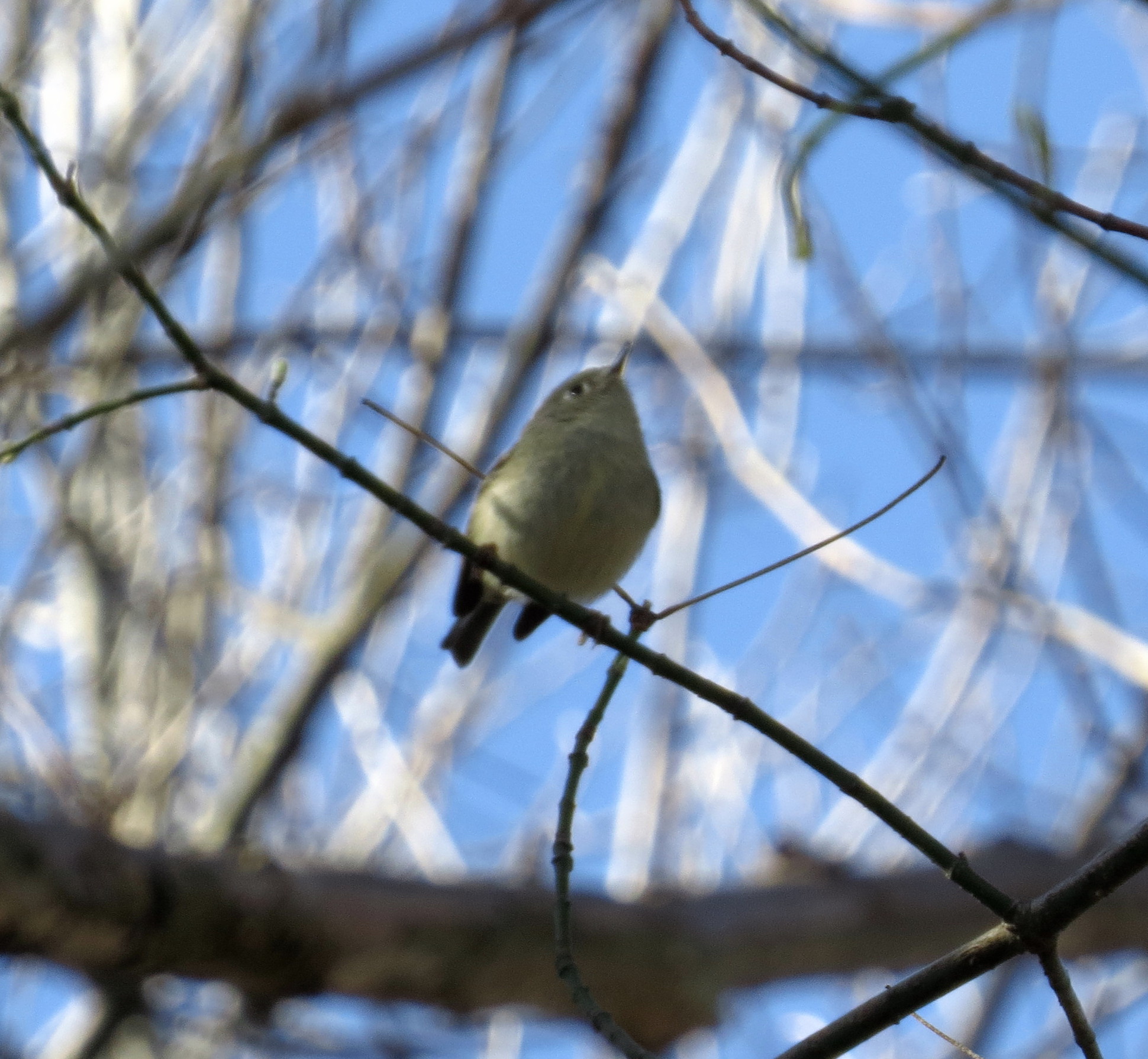
Casual blog followers, I apologize but I have not ID’d this bird. And it’s gotten too late to send it around to my bird ID people (all readers for this blog) for ID. Because I don’t know what it is, and this image quality is poor. I think it’s a Ruby-crowned Kinglet (Regulus calendula) but since I was not in a position to see its crown, I am unable to determine if its ruby colored or not. And I am not familiar enough with them for a positive ID. It is a remarkably tiny bird and I saw it at Pony Pasture this morning: 

I think this is a Ruby-crowned Kinglet. Confirmation or correct identification will be credited in this space w/in 60 minutes of my reading or hearing it.

I think this is a Ruby-crowned Kinglet. Confirmation or correct identification will be credited in this space w/in 60 minutes of my reading or hearing it. [THANK YOU KIM AND BETSY! THEY BOTH TELL ME THIS IS A RUBY-CROWNED KINGLET. AND THEY BOTH KNOW FROM SONGBIRDS AND ALL PLANTS AND LOTS OF OTHER WILDLIFE.]

My favorite editor (and bird identification expert) is out of town for the weekend so errors of every variety are my exclusive property. But please point them out! Meanwhile, please visit again next week! And forward this to your friends if you like it! 

Have a great day,

Jay

=======


Posted in Birds, moon, Rivers, Smiles (including "dog smiles"!), Trains | Tagged , , , , , , | 7 Comments

“We can discover the wonders of nature…”

22 March, 2015 “We can discover the wonders of nature…”

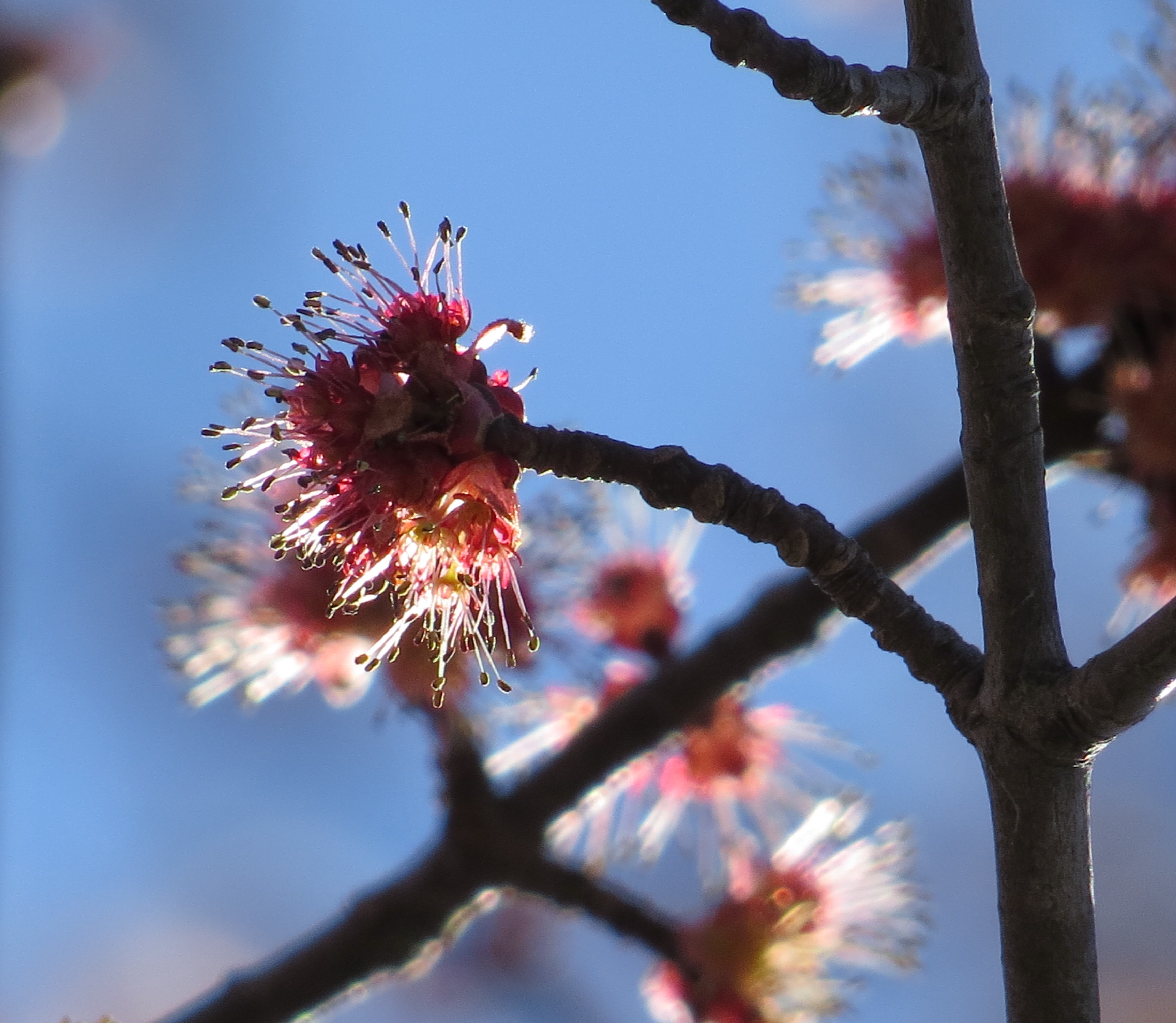
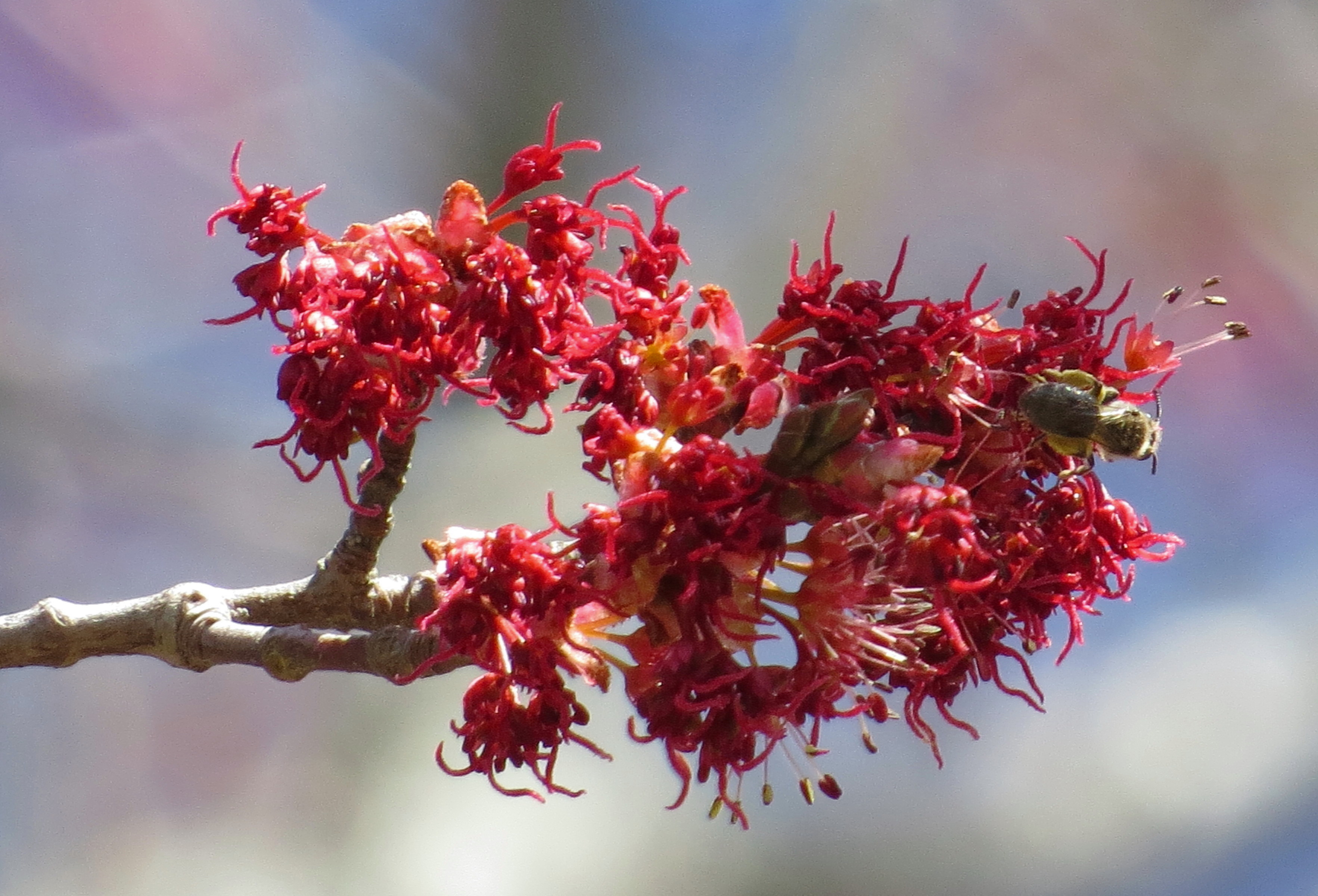
“…hiking with the dogs, down by the riverside.” – with apologies to Robert Hunter, Bob Weir and the Grateful Dead. For reworking the lyrics of Sugar Magnolia. After a cold, snowy winter I’ve been discovering the wonders of nature everywhere I turn. I was in the parking lot at the Tuckahoe Y this week and opened my sunroof and pointed my camera out for this picture of fresh White oak buds (I think): [[I stand corrected! As of 3/23/2015! My friend and mentor Betsy tells me Maples and Elms are blooming now – oaks not yet. She says this is a Red Maple (Acer rubrum) or a Silver Maple (Acer saccharinum)]] 

White oak (Quercus alba) bud - if I'm not mistaken - and I might be!

Red Maple (Acer rubrum) or Silver Maple (Acer saccharinum) bud 

Speaking of the Dead, Ev got me this great bumper sticker: 

Long time to be gone.

Long time to be gone. 

Depending on how long you’ve looked at this blog or how far back you’ve looked, you may have seen another post when I quoted the Grateful Dead in the title. In January of 2013, a couple of months after my Dad died I wrote a post called Attics Of My Life, the title to a Dead song a bit more obscure than Sugar Magnolia.  

Ev and I were at the Saint Stephens Farmer’s Market Saturday (21 March, the first full day of Spring!) morning when I saw an unusual shape high in a tree. Fortunately I had my camera and zoomed way in and got this picture:

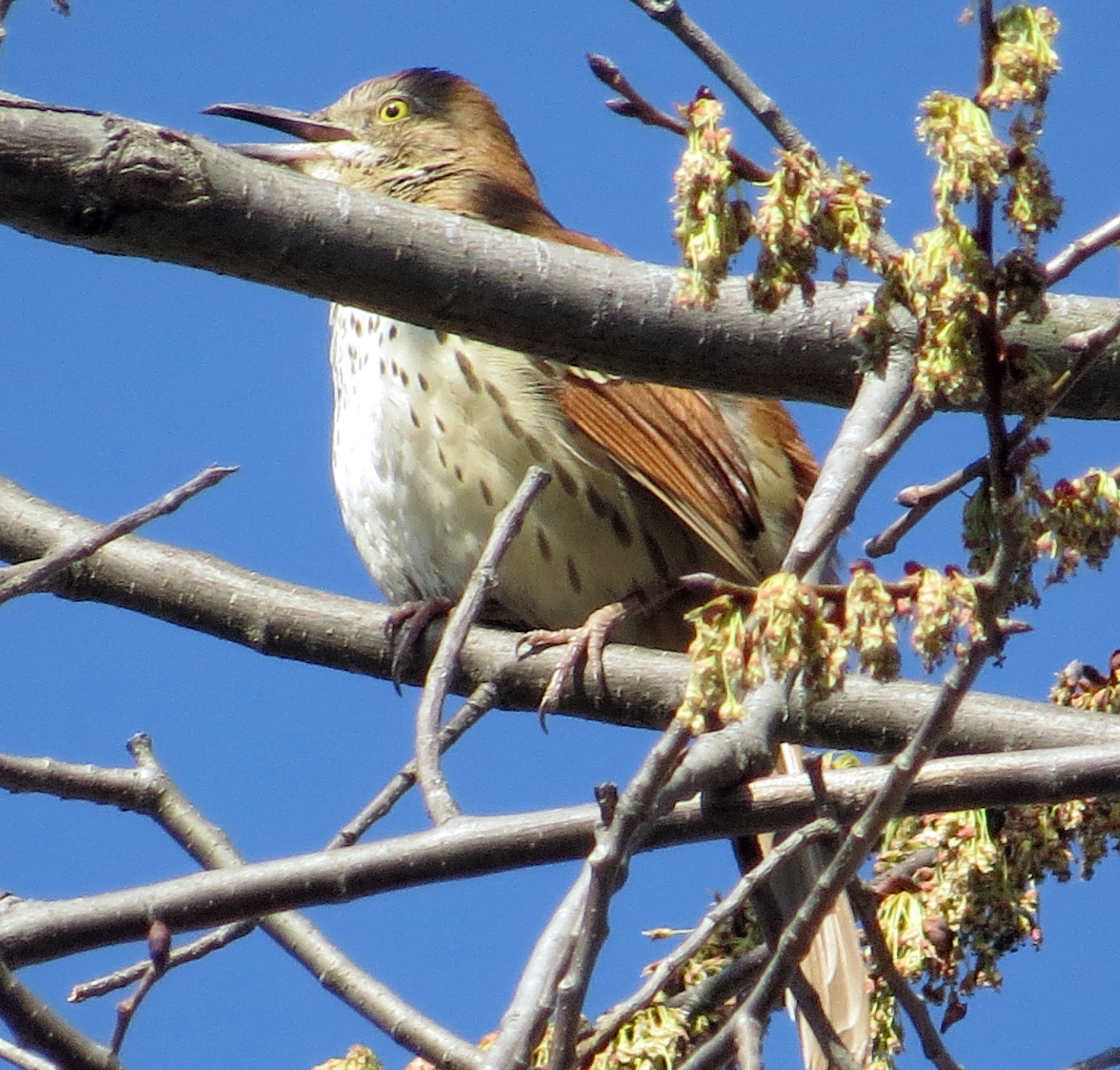
Male Brown Thrasher (Toxostoma rufum)

Male Brown Thrasher (Toxostoma rufum)

I showed it to Ev as we were driving home and she ID’d it – a male Brown Thrasher (Toxostoma rufum). I’ve seen Brown Thrashers my whole life, including growing up in Maryland. And I have never seen one more than six inches off the ground. They are always under bushes. Thrashing – that’s what they do. So when I saw (and heard) this guy singing fifty feet up a tree I didn’t know what he was. And as I read up on them, I learned another “wonder of nature”: I was reading the Cornell Lab of Ornithology web site and learned “During spring and early summer, males climb higher to sing from exposed perches.” Because on the same site they wrote, “It can be tricky to glimpse a Brown Thrasher in a tangled mass of shrubbery.” I also learned this from the Cornell Lab: “Although not as well recognized for its vocal abilities as the Northern Mockingbird (Mimus polyglottos), it is a remarkable singer with one of the largest repertoires of any North American passerine.” Very, very fun to see and hear and learn. Discovering more wonders of nature.

So after we got back from Saint Stephens I took advantage of the pleasant weather on the first full day of Spring and went out to West Creek to spend some time on my bicycle. I parked underneath another budding tree and the red buds looked so pretty against the blue sky I began snapping more pictures. Here’s one:

Bud and bee

Bud and bee

Look closely on the right side of that picture – there’s a bee on that bud! In March! I haven’t seen any bugs in months! 

This happens to me more than I would think possible. I’ll take a picture and when I get it home and look at it closely on the computer, I see something I had no idea was there. So it’s odd – and timely, on a post about discovering the wonders of nature – how much stuff I must pass by every minute and not even know is there. Odd and timely and fun to discover.

Anyway, currently I’m learning a lot about trees. My main guidance is now coming from a superb book called Seeing Trees by Nancy Ross Hugo. At this stage of my learning it’s like drinking from a firehose – the amount I’m learning is nearly overwhelming. And this is just about trees in Pony Pasture! A thousand walks there in over a decade and in the past week – once again – I’ve learned how much I don’t know. As in, did you know that trees have both male and female flowers? Did you even know trees had gender?! And what’s more – some trees have male and female flowers on the same tree (monoecious) and some trees have different gender flowers on different trees (dioecious). I’d give examples of the trees here but I encourage you to google it if you’re interested. In a blog entry like this you walk a fine line and risk turning it into a textbook entry. And I am unqualified to write a textbook. But the subject is fascinating. I’m very qualified to read a textbook. 

Speaking of textbooks (and of learning about trees), my current favorite place to learn is the Virginia Tech Department of Dendrology. It’s a wonderful subject even if you just want to find out a little bit. Or a lot, it’s all there. Anyway.

This morning I photographed a tree at Pony Pasture which I believe – I am currently uncertain – is an Eastern Red Cedar (Juniperus virginiana). Eastern Red Cedar is dioecious – that means this tree is either male or female. At this early point in my dendrology self-education I am unable to tell which this tree is. I think females have berries and this does not, so possibly it’s male. I may know by next week. When I find out I’ll inform you. Here it is in its beauty and its entirety:

Eastern redcedar (Juniperus virginiana)

Eastern red cedar (Juniperus virginiana)

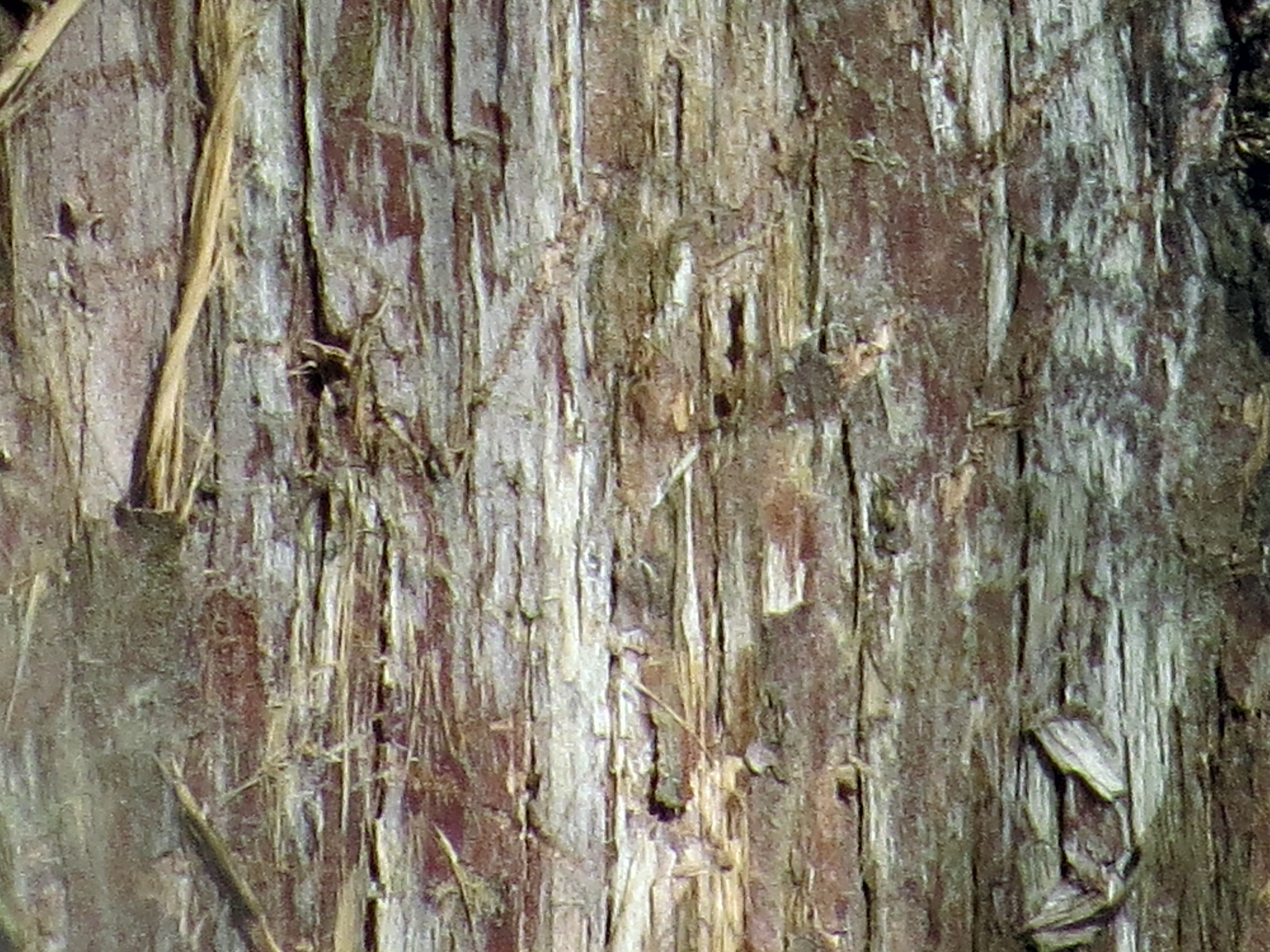
This is a closeup of the bark: 

Eastern redcedar bark

Eastern red cedar bark

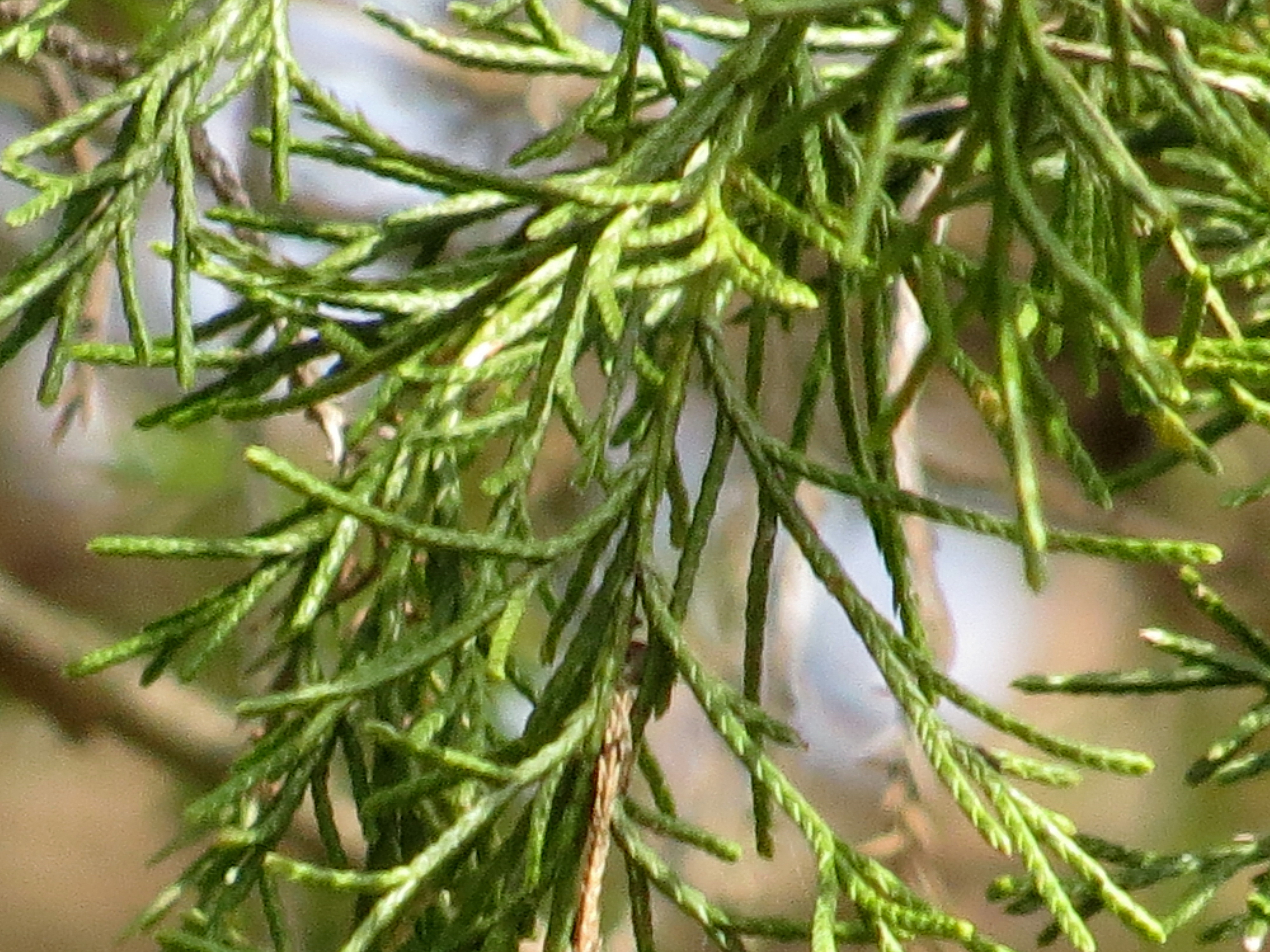
This is a closeup (a poor quality closeup) of its foliage:

Eastern redcedar foliage

Eastern red cedar foliage

One more brief note – it’s not a true cedar. It’s a juniper. Its name is “Eastern red cedar” but it’s a juniper. So there. 

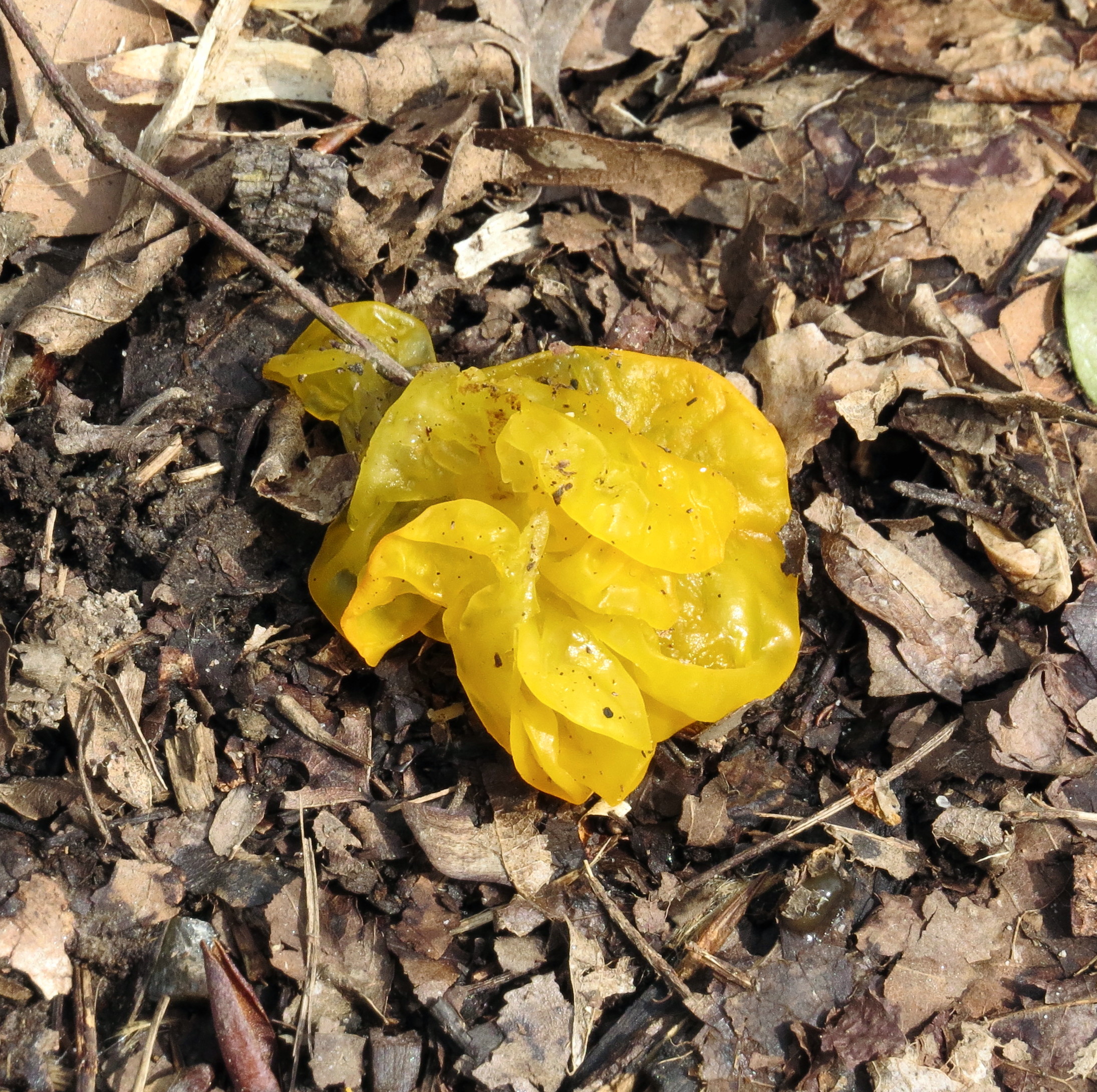
This morning (Sunday, 22 March, 2015) at Pony Pasture, Mackey and Turner and I came across a fungus named “Witch’s butter” (one of its many common names) or, more precisely, Tremella mesenterica. In my research I read several vague hypotheses about why it’s called Witch’s butter – in my opinion they were all made up. The reason I think it’s called Witch’s butter is because it looks like butter. And it grows in the woods. It’s cool looking:

Witch's Butter (Tremella mesenterica)

Witch’s Butter (Tremella mesenterica)

Almost enough for this post, though there are regrettably few pictures. Last week’s post was What’s better than a Golden Spurtle? I had a picture of my excellent new spurtle in that post. But if you’re not a stove top oatmeal maker, or even if you are, it’s possible you’re still unaware how it’s used. I took a quick video of me stirring oatmeal (or “porridge”, if you will) with my new spurtle. Be forewarned that watching oatmeal being stirred is a close second place behind watching paint dry when it comes to boring things to see. But here it is: Me stirring oatmeal with my awesome new custom made locust spurtle

There’s a terrific picture in last week’s post of a gentleman named Dr. Izhar Khan who won the 2014 Golden Spurtle. There was a quote from that contest that I left out of last week’s post. It reflects my own experience with oatmeal and spurtles so I include it here, copied verbatim from the Golden Spurtle web site: 

“The delighted Dr  Khan said: ‘I achieved my aim to win and take the Golden Spurtle to the Granite City. I started eating porridge seven years ago. It is simple, versatile, healthy and very affordable.

I am traditional by nature and like the ritual of making porridge. It sets you up for the day.’

A winning bowl of porridge is testament to the cook’s spurtle, the essential porridge making tool, and Dr Khan explained that he was grateful to one of his patients, who crafted his spurtle for him. So fond is he of his daily oatmeal dish, Dr Khan takes his oatmeal with him when he goes on holiday. With a hectic schedule, Dr Khan makes porridge for his family at the weekend, with his wife Nino, owner of successful curry sauce business `Nino’s Masala` cooking the dish during the week.”

In my own experience, the ritual is lovely and it does set you up for the day. Who knew. 

I also neglected last week to post a link to a place where I bought several bottles of superb maple syrup – some of which I put in my oatmeal this morning! Click on this link to see Back Creek Farms in Highland County, VA.

I also intended last week to put links to blog posts I’ve done about the seven Maple Festivals I’ve attended with some combination of my nieces since 2008. If you’ve never visited Highland County or the Maple Festival, and if you sometimes think the world is changing fast, these blog posts are a good antidote to that sentiment. Because in Highland the world is changing, but it’s also staying the same. I still get “No service” on my iPhone while I’m up there, which is refreshing in its way. Here are the old blog posts, one week late:

2008: Highland Maple Festival – March 8, 2008 3/30/2008

2009: Highland Maple Festival, 2009                   3/14/2009

A couple more pictures from the Maple Festival [2009]:  3/15/2009

2010: Spring has vigorously sprung [Maple Festival, 2010] 3/25/2010

2011: Highland Maple Festival – March 12, 2011 3/12/2011

2011: A few more views from the 2011 Maple Festival 3/14/2011

2011: Back in the flatlands                                                  3/14/2011

2012: No blog post in evidence! 😦

2013: Unwasted dawns – Maple Festival 2013 and more 3/25/2013

2014: Easy to be happy                                                         3/25/2014

2015: What’s better than a Golden Spurtle?                     3/15/2015

I haven’t written one of my stories at the end of a blog post in some time. I’m attaching one to this post. I didn’t write it today; I wrote it in 2010 about a young lady I worked with back then. Her name wasn’t really Edna but that will be sufficient for this story. Read it if you have a minute, it’s fun. And see you next week I hope! Have a great week,

Jay
= = = = = = =

I’ll leave you with a fun little story about Monday at Stony Point. Actually it begins years ago at Stony Point with another client. Monday was just a little epilogue. The only female client I’ve spent a lot of years with was named Edna; she was in Ms. Smith’s class at SPMS. Ms. Smith knows her well. I can tell you a million fascinating stories about Edna; she was a brilliant teacher for me. At the time she lived in Richmond with her father and mother and younger brothers. Edna had a sort of non-specific developmental disability that mimicked autism in a lot of ways but 100% was not autism. When a professional describes autism the first two words they invariably utter are “communication disorder” and those are the last two words you’d think about with Edna. 

Edna wanted to say hello to everyone – to every single person she met. We met more Latinos than any other separate cultural group, and if Edna saw a person with dark skin she would invariably say “Hola, ¿como estas?” to every single one. At the park, at the store, at the mall, anyplace. She was so open and so outgoing and so guilelessly friendly that people always responded, without fail – I never saw a person ignore her. I must have seen her greet a thousand people. If they were some other nationality, they’d correct her. She could greet people in Chinese, both Mandarin and Cantonese, plus Korean, Japanese, Vietnamese, she must have been able to greet people in over twenty languages. Perhaps well over twenty. We even learned some together. When she met a woman with a red dot on her forehead she knew the woman was Indian – I was with her when she learned this – and she’d put her hands together in a prayerful posture and lean forward and say “Namaste.” (Click on that link). It was beautiful to be a part of this. 

Anyway, one day we were at Stony Point and we were walking through to the restrooms and there was this janitorial crew coming toward us. The obvious boss was a very, very large middle-aged hispanic looking guy, much taller and bigger than average. My height, or close to it, and probably fifty pounds heavier than me. Very grave, thoughtful, calm demeanor. Somber, or close to it. Edna was always the anti-somber. Chipper and chirpy constantly. So she walks up to this giant guy pushing his trashcan with all the mop handles and brooms etc. sticking out from it and chirps “Hola, ¿como estas?” A tombstone would smile if Edna addressed it like that. And the giant guy smiled with his mouth but sadly it didn’t go to his eyes and he rested this huge hand on Edna’s shoulder and said “bien, bien” in this deep, kind rumble. That must have been five years ago and I’m seeing the entire experience in my mind’s eye right now as if it happened five seconds ago. It made a huge imprint on me.

= = = = = = =

Posted in Birds, Fun, James River, People, Pony Pasture, Rivers, Smiles (including "dog smiles"!) | Tagged , , , , , , , , | 4 Comments

What’s better than a Golden Spurtle?

15 March, 2015 What’s better than a Golden Spurtle?

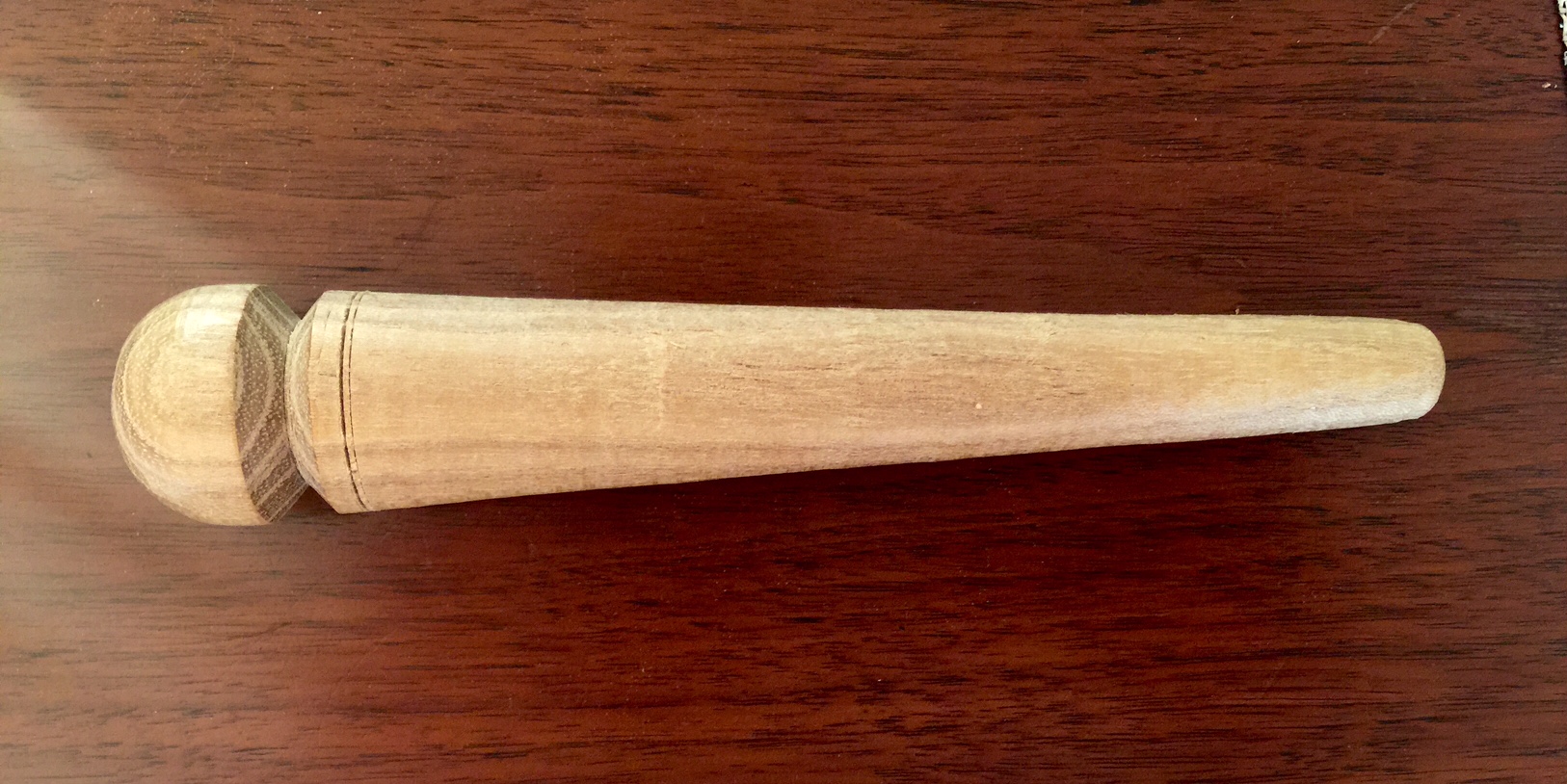
A custom-made, to your specifications, with wood you chose, while you watch it being made, locust spurtle! Of course – it seems obvious now, doesn’t it? Here is the custom-made locust spurtle: 

An actual handmade locust spurtle - made yesterday morning in Highland County by Nathan Jenkins, while I watched!

An actual handmade locust spurtle – made yesterday morning in Highland County by Nathan Jenkins, while I watched!

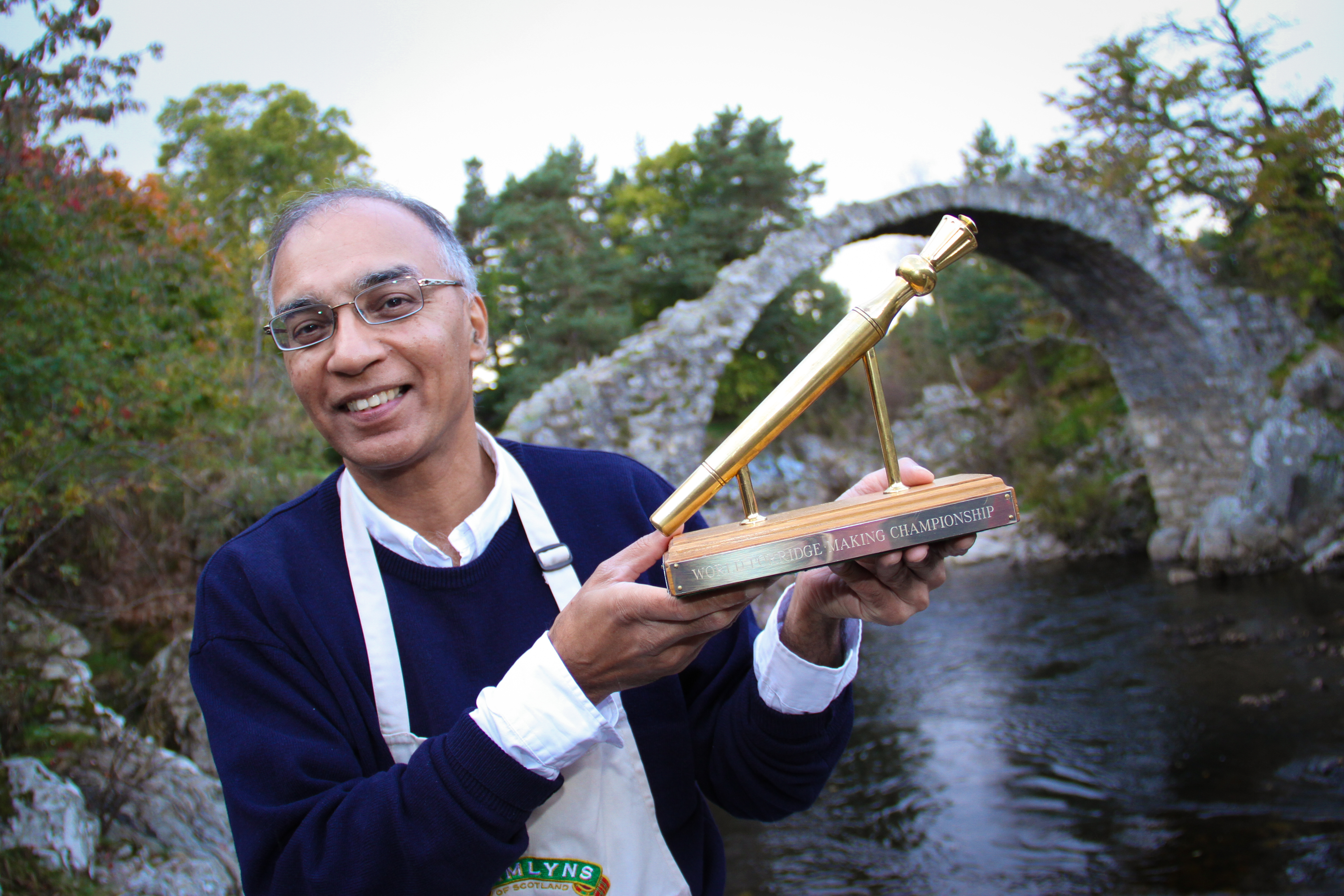
Here, by contrast, is a Golden Spurtle: 

Golden Spurtle held (and won) by Dr. Izhar Khan of Aberdeen, Scotland

Golden Spurtle held (and won) by Dr. Izhar Khan of Aberdeen, Scotland

In that picture it is being held by Dr. Izhar Khan of Aberdeen, Scotland. Here is a link to the website of the The Golden Spurtle, the World Porridge Making Championship – I am not even kidding – held on the tenth day of the tenth month every year for the past 22 years in the village of Carrbridge in the central Scottish Highland region. Who ever even knew? It’s all just so fascinating. 

If the word “spurtle” is not in your current vocabulary, allow me (by way of wikipedia) to enlighten you. Here is the start of the wikipedia definition: “The spurtle (or “spirtle”) is a Scots kitchen tool, dating from at least the fifteenth century.” On marthastewart.com, their definition has a more breathless tone: “A simple, unassuming kitchen tool, the spurtle is one hot ticket.”

The wikipedia entry elaborates: “It was originally a flat, wooden, spatula-like utensil, used for flipping oatcakes on a hot girdle the Scottish equivalent to a griddle.

Over time, the original implement changed shape and began being used specifically for stirring oatmeal and soups. The rod-like shape is designed for constant stirring which prevents the porridge from congealing and so becoming lumpy and unappealing.[1] It looks like a fat wooden dowel, often with a contoured end to give the user a better grip.

Traditionally, a spurtle is made from Scottish maple trees.[citation needed]

The Annual Golden Spurtle World PorridgeMaking Championship, held in Carrbridge each year, invites porridge-makers from across the globe to compete for the “Golden Spurtle“.”

Evelyn and I eat lots of oatmeal. Which for the purpose of this blog post (and in my life) I will use as a synonym for porridge. If you need or desire more precision, please google to  your heart’s content. But what I’ve read says that all oatmeal is porridge but all porridge is not oatmeal. I am aware that may have added confusion rather than reduced it – sorry!

As an aside – and as a sort-of-segue into my more normal blogging mode – watching my genuine locust spurtle being made gave me more interest in the black  locust trees (Robinia pseudoacacia) at the river this morning. More on that in a moment.

We met up again with Nathan Jenkins yesterday at the Highland Maple Festival – the same fellow we met last year. He’d made two beautiful wooden spoons. I’ve eaten my oatmeal with them nearly every day since. When I talked with him Saturday morning (yesterday) I told him I’d eaten oatmeal with one of his wooden spoons that very morning. We started talking about wooden implements. And about making oatmeal. Our conversation turned to spurtles. He’d never heard of them (neither had I) until recently. He was talking with a man from Scotland (of course). The man asked if he knew what a spurtle was. Nathan didn’t know, so the man showed him a picture. And Nathan made one on his spring-pole lathe. And – Saturday morning at the Maple Festival – Nathan said “want me to make one for you?” An offer I could of course not refuse. So he turns to a big pile of wood that looked a lot like my pile of firewood, except it was not all oak. And he pulls out two nice looking pieces of wood and holds them up and says “do you want cherry or locust?” I don’t see cherry too often but there is lots of locust at Pony Pasture. Plus we used to help our friend Doug make fenceposts out of locust at the cabin when we were young. I have more of a connection to locust, so that’s what he used. And that’s what I stirred our oatmeal with for Evie’s and my breakfast this morning.

This post is thus far distressingly picture-free. Allow me to correct that. 2015 marks the eighth consecutive year that some number of my nieces and I have attended the Highland Maple Festival in Highland County, Virginia. This year, two of my five nieces joined me: Phoebe and Wren. Phoebe took this selfie of the three of us on our way up:

Happy carload on the way to the Maple Festival!

Happy carload on the way to the Maple Festival!

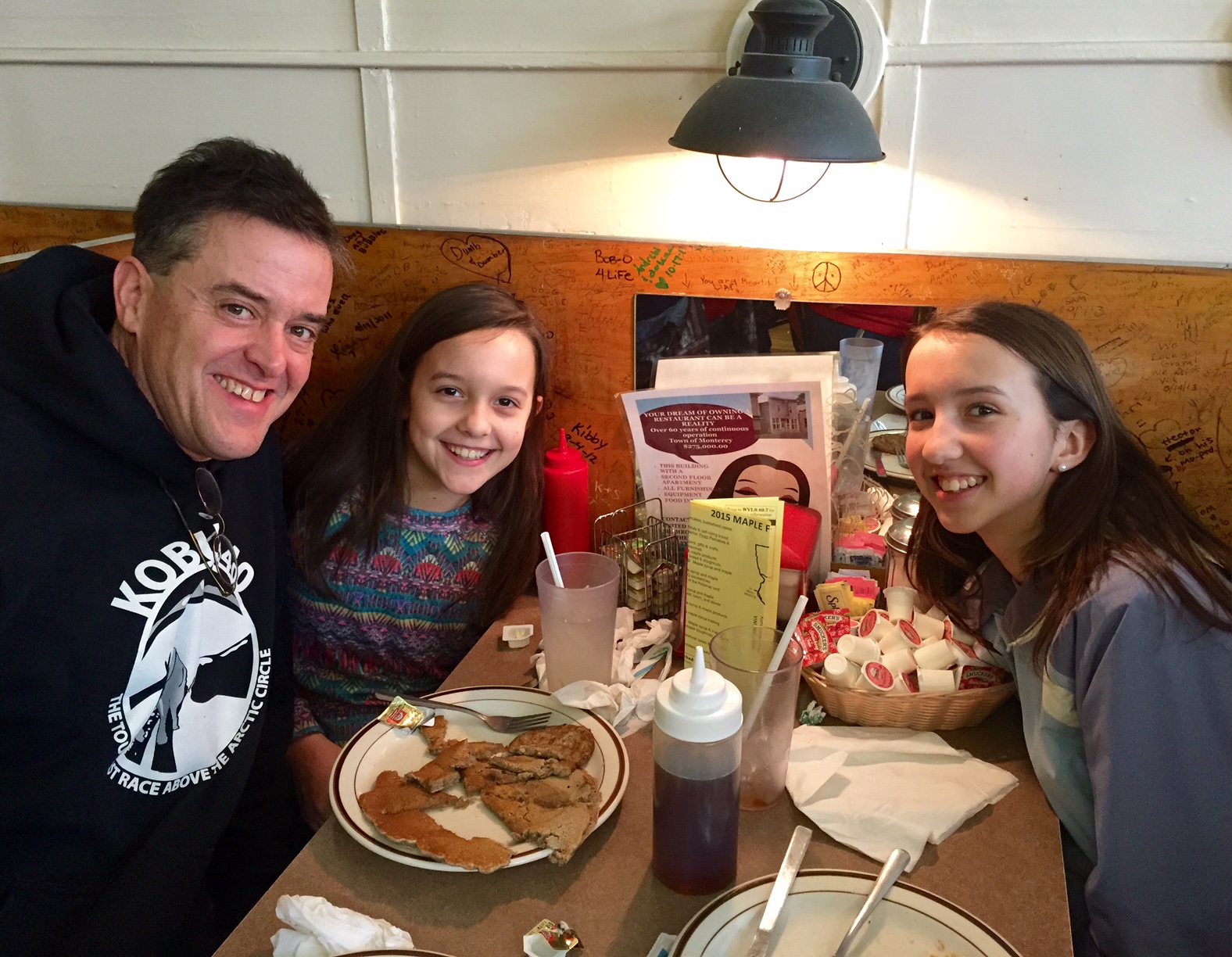
The Highland Inn in Monterey is where we normally have breakfast. They were undergoing renovations this year (we’ll be back in 2016!) so we went across the street to High’s. And had superb buckwheat pancakes and sausages and our charming waitress took our picture! Again!:

Happy crew AT the  Maple Festival!

Happy crew AT the Maple Festival!

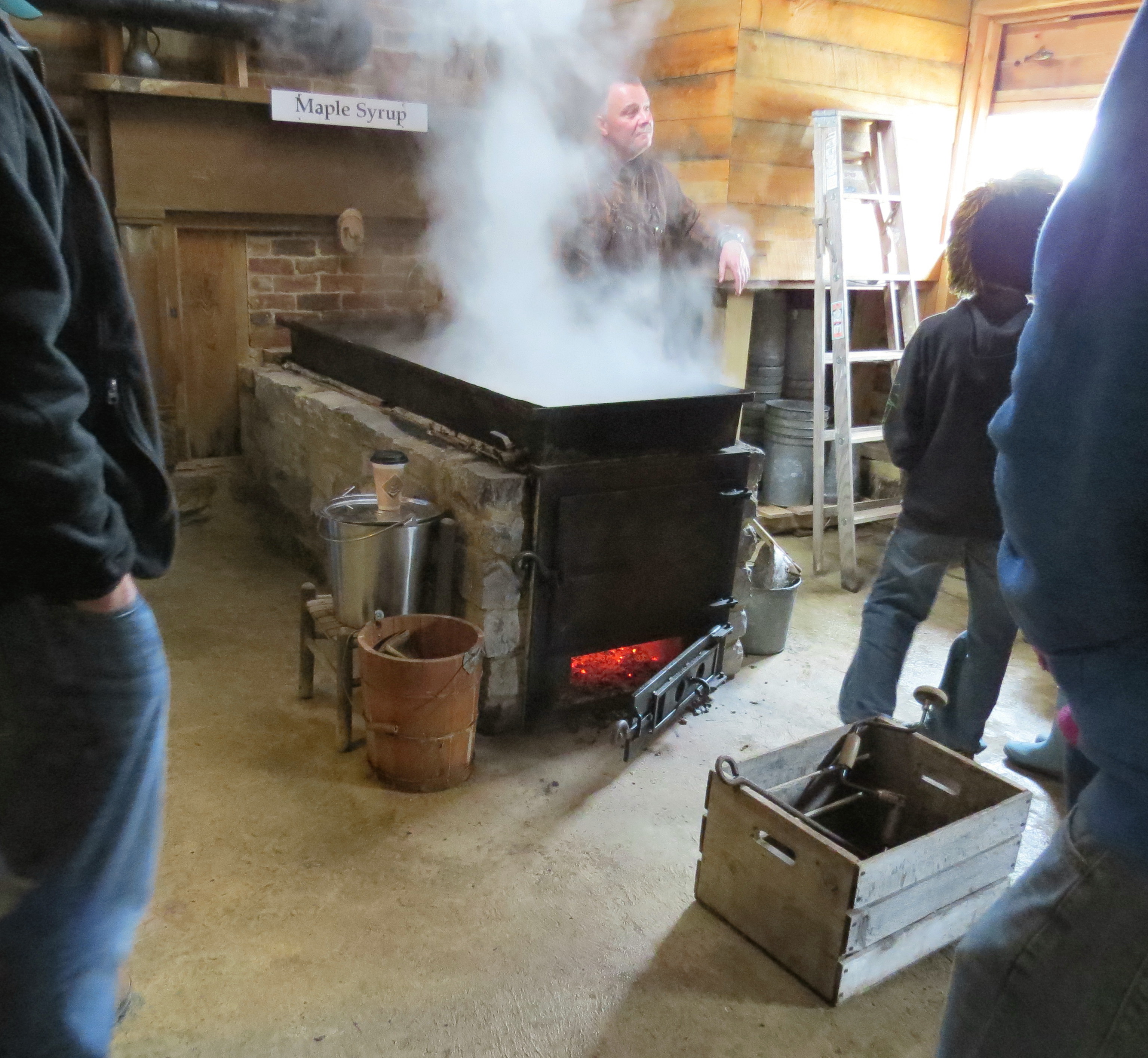
There’s just so much fun stuff at the Maple Festival – every moment of it is a treat. After we walked around Monterey for a while, we made our way back to Duff’s Sugar House a few miles southwest of town. They boil down sugar water (from the massive sugar maple trees (Acer saccharum)) to make maple syrup the old-fashioned way. This is inside the Sugar House where the boiling is in progress:

Inside Duff's sweet smelling Sugar House, where the maple magic happens

Inside Duff’s sweet-smelling Sugar House, where the maple magic happens

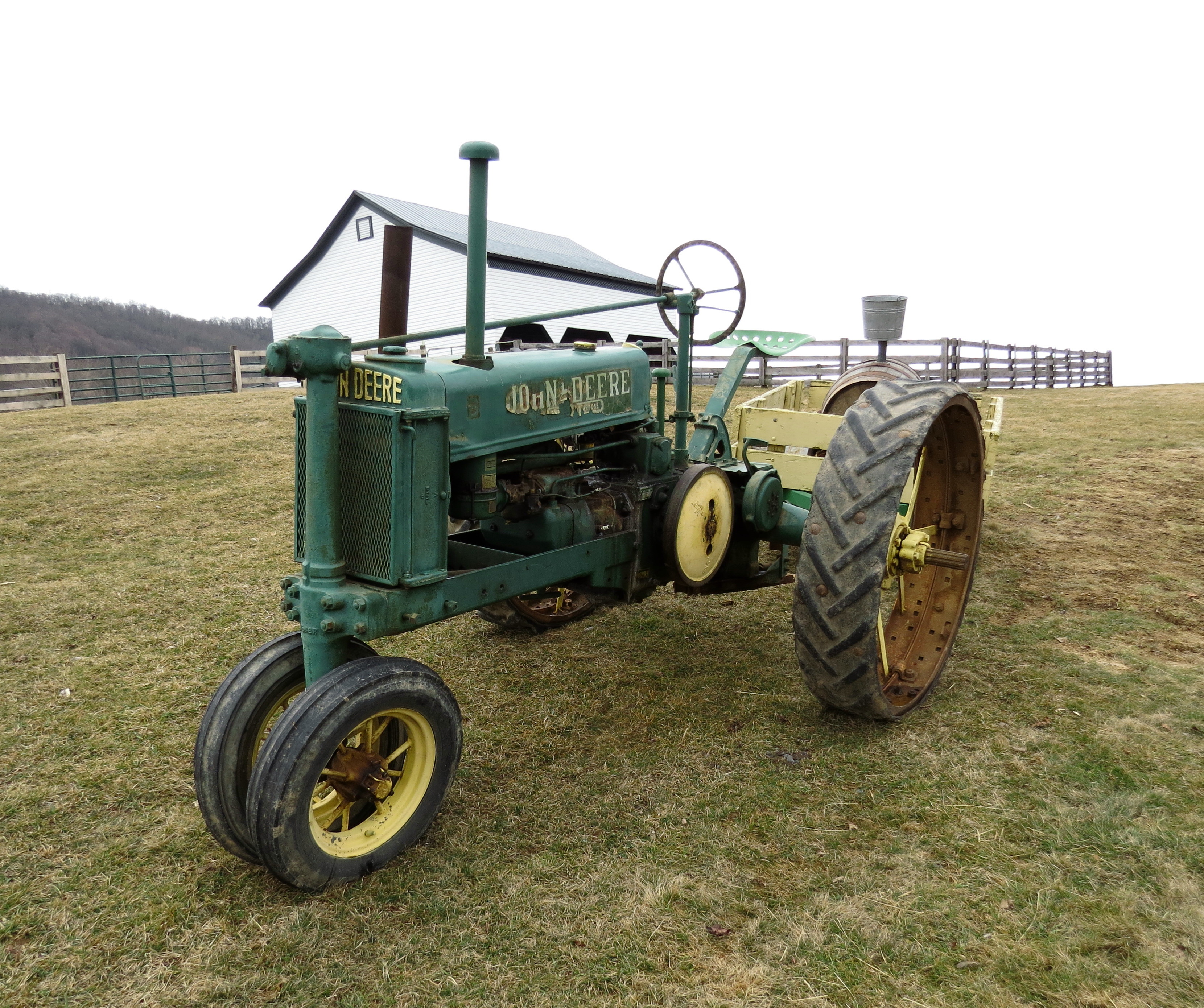
This is outside the sugar house – with an operating antique John Deere tractor: 

Air conditioned tractor cab from back in the old days

Air conditioned tractor cab from back in the old days

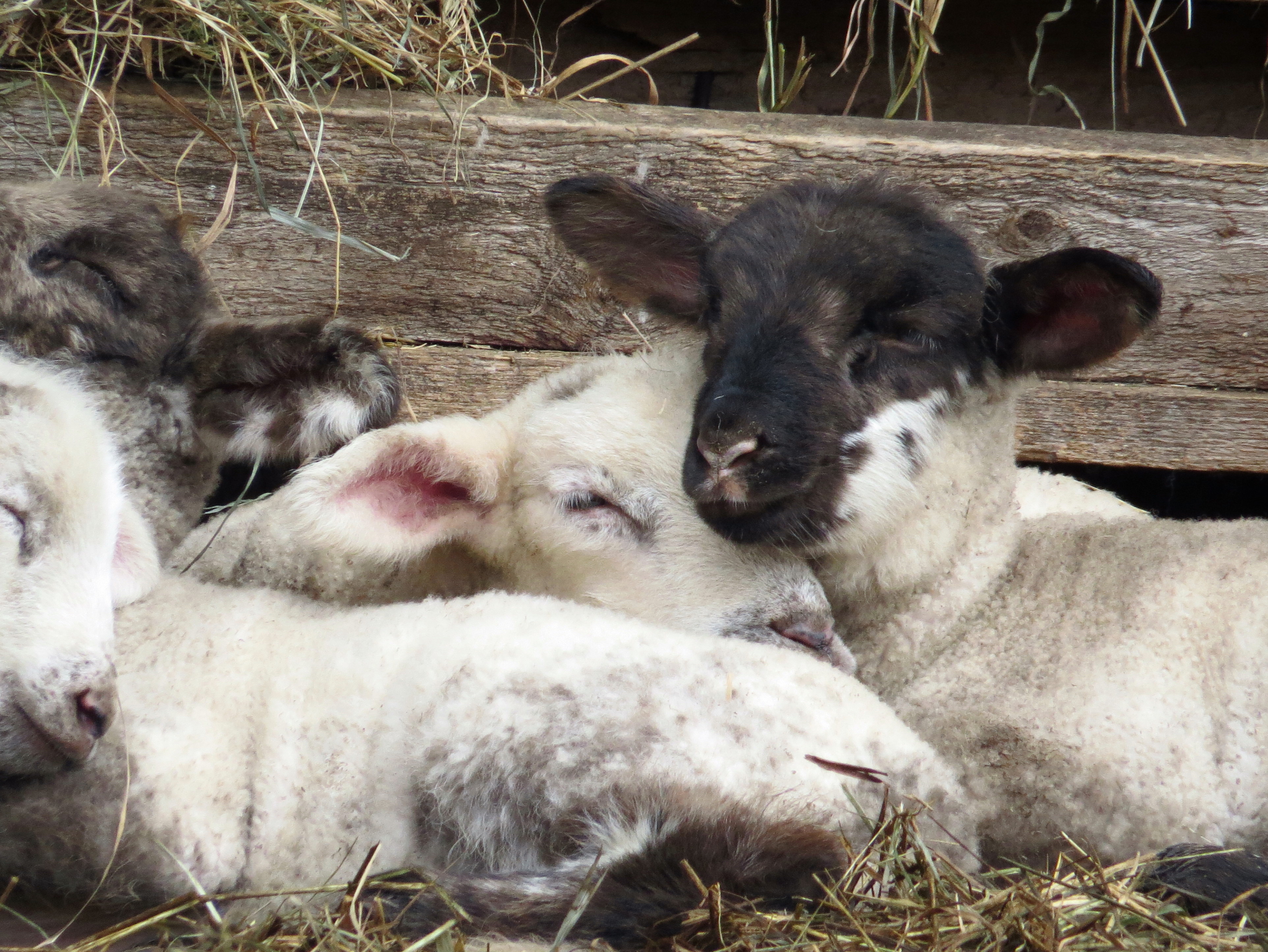
Behind the tractor you can see a barn. Inside it were sheep and many lambs. So cute! 

Some sleepy babies!

Some sleepy babies!

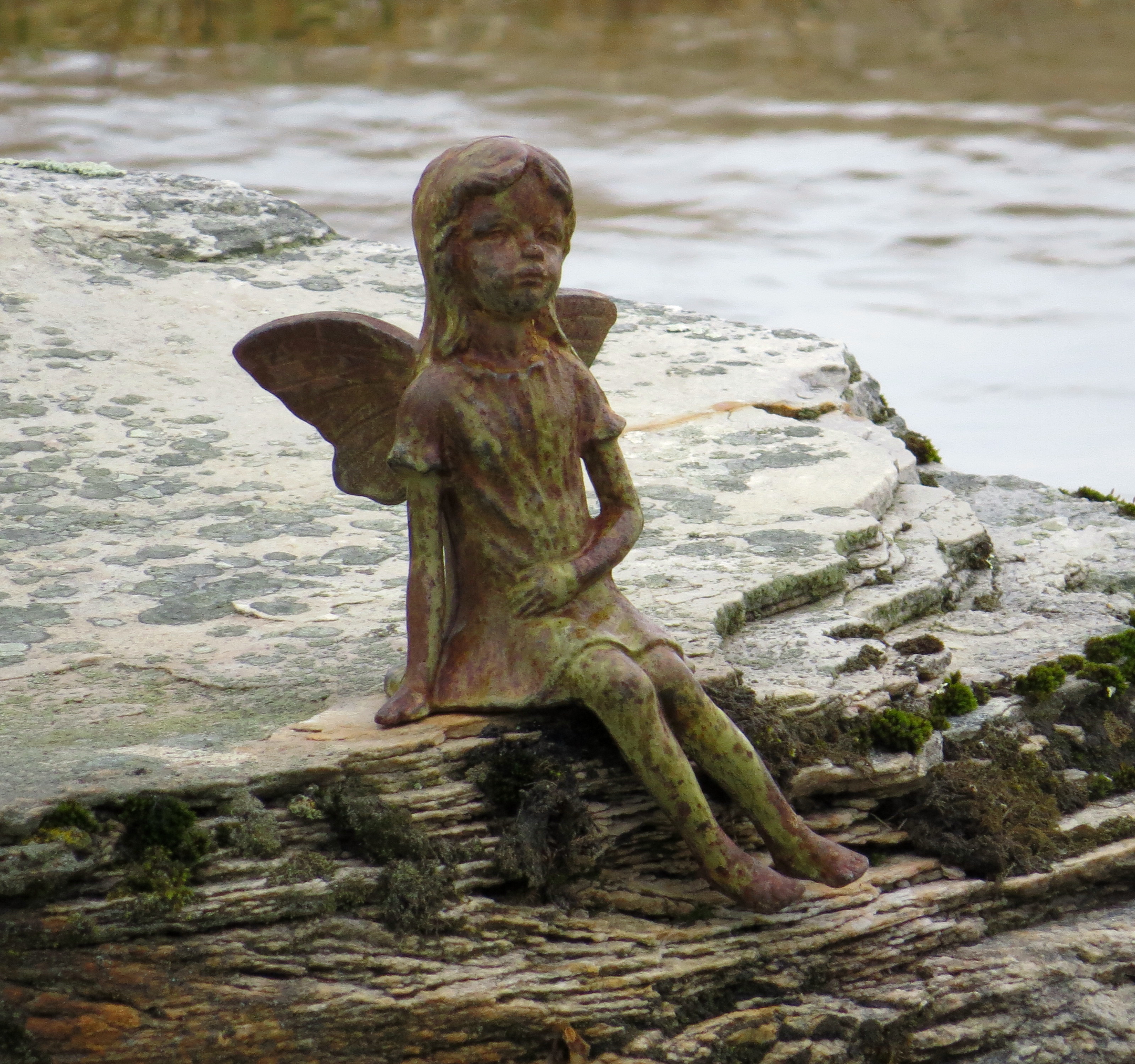
I saw this bronze at the edge of the pond there for the first time in 2011. I referred to it then as the Maple Syrup Fairy. Perhaps I should refer to her as the Syrup Siren; her song brings me back every year: 

The Syrup Fairy - or perhaps the Syrup Siren

The Syrup Fairy – or perhaps the Syrup Siren

It’s possible it’s her song that calls me. But my heart says it’s this that I love to see:

I love the maple syrup. But this is what I long to see:

I love the maple syrup. But this is what I long to see:

Oops! It’s been many paragraphs since I wrote “more on that in a moment” regarding locust wood. In this case, locust trees – at Pony Pasture. Here is a pair as I sign off. More next week! All best,

Jay

PS Locust trees this morning at Pony Pasture (no leaves yet; watch this space):
Twin locust trees - the deeply furrowed bark is easy to recognize.

Twin locust trees – the deeply furrowed bark is easy to recognize.

Posted in Fun, Smiles (including "dog smiles"!) | Tagged , , , , , , , , | 6 Comments